
Close Menu
    Facebook X (Twitter) Instagram
    Trending
    • #Giving Tuesday – Support Orthodox Christian Laity!
    • Together We Thrive: OCL Annual Conference & Year-End Giving Campaign
    • Archon Officers Participate in Historic Pilgrimage to Nicaea
    • Ecumenical Patriarch Bartholomew and Pope Leo recite the Creed together during 1700th Anniversary of Nicaea
    • Mission Center Board Convenes
    • The “Orthodoxy as Masculinity” Narrative
    • Walk with Us: Orthodox Volunteer Corps (OVC)
    • St. John Chrysostom’s Legacy: From Antioch to America
    Orthodox Christian Laity
    Facebook X (Twitter) YouTube
    • Home
    • OCL
      • About OCL
      • Leadership
      • OCL News
      • OCL Publications
      • Focused Study and Research Topics
      • OCL Archives at DePaul University
    • Orthodox News & Links
      • Orthodox News Stories
      • Headlines & News Archives
      • Governance & Unity
        • Governance Top Stories
        • Governance & Unity Essays
        • Grassroots Unity in Action
      • OCL Forums
      • Orthodox Christian Laity News
      • Web Links
    • Audio & Video
      • Audio Index
      • Video Index
    • Contact
    • Make a Donation
    Orthodox Christian Laity
    You are at:Home»Orthodox News»Churchgoers, cut the ‘Chreasters’ some slack

    Churchgoers, cut the ‘Chreasters’ some slack

    0
    By Webmaster on December 23, 2018 Orthodox News, Orthodox News Top Stories
    Share
    Facebook Twitter LinkedIn Pinterest Email Telegram WhatsApp Copy Link

    Source: The Washington Post
    By E.J. Dionne Jr.

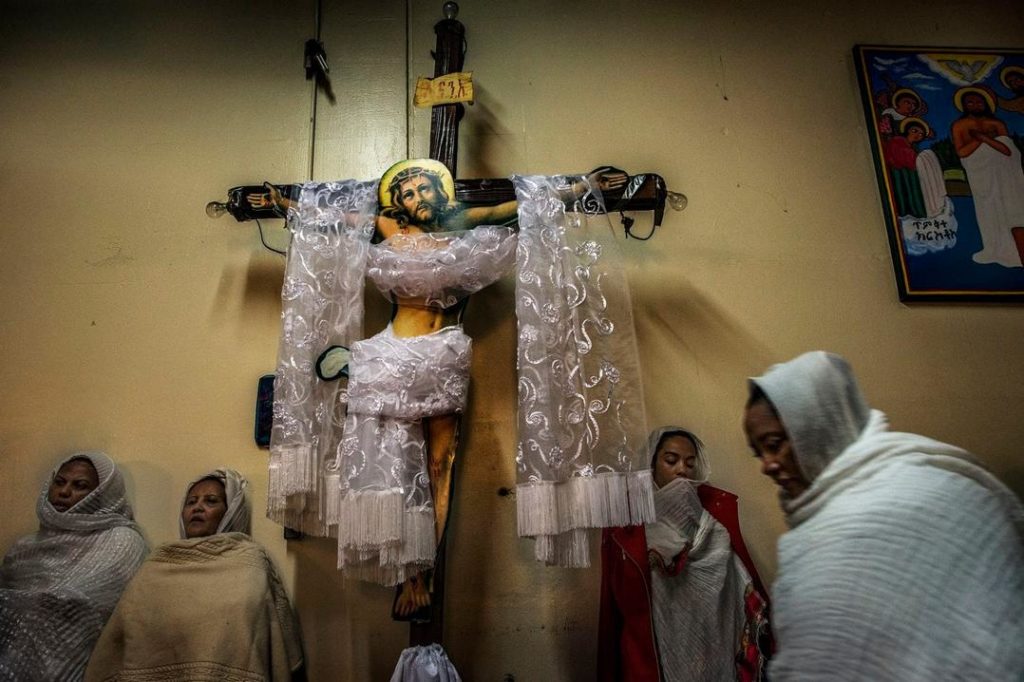
    Members of Debre Selam Kidist Mariam Church attend a Christmas Eve service in Washington. (Bonnie Jo Mount/Washington Post)

    Christmas remains wondrous, but it arrives at a difficult moment for Christianity in the United States.

    We still see Christmas trees strapped to the tops of cars, neighbors lighting up their homes, and children getting as excited as ever. And the churches will be unusually full. This last point is revealing: A relative decline of religious observance has brought forth the “Chreasters,” Christians who attend services only on Christmas and Easter.

    Regular worshipers can be disdainful of the Chreasters. They make it hard for the loyalists to find seats in the pews and are, in a sense, free riding on those who, week in and week out, keep the institutions going. The Chreasters’ participation on special days is often written off as little more than a gush of sentiment inspired by warm childhood memories or an affection for the Christmas story and the songs and ceremonies we have developed around it.

    But these twice-a-year visitors deserve our attention and, I would argue, our respect. While they do teach us a good deal about Christianity’s challenges in our time, their semiannual presence is also testimony to the enduring hunger for the experience of the sacred.

    Organized Christianity’s problems are obvious. Consider that the most widely discussed and fastest-growing religious group in the country is not, strictly speaking, a religious group at all. The “nones” are the people who tell pollsters that they are not formally affiliated with any religious tradition. They now account for more than a quarter of the population, and about 40 percent of Americans under 30.

    Religious disaffiliation has many causes, including a belief among progressive young people that Christianity is a fundamentally conservative force (particularly on LGBTQ issues) and a widespread mistrust of institutions of all kinds. For those of us who are Catholic, the suspicion of religious authorities is aggravated by the child abuse scandal that never seems to go away. Despite Pope Francis’s call on Friday for guilty clerics to turn themselves over to civil authorities, the church’s leadership has still not taken full responsibility for its failures.

    Dan Cox, a scholar who is writing a book on the nones, also points to changes in family life, the prevalence of divorce and the rising number of religiously blended families as disrupting organized religion’s traditional transmission lines.

    All this culminates in the increasingly popular view that it is perfectly possible to live a rich spiritual life without becoming entangled in the complicated and compromised structures of churches and denominations.

    What the theologian Gabriel Vahanian observed decades ago in his influential book “The Death of God” explains the larger context: “Christianity has long since ceased to be coextensive with our culture,” he wrote, and “our age is post-Christian both theologically and culturally.”

    The Chreasters, with their thin attachments to religious tradition, might be fairly viewed as a product of this transformation. But if they have simply chucked the whole thing, why do they keep coming back?

    The great sociologist of religion Peter Berger offers a clue in “A Rumor of Angels,” his 1969 book about the persistence of faith in the face of rapid secularization. The Chreasters reflect the stubborn refusal of human beings to give up on the transcendent. As the Christian writer Joseph Bottum put it last week in the (sadly) final issue of the Weekly Standard, Christmas sketches “a picture of a cosmos capable of love.” Even doubters and tepid believers would rather not abandon the possibility that this very large claim is true.

    The biblical scholar and former Anglican bishop N.T. Wright sees “the longing for justice, the quest for spirituality, the hunger for relationships and the delight in beauty” as human aspirations beyond the material that can be heard as “echoes of a voice” pointing toward God.

    Of course, nonbelievers revere justice, relationships and beauty, too. But my hunch is that Chreasters show up twice a year because some part of them is in rebellion against a society defined solely by self-interest and calculation, by the visible, the measurable and the tangible. They have an intimation that the world is made up, in the words of the Nicene Creed, of both the “seen and unseen.”

    I am, perhaps, risking a sin, common among those who write columns, by overanalyzing the Chreasters. Maybe most do show up mainly for the music and the memories. But the regulars would do well to cut them some slack. In a reading often used at Christmas services, John’s Gospel tells us that “the light shines in the darkness, and the darkness has not overcome it.” In seeking and celebrating that light, we should stand in solidarity.

    Read more from E.J. Dionne’s archive, follow him on Twitter or subscribe to his updates on Facebook.

    Share. Facebook Twitter Pinterest LinkedIn Tumblr Email WhatsApp Copy Link
    Previous ArticleStaying Catholic at Christmas
    Next Article NATIVITY GREETINGS FROM ORTHODOX CHRISTIAN LAITY

    Related Posts

    December 1, 20251 Min Read

    Together We Thrive: OCL Annual Conference & Year-End Giving Campaign

    November 22, 20253 Mins Read

    Mission Center Board Convenes

    November 20, 20253 Mins Read

    Walk with Us: Orthodox Volunteer Corps (OVC)

    Leave A Reply Cancel Reply

    This site uses Akismet to reduce spam. Learn how your comment data is processed.

    Sign the Declaration for Orthodox Unity – click here…

    Register for OCL's Annual Conference - October 11, 2025

    Sign the Declaration for Orthodox Christian Unity

    Enter the Slogan Contest

    Share this page
    DISCLAIMER

    All articles represent the views of the authors and  not necessarily the official views of Orthodox Christian Laity (OCL). They are posted to encourage thoughtful discussion on topics and concerns relevant to Orthodox Christians living in a pluralistic society. OCL encourages your comments.

    Stay Informed!

    Subscribe to our Newsletter

    WE WELCOME YOUR INPUT AND SUPPORT!

    Your donation impacts and helps advance the unity of the Orthodox Church of America.

    DONATE NOW

    THANK YOU FOR YOUR CONTINUED SUPPORT!

    Upcoming Events
    Notice
    There are no upcoming events.
    Recent Comments
    • George Warholak on Ecumenical Patriarch Bartholomew and Pope Leo recite the Creed together during 1700th Anniversary of Nicaea
    • Dn Nicholas on Ecumenical Patriarch Bartholomew and Pope Leo recite the Creed together during 1700th Anniversary of Nicaea
    • Dana C Purnell on Ethiopian Bible is the oldest and complete bible on earth
    • Peter on Abp. Elpidophoros installed as National Council of Churches board chair
    • james wiliams on Video: A Vision for Orthodox Christianity’s Future in North America
    • Veras Coltroupis on Abp. Elpidophoros installed as National Council of Churches board chair
    • Joe Forzani on Ancient Christianity (Free Course) – Hillsdale College Online
    • Joe Forzani on Ancient Christianity (Free Course) – Hillsdale College Online
    • sandy myers on Ethiopian Bible is the oldest and complete bible on earth
    • Peter on Unity in the Orthodox Church
    OCL Archives Online
    Project for Orthodox Renewal
    renewal-resize
    OCL Digital Newsletter

    Subscribe to our Newsletter

    MAKE A DONATION

    Sign the Declaration for Orthodox Christian Unity

    Facebook
    Twitter
    YouTube

    St. Symeon the New Theologian and St. Photini are the Patron Saints of OCL

    footer-fnl

    Orthodox Christian Laity
    PO Box 6954

    West Palm Beach, FL · 33405
    561-585-0245

    ocladmin@ocl.org (or) orthodoxchristianlaity@gmail.com

    Sponsored by Ann Souvall in memory of husband George

    DISCLAIMER: All articles represent the views of the authors and  not necessarily the official views of Orthodox Christian Laity (OCL). They are posted to encourage thoughtful discussion on topics and concerns relevant to Orthodox Christians living in a pluralistic society. OCL encourages your comments.

    ©2025 Orthodox Christian Laity (OCL) ·  Login

    Type above and press Enter to search. Press Esc to cancel.