
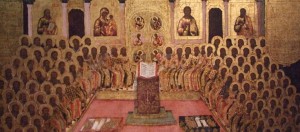
 Source: Orthodox Christian Laity
The year 2016 is a momentous, historic time for Orthodox Christianity throughout the world. After 1,200 years, Orthodox Christianity is on the verge of a seminal event, a meeting of the Holy and Great Council of the Orthodox Church, to be held in Crete, Greece, during the week of Pentecost this June.
This event will provide a pivotal opportunity for hierarchs to officially recognize a unified American Orthodox Church which selects its own hierarchs. It is an idea whose time has come. Moreover, it is properly based on the canonical precedents of the Church.
Indeed, it is a clarion call for action — a firm declaration — for the appropriate hierarchs to make sure that the subject of unity in the United States is on the official agenda of the forthcoming Holy Council. There is an urgency to reach a pragmatic consensus among the church leaders, for the world is changing rapidly, with dire consequences to traditional faith and Christian virtues.
The necessity for ecclesiastical teamwork was made explicitly clear when Ecumenical Patriarch Bartholomew addressed the American Assembly of Bishops in Dallas, Texas in 2014. His video message unmistakably sounded the call for unity among them:
“…move beyond words to actions. We know much better than what we actually do. We are called to put our theory and theology into policy and practice. We are called to move beyond what is “mine” and what is ‘yours” to what is “ours.” From now on, this is how we should conceive and conduct all of our ministries and resources, all of our departments and initiatives. Otherwise, we do not practice what we preach. It is really up to us to accept the challenge or to refuse the call.”
This important and insightful statement by the “First among Equals” Patriarch resonates historically, since the Holy and Great Council will be meeting soon in Crete.
A Historical Perspective
The forthcoming Holy and Great Council of the Orthodox Church is enormously significant and consequential. The historic importance of this event needs to be understood in chronological context. This will be the first Holy and Great Council in the Orthodox Church’s long history. All seven ancient Ecumenical Councils (325-787) were meetings of bishops of the SINGLE unified Christian Church which included Rome, hundreds of years before the Great Schism between East and West in 1054.
Over 300 Church representatives are expected to attend from the Patriarchates of Constantinople, Alexandria, Antioch, Jerusalem, Russia, Serbia, Romania, Bulgaria, Georgia, and the autonomous and autocephalous Churches of Cyprus, Greece, Poland, Albania the Czech lands, and Slovakia. It is not widely known that attempts to unify the Church have been an integral component of the 2000-year history of Orthodoxy.
After the tragic and decisive events of 1054, 1204 and 1453, the Orthodox world became increasingly under the captivity of Islamic rule. When Islamic rule ended, Communist control enslaved the Church in Russia and nations of Eastern Europe until the last few decades.
These far-reaching and profound political occurrences had horrific impact on the Patriarchates and national Churches in the Old World. After such traumatic upheavals, they found themselves weary but freer to resume their legitimate functions which were interrupted over a millennium of Islamic and Communist oppression. Some Orthodox centers continue to tragically struggle to survive.
During the same epic time, newly-formed Church communities became a central link for the wave of immigrants that emigrated to the New World. Finally by 1960, after years of deliberations, a framework to achieve a unified Orthodox Church in the United States was established. The Pan-Orthodox jurisdictions were called SCOBA (The Standing Conference of Canonical Orthodox Bishops in the Americas). SCOBA was replaced in 2010, at the direction of the Mother Churches, by the Assembly of Canonical Orthodox Bishops in the United States of America.
The importance of singularity of purpose became the mandate of the Assembly of Bishops, by the firm directive from a 2009 meeting in Chambesy, Switzerland. All Orthodox Patriarchs were represented. The meeting was called and presided by Ecumenical Patriarch Bartholomew after 20 years of contemplative activity by these mother churches. At Chambesy, the Patriarchs signed protocols establishing Assemblies of Bishops throughout the world in order to restore canonical order. The largest group was in the United States with 54 bishops.
In response to the Chambesy protocol, the United States bishops have been meeting for six years as a group and in committees. They recognize that the existing parochial arrangements are impractical, counterproductive and uncanonical, resulting in loss of members, fragmentation and overlapping of functions.
The convener of the Assembly is Archbishop Demetrios of the Greek Orthodox Archdiocese of America. He has been a driving force in asserting his leadership in favor of Orthodox unity, reflecting the vision of the Chambesy Protocols. He continues to face the challenge of hastening the Assembly’s deliberate but uneven progress. A few jurisdictions, for a variety of reasons, believe it is better to delay the unification of Orthodoxy in America for 10 or more years. However, their reluctance in overcoming obstacles does not reflect the urgent commitment toward unity and collegiality as expressed in the official statements of the Chambesy Protocols. .
Ethnic and Cultural Factors
The ethnic and cultural diversity of the American Orthodox Church reflects global Orthodoxy in microcosm. Its essence is a doctrinal Church of diversity with local ethnic and cultural variations. The cardinal principle of decentralization has allowed the Church to ADAPT to the culture of its local people on a selective basis, including the liturgical language and traditions.
In the past 60 years, there has been extensive ethnic research which offers valuable insight on the complexity of assimilation within a culturally pluralistic society. For the preservation of ethnic/cultural practices to survive, there needs to be ongoing modifications among identifiable community institutions, especially the church affiliation. Studies also concur that there is a lessening of ethnic bonds with each successive generation, especially past the sixth generation. Unlike the misinformation of some, no organization is asking for an eventual abandonment of one’s heritage and ethnic identity. Just the opposite is true!
Other reports show that when American-born offspring of immigrants completely abandon their original church affiliation, their ethnic identity is quickly diminished. Compelling statistical data of Orthodoxy in America reveal a serious decline of active and marginal supporters in recent decades. With the present church structure, Orthodox authenticity is weakened and confusing, especially for converts.
One of the causes of confusion is due to the varying waves of early, and then later immigration to the New World which resulted in multiple “ethnic” jurisdictions, with different assimilation rates. Today, there are 14 jurisdictions, with the majority of bishops located in a few big cities. A few jurisdictions have one bishop for all 50 states. Some bishops live and work a few blocks apart with limited interaction.
The transition toward an administratively-united Church would strengthen Christian outreach. Imagine the effectiveness of a unified Orthodox Church actively embracing internal and worldwide evangelism; in unified rather than competing parishes in small towns; and in raising a single bold voice at the highest levels of government and media to decry the persecution of Orthodox brethren!
Adaptation, modification and infusion of cultural distinctiveness are essential characteristics for Orthodox viability in America. One way to describe the similarity of common ideals that bind people together is America’s motto of national unity—E PLURIBUS UNUM—from many one.
A Proclamation for Leadership
Amidst a rapidly changing inter-connected world, the year 2016 is an enormous crossroad for Orthodoxy everywhere. It necessitates a call to action—a proclamation for leadership—among the Orthodox prelates in order to resolve the canonical issue of unity. As stated earlier, the subject needs to be on the Holy Council’s agenda in Crete. Furthermore, the Assembly of Bishops from the United States are in a unique position to take concrete steps to transform the call for unity into reality. The laity must be enlisted to assist in the implementation of a workable blueprint. It can become the “best of times” for Orthodoxy.
Without a unified Orthodox Church in the United States, the consequences are regressive for Church survival and sustainable growth. A healthy, viable Church guarantees a multicultural adaptation and appreciation for continued customs and traditions; not the other way around.
It is a decisive mission and monumental moment whose time has come. Pray that the bishops attending the Holy and Great Council capture the Spirit of hope and courage and take bold action now. Above all, it can become a LANDMARK LEGACY for the future of Orthodoxy in America. Amen!
CLICK HERE to view the booklet version in PDF format.
1 Comment
It would be great if the writer of the article, with which I have nothing but sympathy, would realize that this is not just an issue for “the United States” but is much larger than that. To start with, Canada is in the same situation as the U.S. in this matter. There are over-lapping jurisdictions in many other areas of the world as well. They, too, need to be addressed.