
 Source: Public Orthodoxy
Originally published on May 7, 2018
by Mark Arey
For many years now, the word “hierarch” has become a catch-all when referring to bishops with differing titles (e.g. Archbishop, Metropolitan, Auxiliary Bishop). Many of us have had that moment of discomfort when we address a “hierarch” and get their salutation or title wrong! The reactions can range from neutral indifference to a hurtful scolding. “Hierarch” has become a safe alternative, especially when in doubt. But it would be a mistake to leave “hierarch” as a mere synonym for any member of the Episcopacy.
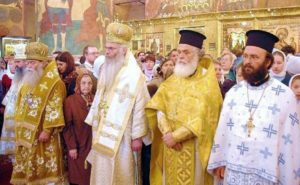
All bishops, regardless of their titles, jurisdictions, antiquity, are hierarchs, or at least are called to function as hierarchs. As bishops, they ἐπισκοπεύειν, they “oversee” (literally) their flocks, hopefully in imitation of our Great Chief Shepherd, the Lord Jesus Christ. In all the Divine Services the bishops preside, and in the Divine Liturgy—the central and chief liturgy of the Church—they preside in the full complement of the signs of their episcopal dignity. The omophorion—the episcopal stole that represents the lost sheep carried home (Luke 15: 4-6). The crown—a late accretion but a referent of the Kingship of Christ. The sakkos—a vestment of the Byzantine Emperor shared first with the Ecumenical Patriarch and then with all bishops to honor their position. The staff—a wonderful mash-up of the Ascelpian staff and the brass snake that Moses raised in the desert (Numbers 21:9)—both symbols of healing. The dikērotríkēra—the set of candles in two (δίκηρον) and three (τρίκηρον) with which bishops bless the faithful. And there are others as well, some shared with presbyters and deacons. These vestments are not worn or used outside the celebration of the Sacred Services. Although these signs belong to the bishop, their symbolic value goes much deeper.
Imagine showing up at the office of the bishop, only to find him seated at his desk wearing his crown! (It is worth noting that there is one Orthodox Altar in the world where no bishop wears a crown, even a patriarch: Golgotha.) So the signs of his episcopacy are symbolic of his role, reminders of his responsibility to reflect the Great High Priest Christ in all that he says and does. But they are also specific to his liturgical function as a hierarch, whose root meaning is the same as hierarchy, ἱεραρχία: ἱερά (sacred) and ἀρχή (principle or source). So a hierarch is a sacred principle or source. Hierarchy defined by the Pseudo-Denis is as follows:
“Hierarchy is, in my opinion, a holy order and knowledge and activity which, so far as is attainable, participates in the Divine Likeness, and is lifted up to the illuminations given from God, and correspondingly towards the imitation of God.” (The Celestial Hierarchies, chapter 3)
As a “holy order,” hierarchy is a rank, a τάγμα in the glorious array of the Church, just as there are ranks among the Holy Angels. Rank is also position, literal position both in the throne (or Bema) or before the Holy Table. As such, the hierarch is a mode of participation for all the Faithful, whom the bishop incorporates in himself through prayer composed of “knowledge and activity.” Even the movements of the hierarch in the Divine Liturgy are specific and designed to lead the Faithful through the liminal portal of the physical space into the celestial reality of the Divine Presence (cf. James Miller’s Measures of Wisdom: The Cosmic Dance in Classical and Christian Antiquity). The hierarch, a living symbol of the High Priest Christ, “binds together” (the root meaning of συμβολίζειν) the People of God to the Divine, that they may participate fully in, as Pseudo-Denis continues, “… the greatest possible assimilation and union with God … to become like Him….”
The hierarch’s incorporation of the faithful into himself and leading the Flock of Christ as a shepherd is in holy imitation of the Good Shepherd Himself, Who sacrificed His life for all our sakes. Before His Holy Passion, He fully incorporated all of us—past, present, and future—when, as Chrysostom alludes, He ate his own Body and drank His own Blood at the Mystical Supper (Homily 82 on St. Matthew). So also the bishop, by his “knowledge and activity”, brings with himself all the faithful, leading us to be “partakers of the divine nature” (II Peter 1:4) in the Holy Communion of the Sacred Body and Blood.
This is the nature of hierarchy for a bishop; this is what makes him a hierarch. It is not governance, rule, or authority, the usual and daily exercises of our ecclesiastical leaders. It is the recognition of his place in the divine order and his willful, intelligent, faith-filled exercise of his symbolical role and function.
As an example, when bishops bless the faithful in the Divine Liturgy during the Trisagion Hymn with the dikērotríkēra, is it only to convey a beautiful pageant? Or is it to ceremonially appropriate the light of Christ from the Holy Gospel (on which the dikērotríkēra are individually placed and moved) and then convey this light to the People of God, that our light may ‘so shine before all people, that they may see our good works and give glory to our Father Who is in Heaven’ (cf. Matthew 5:16)? Are the faithful conscious of this? In that moment, is the bishop? (Matthew 5:16 is the prayer uttered when the hierarch first takes up the dikērotríkēra at his episcopal ordination and thereafter at every vesting.)
Episcopacy and hierarchy are two sides of the same coin, obverse and reverse. Both must be exercised if the ministry is to be faithful to the ‘Shepherd and Bishop of our souls’ (I Peter 2:25) and of service to the Faithful. The coin has two sides, but only one image and superscription (cf. Luke 20:24). Therefore, we pray for our hierarchs, that they may “render unto God the things that are God’s”: chiefly the salvation of their flocks, by “a holy order and knowledge and activity.”
Mark Arey was a priest of the GOA for over 30 years. His most recent book is “The Gospel of Love: A Meta-Translation” (more at www.markarey.com).