
Source: Pravoslavie.ru
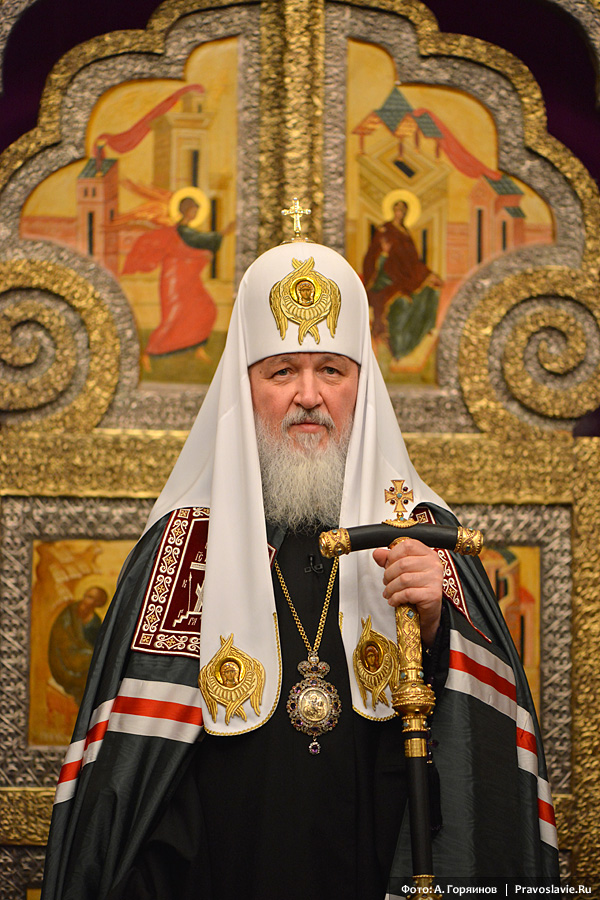
His Holiness Kirill, Patriarch of Moscow and All Russia
On March 23, 2013, the eve of the first Sunday of Great Lent—the Sunday of the Triumph of Orthodoxy, His Holiness Patriarch Kirill of Moscow and All Russia lead the Vigil service at Sretensky Stavropegic Monastery in Moscow. At the end of the service, abbot of the monastery Archimandrite Tikhon thanked His Holiness for finding the opportunity to celebrate this important service with them, and also for his Patriarchal support and blessing upon the monastery’s plans to build a new church dedicated to the New Martyrs of Russia, which will called the Church “On the Blood, on the Lubyanka”. The first hierarch of the Russian Orthodox Church thanked Fr. Tikhon for his kind words, the Stretensky choir for its fine singing, and the worshippers for assembling in such numbers on this occasion. His Holiness also gave a homily.
* * *
Dear Fr, Tikhon! Dear fathers, brothers, and sisters!
I am happy to have the opportunity to conclude the first week of Great Lent with the solemn All-Night Vigil in Sretensky Monastery. This was a very special week, particularly for those who were able to attend church. But even for those who were not able, the very remembrance, the very thought that we have entered the arena of the Holy Forty Days Fast has undoubtedly left a beneficial mark upon our thoughts and deeds. It is during the first week of Great Lent that many people make important decisions to change in their lives.
I would like to say a few words about just such changes. Sin, which manifests itself in many vices, always brings evil to people. This can be easily proven. We all know that the nature of sin manifests itself especially and with particularly fullness in such vices as pride, falsehood, and rancor. We also know that pride gives birth to other vices, such as wrath and envy. And now let us ask ourselves: Can wrath and envy bring a person peace, rest, joy, and quiet? No, it can’t. Nevertheless, this is a manifestation of pride that many do not even consider a sin.
Well, and what about falsehood? The products of falsehood are hypocrisy, flattery, and duplicity. Can a person be happy if he lives a double life, broken in half, deprived of inner integrity, thinking one thing yet saying another? Such a person can be neither happy nor strong.
And what about rancor? Rancor is a very particular manifestation of sin. The Lord created man in His own image, but there is no evil rancor in God. This means that the rancor in us is not from God—it is from the dark powers. If a person is totally overcome by evil rancor, if it forms his thoughts, feelings, and deeds, then he becomes deeply unhappy.
Let us strain our memory to the maximum and try to recall: Have we seen at least one rancorous person who was happy? He may be outwardly successful, he may be rich and highly-placed, but can he really be happy and living a peaceful, serene, joyful life surrounded by his loved ones? A rancorous person has no loved ones, because love and evil rancor are not compatible.
So, what do we have? Sin brings unhappiness to people, and it could not be any other way.
Vices sometimes have an appearance of a sort of pleasure, or, as the holy fathers say, they bring people ephemeral pleasure. But in the final analysis, this all turns into disasters, sorrows, and pain for people. Thus, embarking on the path of virtues means embarking upon the path that leads us to a happy life; and walking the path of sin means walking right into trials, sorrows, and misfortune. Therefore, those who over the course of these past seven days have made the decision to change their lives from sinful to virtuous have made the right decision. But those who have not made that decision, especially with regard to certain more painful vices, should make that decision over the course of Great Lent.
Well, and what about a virtuous life? How do we achieve that life? It is not so easy—to do it we need to meet several conditions. Today I would like to ponder with you on one of the conditions necessary for the formation of a virtuous way of life.
As the scientists say, man is a social creature. A person is formed through his social interaction with others. A social milieu is a person’s life milieu, and therefore his association with others has a great influence on him. Through social interaction we not only receive information—for example, learning in a school or institute, or simply reading books and acquiring knowledge. Through social interaction we also receive a certain energy—this energy could be called the psychological influence of one person on another. Everyone knows that our association with other people is not a matter of spiritual indifference, because in possessing one or another kind of energy—good or evil—we disseminate it, subjecting those around us to the influence of this energy. Furthermore, through association with others we get our examples in life; and we know how important an example is, in part, for raising children. Without a good example it is impossible to bring a child up to be what we would like him to be.
And what happens when we are surrounded by evil people? St. John Chrysostom makes a remarkable comparison concerning the influence an evil person has on those around him. He says that the harm an evil person causes is no less than the harm caused by the bite of a poisonous snake. This is truly the case. We know very well that we had better not be around people with infectious illnesses, and if we must be around them, we should take great precautions, as do doctors. They put on face masks and gloves, and if the infection is very dangerous, they even wear special suits to prevent the infection from touching any part of their bodies. But what if a person is spiritually infected, if he spreads this infection, yet we do not see it? After all, this infection is invisible and it is not possible to recognize it right away; we recognized it only by its consequences.
St. John Chrysostom also compares the influence evil people have upon spiritually healthy people with the infection of leprosy, and he confirms that the infection of leprosy and the infection of evil people are similar—only, one harms the body while the other harms the soul.
So what should we do? How can we discern the spirits? How can we discern people? One of the conditions for the formation of a virtuous way of life is our choice of close ones, acquaintances, and friends—that especially close circle of people who surround us and who will undoubtedly influence us because of their close contact with us. This is especially important to remember for young people who are open to social contact, who do not yet have any life experience, and often are not immediately able to assess a person, to discern between the truth and a lie, to see hypocrisy, or to understand that a person is spreading a dangerous spiritual contagion. Therefore our choice of surroundings and friends, and especially our choice of a spouse, is enormously significant and goes a long way in determining our ability to walk the path of virtue.
However, in our times, each person’s social circle may be unlimited. We live in a so-called “open information society”. An enormous flood of information flows over us; and so much of it is evil, destructive, and poisonous. How much spiritual infection there is! What can we do? It is the same as with our choice of friends: we should carefully choose what to read and what not to read, what to watch and what not to watch.
I remember a discussion I once had with some directors of our television channels. When I expressed the concern of many people that there are programs on some channels, which bring direct spiritual injury to the personality and something must be done about it, I heard the following reply: “If you don’t want it, don’t watch it. Every viewer, every person can choose by pressing a button.” Well, I want to repeat what the director of one of our TV channels said: Don’t watch it. With the touch of a button, protect yourselves from spiritual infection. I am almost sure that my words will provoke a flood a criticism and someone will say, “What do you mean? People should be open to information; we can’t just close ourselves off.” The answer is simple: Do not watch it if you see danger in it; do not read it if you feel that sin is being introduced to your soul. And if even secular people who are responsible for the mass media say this, then God Himself commands that we make use of this approach in choosing information.
One time I read a portion of an article written by one of those authors who spread spiritual infection. He was complaining, saying that he and others like him have been writing and writing, speaking and speaking, but people go to church regardless of what they say! He came to the conclusion that probably people just weren’t reading what they wrote. Well, I would like to answer that person: I call on people not to read you or any writers or journalists like you, so that people might retain their own autonomy, their inner freedom. This is not weakness, but a wise approach to determining with whom we should and should not associate. I think that the example of a healthy person in an infectious disease ward can help us understand the logic of such reasoning even if a person does not particularly wish that believing Christians would refuse to make use of an informational product that carries the bacilli of incurable spiritual diseases.
Our way of life depends in many respects upon our social interaction—our choice of friends, acquaintances, spouse, and upon what we read and watch. Our times require an especially thoughtful, shrewd, and wise view of the world around us. Without this it is hard to form a virtuous way of life—that very way of life, which leads people not to ephemeral happiness, not to the trinkets that are foisted upon us as if they were authentic valuables, but to the real, authentic values of existence, to those values that God desires to share with us, having created us in His own image, and having called us to be like unto Him. Amen.
For an audio recording of this homily in Russian, see Pravoslavie.ru.
His Holiness Patriarch Kirill
Translation by OrthoChristian.com
[subscribe2]