
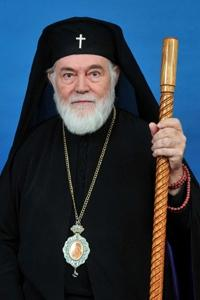
Grace, Mercy and Peace from God, and from us our fatherly love and hierarchal blessing.
CHRIST IS RISEN!
“We believe that having died with Christ we shall return to life with him; Christ, as we know, having been raised from the dead, will never die again. Death has no power over him anymore. When he died, he died, once for all, to sin, so His life now is life in God; and in that way, you too must consider yourselves to be dead to sin but alive for God in Christ Jesus” (Rom. 6: 8-11).
Dearly Beloved:
You heard these select verses from Saint Paul’s Letter to the Romans yesterday on Great and Holy Saturday morning during the Vesperal Liturgy of Saint Basil the Great. The Epistle follows the reading of many Prophecies about the Messiah and his saving of humanity from oblivion through God’s plan. These many Prophecies are read on this day as a teaching resume for those who are called “catechumens”, those who were baptized, traditionally on the eve of Pascha.
Having completed the long period of study, having been found worthy of Holy Baptism, the catechumens are confessed and then baptized, and receiving for the first time, the Precious Body and Blood of our Lord and God and Savior Jesus Christ. St. Cyril of Jerusalem (+345) reminds us: “You made the profession of faith that brings salvation, you were plunged into the water, and three times you rose again. This symbolized the three days Christ spent in the tomb…”. Having been plunged into the saving water, they are no longer catechumens but faithful who are now alive for God in Christ Jesus.
Saint Paul says: “We believe”, “We know,” meaning of course, those baptized in Christ believe and know. These are statements of our faith that Jesus did die but returned to life, and that once dead he cannot die again. Paul reminds us that we, too, have already died with Christ when we were baptized by immersion into the baptismal font. We see being covered with the waters as a form of burial. Coming out of the waters is like coming out of the tomb; from death to life, a new life. We came from our mother’s womb into a worldly life; we come from the womb of the water of baptism into a new spiritual life; we have been born anew!
Christ died in his human body, not because he sinned, but because it is through the body that sin takes place. Thus, the body must die so that the possibility of sin is no more in it. Once we die in the body, we can no longer sin. Once dead, we are incapable of acting in this human body, because the body is inert, lifeless, without power. Sin, therefore, is dead in us, because we can no longer act after our body dies.
We are reminded to live as though we have already died to sin; in other words, that although we are alive in the body, we can live as though we had already died in the body and therefore can choose to not sin. Paul says “…consider yourselves to be dead to sin but alive for God in Christ Jesus” (Rom. 6:11). St. Basil the Great says: “When we wish to reverse the direction of our lives, there must be a pause, or a death, to mark the end of one life and the beginning of another.” Thus, we are already living a “resurrected” life. Our life is not our own, for “all baptized in Christ…have all clothed yourselves in Christ!”
Sin disfigures us. It distorts in us the original image of God in which we are created. We cannot wait until the body dies in order to live a life pleasing to God and a life which truly fulfills us in the image in which we were created. Paul reminds us precisely of this: our present baptized life is a new life in a new kingdom in which we live our days in all that is pleasing to God. Let us remember what our Lord said: “For you must know, the kingdom of God is among you” (Luke 17:20).
In the Creed, we confess that: “Christ…arose on the third day and …He will come again to judge the living and the dead and his kingdom will have no end.” This life in the resurrected Christ is not just by our personal desire but by the power, the grace of God living in us and strengthening our will to live in harmony with God, with man and with nature. This celebration today is a celebration not only of the new life of Christ but of our own “life for God in Christ.”
Saint Athanasius the Great (+373) rejoices saying: “God who first established this feast for us allows us to celebrate it each year. He who gave up His Son for our salvation, from the same motive gives us this feast…allowing us to pray together and to offer common thanksgiving…He gathers to this feast those who are far apart.”
On the celebration of Matins on the evening of The Entrance into Jerusalem (Palm Sunday), in the Canon hymn (Ode 1), we hear these words put into the mouth of Christ: “I myself have come to minister to Adam the dispossessed whose form I, who shaped it, have willingly assumed.
In the fullness of my divinity, and with no loss of it, I have laid down my life as ransom for his.” The one ransomed is indebted to the one who saved him. All humanity is indebted to Christ for his death on the Cross by which we have this new life in the kingdom that is already among us.
Each and every Sunday is a little resurrection day. Each and every Sunday we sing in Matins: “Seeing the resurrection of Christ, let us worship the holy Lord, Jesus, the only one who is without sin. We venerate your Cross, O Christ, and praise and glorify your holy resurrection, for you are our God and we have no other than you, we call your name. Come, all you faithful, let us venerate the holy resurrection of Christ, for behold joy for the whole world has come through the cross. Forever blessing the Lord, we praise his resurrection because enduring the cross for us he destroyed death by death.”
This hymn reminds us that Christ is truly God who assumed our fallen nature in order to restore Adam and all his seed to the original state of harmony with God, with man and with the rest of creation. He says, “I shaped Adam and now I am going to restore him. I will lay down my life so he can have a new and eternal life.”
St. Leo the Great (+461) exhorts us thus: “Recognize the dignity of your nature…an image restored in Christ…we are born in the present only to be reborn in the future. Our attachment therefore should not be to the transitory; instead, we must be intent upon the eternal.”
Dearly Beloved, let us live this new life in Christ, for there is no other. There can be no choice, for we belong to him who saved us, who redeemed us from sin in this life; and “we believe that having died with Christ, we shall return to life with him.”
Christ is risen! Truly he is risen!
Accept our fatherly love and archpastoral blessings on those near and those far away.
+NATHANIEL, Archbishop