
Source: Orthodox Observer
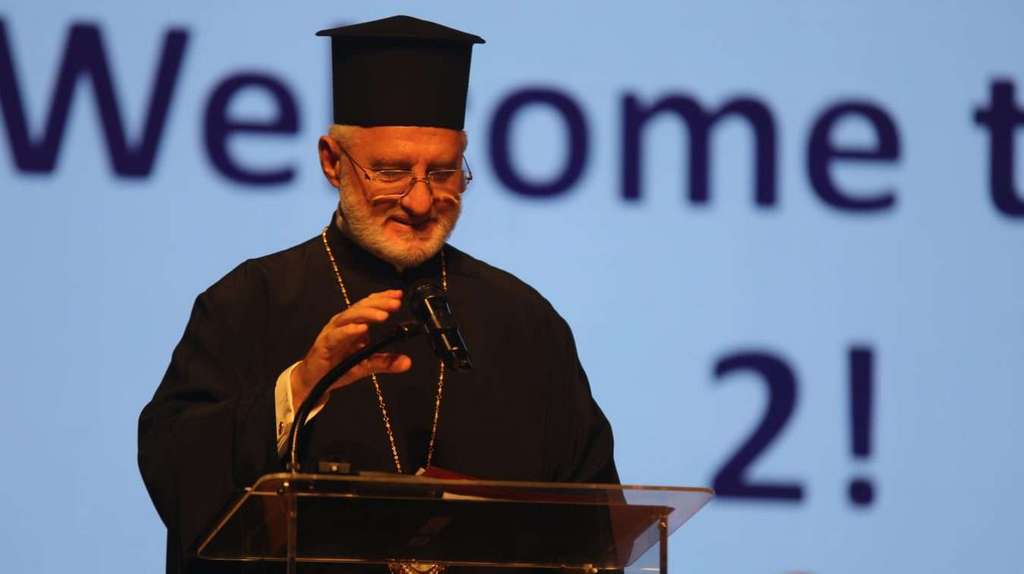
Atop Holy Cross Greek Orthodox Seminary’s “hill of hope” in Brookline, Mass., His Eminence Archbishop Elpidophoros of America was installed as the new Chair of the Governing Board of the National Council of Churches of Christ in the U.S. (NCC) on Oct. 14.
As the first Eastern Orthodox hierarch and head of a jurisdiction to be Chair of the Board, Archbishop Elpidophoros’s installation marks a significant milestone in the history of both the NCC and the Greek Orthodox Archdiocese of America.
The installation took place during NCC’s 75th anniversary and Christian Unity Gathering, meeting from Oct. 13-16 in Boston. The NCC is the oldest and largest ecumenical body in the U.S.
Speaking to the gathered seminarians and NCC representatives, the Archbishop addressed fears often sparked by the ecumenical movement.
“There is a mistaken notion that the ecumenical endeavor is like a blender, concocting a muddled version of the disparate elements that we each put in, a syncretistic smoothie of indeterminate taste,” His Eminence said. “Nothing could be further from the truth.”
Rather, the Archbishop presented love as being at the center of ecumenical work.
“Together, we continue our journey toward reconciliation and the restoration of the unity of all Christians—a unity not of uniformity, but of communion, rooted in the inexhaustible mystery of God’s sacrificial love,” he said.
> Previously: Archbishop Elpidophoros continues the ecumenical legacy of his predecessors.
Co-hosted by Hellenic College Holy Cross (HCHC) and its Huffington Ecumenical Institute (HEI) and Maliotis Cultural Center (MCC), the day began with sessions highlighting Orthodox scholarship.
A particular highlight was a presentation by HCHC’s Fr. Philip Zymaris, Th.D., who argued communal images of the Resurrection are common to both Eastern and Western Christian traditions.
Fr. Philip connected his theological discussion not only to the ecumenical movement but to environmentalist work, presenting Christ’s Resurrection as one of advocacy for all humanity and indeed all creation.
Leading a session entitled “The Challenges and Opportunities of Ecumenism in a Polarized Society,” Fr. Nicolas Kazarian, Ph.D., also spoke.
“Unity is not an abstract ideal or a distant utopia, but a vocation, an endeavor, a journey rooted in the very nature of this church,” Fr. Nicolas said. He proposed that to be effective, ecumenical dialogue must be “anchored in truth, sustained by love, and oriented toward visible unity in Christ.”
Archbishop Elpidophoros welcomed NCC visitors alongside His Grace Bishop Anthony of Synada, the Rev. Archdeacon John Chryssavgis, and Dr. Demetrios Katos, sharing his particular joy at gathering upon the HCHC campus.
“One of my aspirations for our meeting here is to inspire the student body with a healthy and respectful understanding of ecumenism,” His Eminence said.
The Archbishop referred to the outright rejection of ecumenical work as “retrograde,” instead insisting that “sound ecumenism” provides an important framework for living in a religious landscape that is pluralistic and fragmented even among Christians.
Archbishop Elpidophoros closed his installation remarks on a note of hope and expectation. “Unity will be a miracle, but this miracle will occur in time,” he said, quoting his Archiepiscopal predecessor Ecumenical Patriarch Athenagoras.
3 Comments
There exist photographs of late Ottoman public celebrations involving Orthodox priests, Jewish rabbis and Muslim Muftis. Such apparent concelebration is not syncretism, the way many peasant passive aggressive cave dwellers claim, coming up with wierdo labels like “panheresy of ecumenism” to describe it. And I strongly suspect this happened long before
photographs. Further, if our clergy do not cooperate with other faiths in matters where we share interests, we will be left out and unable to survive. Why is it wrong if our clergy bless political conventions, mourn at national catastrophes, and stand up for issues which unite us with other faiths? Such cave dwellers seem to only wish our clergy to speak up for “Greek National Issues” and to even remain silent on religious matters, eg Dukakis on abortion. The cave dwellers think that if our clergy even step out of the ghetto, they are disrespecting the pagan bohemians that dwell there.
Veras,
Well stated. We tend to forget that the Roman emperor Constantine was a practicing pagan, tolerant of Christianity, and converted to the faith on his deathbed where he was baptized by a Nestorian (not an Orthodox!) priest. Moreover, some church scholars claim that he favored the Nestorian interpretation of the faith over that expressed in Nicea.
I think you mean Arian rather than Nestorian.