
Source: Assembly of Canonical Orthodox Bishops of the USA
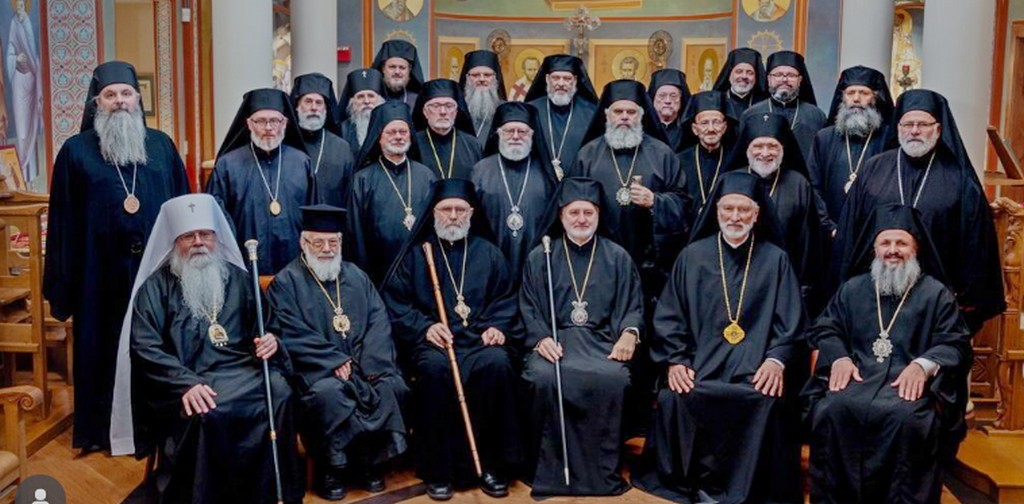
Opening Remarks of the Chairman at Assembly of Bishops XIV
My Beloved Brothers and Concelebrants in the Holy Spirit,
I commence my remarks today by greeting you in the spirit of fraternal love and appreciation for your presence in this Fourteenth Convening of our Assembly of Bishops. In this year when we celebrate the Seventeen Hundredth Anniversary of the First Ecumenical Council in Nicaea, I perceive a true momentum, a genuine Kairos, inspired by the Holy Spirit within our Holy Orthodox Church, not only in these United States, but around the world.
The influx of newcomers and seekers – something that we will address together – is surely a sign that the Faith of the Apostles, the Faith of the Fathers, the Faith that has established the Universe, is just as relevant today, as it was seventeen hundred years ago. Then, the 318 Fathers assembled to articulate the experience of salvation in Christ. They achieved a formulation of what it means to be a Christian, a formulation refined by the Second Ecumenical Council fifty-six years later in Constantinople, that has stood the test of time – even centuries upon centuries.
Just three days ago, at Hellenic College and Holy Cross, some of the Brother Hierarchs here today joined with me in an ongoing conversation and dialogue with our Oriental Orthodox Brethren, to explore how the achievement of the Nicene Creed could be the cause, once again, for the unity of the Faith and of the Church.
And I note with pride and gladness, that in a few weeks, when His Holiness Pope Leo XIV visits the Ecumenical Patriarchate of Constantinople for the Feast of the First-Called Apostle Saint Andrew, he will join His All-Holiness Ecumenical Patriarch Bartholomew, His Beatitude Theodoros II, Patriarch and Pope of Alexandria and All Africa, His Beatitude John X, Patriarch of Antioch and All the East, and we pray His Beatitude Theophilos III, Patriarch of the Holy City of Jerusalem and All Palestine, and travel to modern-day İznik, the site of Nicaea and the First Ecumenical Council, to commemorate this wellspring of, as Saint Paul says, “the great mystery of piety.” [1]
Now, we do not know whether our relations with our Oriental Orthodox or Roman Catholic Brethren will be further conciliated by all of the contacts and conversations that have been occasioned by the Nicene Anniversary, but it is undeniable that Orthodox Christianity – the foundation of this Patristic faith – is being sought out by greater and greater numbers of heterodox Christians, and even those with no affiliation whatsoever. And we must be prepared to welcome them into our midst.
His Eminence Metropolitan Saba will be leading our discussion on this very topic, and I want to thank him in advance for the energetic and thoughtful approach that he will no doubt share with us in due course.
At the same time, we must recognize that the cultural and historical qualities of our communities are more attractive to those seeking a richer and deeper historical connection to Christ, than the oftentimes mundane and even profane versions of Christianity prevalent in contemporary society.
Therefore, we have a duty and responsibility to prepare our Faithful for the eventual advent of a shift in the populations of our communities. Perhaps not today, nor tomorrow. But there is a tide coming our way. I, for one, look forward to Metropolitan Saba’s assessment of the time horizon, the current situation, and the responses that we can prepare in advance.
In addition to the Anniversary of Nicaea One, the recent Visit of Ecumenical Patriarch Bartholomew to receive the Templeton Prize, continued the tradition of the occasional presence of the Heads of the Local Autocephalous Churches in the United States.
I am thinking in particular of the visits of His Beatitude Patriarch John X of Antioch in 2023 and His Beatitude Patriarch Porfirije of Serbia in 2024, both of whom graced America with their presence. Such visitations seem to me a positive sign to the Faithful of the universality of Orthodoxy, and they remind our people of our presence throughout the world.
* * *
Changing course for a moment, I feel it is necessary to note that, since our Convening last year, the tragedies in Ukraine and in the Middle East, drag on with sorrowful consequences. We must continue to support an immediate cessation of hostilities where active war is taking place, and pray that sanity will return to these regions. At the same time, we should keep our Faithful informed of how they can help, both in terms of philanthropy, and in terms of advocacy. We must also give due recognition to the efforts of the present Administration, under the leadership of President Trump, in seeking to advance peace in lands where Orthodox Christians are most exposed to peril—above all in the Middle East— while also giving voice to the plight of persecuted Christians across the world, not least in Nigeria. Perfect peace, we know, lies in the keeping of Almighty God; yet it is our duty to honor every earnest endeavor that moves humanity nearer to that divine promise: the institution of ceasefires, the freeing of hostages and prisoners, and the rekindling of hope in the Holy Land, where Christians have borne sorrows beyond all reckoning. As we receive these signs of peace with gratitude, let us hold fast in prayer and stand united in steadfast solidarity.
I am hopeful that, in my new role as Chair of the Governing Board of the National Council of Churches of Christ in the USA, in which a number of our Assembly members belong – including the Orthodox Church in America and a number of our friends from SCOOCh – we can advocate for peace in these troubled lands together with our Protestant neighbors, amplifying our voices, so that those in the halls of political power might exert their will on behalf of alleviating these appalling circumstances.
* * *
Before I address what I believe to be the vanguard of our Assembly’s activities, allow me now to give the traditional update about our brotherhood:
Since our last meeting, we have endured the passing of Archbishop Peter of ROCOR, who fell asleep in the Lord on November 8 of last year. May he find the reward of a good and faithful servant in the Kingdom of Heaven, and may his memory be eternal.
We also have the following newly ordained Hierarchs:
- His Grace Bishop Serafim (Patriarchate of Serbia, Bishop of Kostajnica and Vicar to the Metropolitan of Midwestern America)
- His Grace Bishop Clement (Patriarchate of Bulgaria, Bishop of Levski and Vicar Bishop for the Bulgarian Orthodox Diocese of the USA, Canada, and Australia)
- And His Grace Bishop Vasily (Orthodox Church in America)
Unto all those who have been elected let us all say: “Many Years!” “Axios!”
We also recognize the retirement of two Hierarchs of our Assembly: His Eminence Metropolitan Alexios, who served the Atlanta Metropolis for decades, and His Eminence Archbishop Benjamin, who served the OCA Diocese of the West. We wish them both good health of body and soul.
* * *
Yesterday, I shared some ideas with the Executive Committee on why our Assembly still has validity and purpose, despite the fact that we no longer are addressing the primary concern that created all the Assemblies around the world – the non-canonical organization of Diasporic Churches in the various regions where no Local Church solely existed.
But as each of you has reviewed all the materials prepared for this Meeting of our Assembly, you can clearly see that there have been unforeseen and unanticipated benefits to our Holy Church from all the activities taking place under the aegis of the Assembly.
I want to express the profound gratitude of all, particularly to the Brothers who serve as Episcopal Liaisons to the various Agencies and Affiliated Ministries. These diverse and varied expressions of diakonia are the arms and legs of our Assembly, for they are reaching out across the country to bring outstanding services to God’s Faithful People.
The amazing Orthodox Christian Prison Ministry is bringing comprehensive resources and pastoral care to the incarcerated, by those called to this truly Evangelical mission. Assembly ministires are reaching the poor and the dispossessed, and providing the good people of our Churches opportunities to live out their Orthodox Christian Faith in real time, making a difference in the lives of those less fortunate. Our Assembly provides these possibilities to our Faithful, because we have established good order and responsible governance throughout all our ministerial projects. We should all be grateful to the laity and the local clergy who take advantage of these programs to enhance and increase the experience of Christ’s love in their local flocks.
I want to especially note the Committee for Agencies and Affiliated Ministries and its Chairman, His Grace Bishop Irinej, for they are our oversight body – true overseers of all the activities that take place in our name. And, although as individual Hierarchs and ecclesial bodies we are not bound by this Assembly, this Fellowship of Hierarchs constitutes the single most visible expression of Orthodox Unity in the United States, something for which we should all be very proud.
The ministries that we bless – whether it is IOCC founded in 1992 under SCOBA, or OYM – our Youth and Young Adult Ministry established by this Assembly in 2021 together with OVC, the Orthodox Volunteer Corps – they have the unique character of serving all Orthodox Christians in this great Country of ours. Their reach is beyond the parochial; it is national, and it reflects our fundamental unity in Christ as the Assembly for the United States, and we should never underestimate its impact.
You will hear updates about these ministries, but I want to stress that without a central funding mechanism from this Assembly, they are taking the initiative to glean support – not only from the Faithful directly – but from major institutions like the Lilly Foundation. For example, both the Orthodox Youth Ministry and the Orthodox Volunteer Corps have obtained grants in excess of one million dollars each from the Lilly Foundation. And this is just the beginning.
I also want to highlight the IPA – the Inter-Parish Associations, that are springing up all over the map. They promote community within regions across parish demarcations, and in many respects, represent a net that is bringing the Church together in ways we have not seen in generations. I am aware that over fifty years ago, there were inter-Orthodox Clergy associations flourishing across the country, and many of these still exist, but now, we are expanding that reach to include the laity as well, bringing parishes together in a sense of Orthodox fellowship.
All of this is to say that the networks created by our Assembly ministries are the building blocks, the interstitial tissue necessary to provide us with a robust resiliency and flexibility, as we face the inevitable augmentation in our communities occasioned by the arrival of so many newcomers. And we know this is happening. Just look at the levels of Church attendance this last Summer. Many parishes actually experienced increases in Sunday to Sunday attendance, rather than the expected decrease due to vacations and the like.
My Brothers, I would also like to highlight an outgrowth of our Assembly that bodes well for our future – and that is the contributions of the laity who are connected to the Assembly. We have literally hundreds of volunteers and staff members who are working in and for our Agencies and Ministries. They are achieving levels of cooperation and impact that will rebound to the benefit of every Hierarch and his faithful.
Of special note, our Legal Committee – comprised of exceptional attorneys from all the jurisdictions around the country – is ensuring that the interests of our Church vis-à-vis the greater body politic are being protected. You may not realize this but through this Committee, we have spoken in unison about serious matters pertaining to that most fundamental American principle of religious freedom. The Committee has filed what are known as “Amicus Briefs” – documents supporting other religious entities and advocating for the protection of religious freedom principles in courts around the Nation. This is no small thing, because it keeps our Orthodox faith in the forefront of safeguarding the religious liberties enshrined in the First Amendment.
My Brother Hierarchs,
I hope you can see that the whole of our Assembly is much greater than the sum of our parts, for the Spirit of God rests upon us and is guiding us. I thank you for allowing me to give just a few highlights of this whole, and I pray you look forward to even greater elucidation as the day goes on.
Finally, allow me to express on behalf of all, our deep appreciation to His Eminence Metropolitan Constantine, and the local Church communities from across all the orthodox presences, who have made such marvelous preparations for our meeting. Their hospitality and welcome are recognized for what they are – signs of Christian love and fellowship. I want to express the gratitude of all to His Eminence Metropolitan Gregory and the Secretariat who meet every month, to keep track of our progress, and who work to orient our mission in accordance with our fundamental purpose.
I also commend the Director of Operations Father Nicholas Anton and the staff of the Assembly, for their extraordinary efforts to make this 14th Convening of our Assembly a success.
* * *
Beloved Brothers:
Thank you again for your pious and prayerful presence and your commitment to our deliberations. May they by blessed through the intercessions of the Theotokos and Ever-Virgin Mary, and all the Saints.
Amen.
[1] I Timothy 3:16.
Presentation “On Converts to Orthodoxy” by the Vice Chairman at Assembly of Bishops XIV
Introduction
For centuries, the New World has drawn successive waves of migration. In most of the twentieth century, there was a modest Orthodox presence that remained largely confined to Orthodox communities across North America, especially in the big cities. Orthodox immigrants established their churches in the midst of their residential clusters and preserved their faith as best they could at that time. With the organization of church life in North America, the expansion of immigration after the Second World War, and the birth of new generations within American culture, Orthodoxy came to be known as an Eastern Church—a church of immigrants and ethnic communities: “Greeks,” “Slavs,” “Syrians,” etc.—rather than by their apostolic faith.
However, the changes that took place in Western society in general, and among American Christians in particular, pushed some to search for the original roots of Christianity. They discovered that “the faith once delivered to the saints” (Jude 1:3) had been preserved in the Orthodox Church, and they turned to it. Thus began the first large wave of converts—at least in the Antiochian Church—in the 1980s. These new Orthodox took upon themselves the task of evangelizing the Orthodox faith in the land, and their children and grandchildren were raised Orthodox.
By the end of the twentieth century, we almost thought that the century of immigration for Orthodox Christians in America had ended and that the century of evangelization had begun. Yet the collapse of the communist world in the early 1990s quickly brought a renewed flow of immigration from Eastern Europe, and the economic problems that have continued to plague Greece prompted the continued flow of Greeks to America. Two decades later came what was called the Arab Spring, which sent many Middle Eastern Orthodox to North America as well. Today, it seems as though we are returning to the first century A.D., when new believers left Jerusalem because of persecution and the Gospel spread throughout the oikoumene (inhabited world).
The growth of the conversion movement, for various reasons, contributed to making Orthodoxy a known religion in North America; indeed, it is now witnessing accelerated growth—some have even called it a flood. To put it mildly, we were no longer, as my predecessor Metropolitan Philip, of thrice-blessed memory once called us, “the best kept secret in America.”
Motives for Conversion
There is no doubt that the abundance and variety of Protestant churches, and their differences from one another, are one reason many Protestants seek the authentic Church. There is a palpable hunger for Christian authenticity in America.
Over the last five centuries, Protestantism has developed its own “tradition” while at the same time rejecting the fullness of Holy Tradition. Today, however, many ask how they can accept a Protestant tradition that began with Luther’s movement and grew and developed to the present day, yet reject the Tradition that goes back to the beginning of Christianity.
As for the rootlessness that has prevailed in many Evangelical settings, it remains the greatest driver for those seeking a firm, unchanging faith—for “the faith once delivered to the saints.” These motives apply especially to those coming to Orthodoxy from Evangelical backgrounds. But there are also other Christians, atheists, non-religious people, and followers of other religions who are drawn by the beauty of Orthodox worship and its sacred arts—iconography and church music—into the spiritual world for which they thirst. Many find in the spirituality of the Orthodox Church both accountability and discipline amid the decadence and compartmentalization of contemporary life.
Social media also plays a large role in introducing American society to Orthodoxy, prompting many to look for the nearest Orthodox church and become acquainted with it.
Because Orthodoxy was, in the past century, a church of ethnic communities, it drew the attention of many non-Orthodox to certain beauties of the cultures Orthodox Christians brought from their countries of origin—family life, hospitality, friendship, community, cuisine, and the like. Many of our priests also observe that Orthodoxy’s resistance to a commercial spirit gives it credibility in a world where faith has become a consumer commodity, while the blood of our many and recent martyrs gives it further credibility. There is no relativism in Orthodoxy, nor populist, emotional mass appeal.
In short, as one of the priests who responded to a survey I circulated put it regarding this century: “The century of the ‘church of immigrants’ has ended; the century of evangelization has begun. Orthodoxy’s mission is no longer primarily geographical (from Antioch to America) but existential.”
The Youth Awakening
Speaking about conversion requires pausing to consider youth. The phenomenon of young people, ages roughly 15-30, coming to Orthodoxy has become very clear in many churches. For example, in New York—where previous waves of conversion were not known—you will find today in our Antiochian cathedral in Brooklyn more than fifty university-age catechumens or very recent converts of every race and religious background—or even of no religious background at all.
It is also notable that many young men with little prior contact with Christianity are drawn to the order, hierarchy, and seriousness they find in Orthodoxy. Young people in general summarize the reason for their choice of Orthodoxy in these words: “We were looking for a real spiritual life, and we found it in Orthodoxy.” Before Orthodoxy became more widely known, many of these same people would leave rationalistic Western Christianity for Eastern religions, seeking that very spirituality in religions like Hinduism and Buddhism—not knowing that authentic spirituality already existed in Eastern Christianity.
Youth admire the authenticity, dignity, and spirituality they find in Orthodoxy. They discover an ascetic and moral seriousness that offers them an alternative to the relativistic, fragmented culture they experience in society. In addition, many young Americans now long for Christian community and seek it in traditional churches. It is no exaggeration to say that mysticism is what most strongly draws them to Orthodoxy: they are captivated by the mystery they experience—whether in the various liturgical services or in the sacred arts such as architecture, icons, and music. Any visitor to Orthodox monasteries in America will notice the abundance of monks and nuns who are themselves young.
Their model is holiness and the Church as a eucharistic communion in which they find the family they have missed. They are tired of ideology; they seek holiness, serious faith, and love. They do not want a faith that is merely reactionary, nor a lax religion. Their seriousness can push them toward rigidity and extremism if they do not have mature and balanced spiritual fathers. The same internet that plays a positive role in introducing them to Orthodoxy also plays a negative role if they encounter rigid and fundamentalist Orthodox preachers. Despite the existence of extremism, they remain in the Church because of the peace they feel there. They accept rules and boundaries that heal them, while at the same time rejecting other rules that they think shackle them and block their freedom. Accompanying these young people shows how great their need is for genuine, pure discipleship.
Difficulties of Converts
Perhaps the first difficulty lies in the lack of follow-up and personal discipleship, which are not always available. Many cradle Orthodox welcome converts joyfully but do not make the required effort to disciple them and provide the spiritual care they need, or they become indifferent to this responsibility and caught up in their own cares.
The truth is that the Orthodox world in general lived for centuries under persecution, which made the preservation of the faith and the continuity of Orthodox existence the priority overshadowing all else. The prohibition of Christian evangelization under threat of death made mission entirely forgotten; thus, many Orthodox lost the experience of dealing with converts, since they were unable to evangelize for centuries and forgot that great task. Their indifference to evangelization was further deepened in America by living for a long time as ethnic-community churches.
From the 1980s onward, they began to see the new conversion movement, which began by the Holy Spirit—not by cradle Orthodox themselves. But the conflation of the social culture they carried from their homelands with their Orthodox faith did not sufficiently equip them to care for new converts and help them acquire the Orthodox mind or phronema.
Here lies perhaps the greatest difficulty converts face. Acquiring the Orthodox way of thinking does not come from books but from life in the Holy Spirit, and this requires long-term rootedness in Orthodoxy. The Orthodox Faith is not an idea but a lived experience of repentance and communion with God. There is a danger that Orthodoxy becomes an ideology. Conversion to Orthodoxy is not so much an event as a journey and a process. Converts need accompaniment after receiving baptism or chrismation.
A decline of zeal is also noticed in some after an initial period of great enthusiasm.
There are cases of extremism and fundamentalism, and a tendency toward narrow legalism and a kind of theological intellectualism here and there.
Many who are coming to the Church today are psychologically, emotionally, or socially wounded, which requires experienced and mature spiritual fathers. All patristic teaching is based on the Church as a spiritual hospital that heals people from the consequences of their passions. A great task faces Orthodox Christians in America: transforming the Church from a club or religious association into a eucharistic community that heals through the mysteries (sacraments), spiritual care, and love.
It is difficult to form an American Orthodox community because of the dominance of individualism, the reality that believers do not live clustered around the church in one neighborhood, and the drain of human energy from working long hours that leave little room for gatherings outside Sunday. These factors have not yet helped to crystallize an American Orthodoxy. Meanwhile, immigrant believers still mix their social culture with Orthodoxy in ways that do not help converts distinguish what is authentic ecclesial tradition from what is merely social custom.
What makes things harder for converts is that Orthodoxy is a way of life more than a set of doctrinal rules and moral codes. Being thus, it rests on personal discipleship, which itself requires spiritually mature people and serious, patient accompaniment of new believers for a period of time. There is a pressing need here to translate doctrine into pastoral care—another very delicate task. Orthodox ethics are not merely principles and rules but a practical reflection of faith that appears in the believer’s conduct and character.
As I mentioned earlier, alongside the positive face of the internet that introduces many to Orthodoxy, there is a negative face in that people encounter an Orthodoxy that is not always authoritative or theologically sound. The open space allows anyone to speak about anything. Fundamentalism, in its negative, rigid sense, has also increased because of much that is available online—to the point that some have labeled it “internet fundamentalism” and consider it a new heresy.
We must remember that the Church has honored only three saints with the title “Theologian.” As Presbytera Eugenia Constantinou writes in her book Thinking Orthodox: “The Fathers of the Church frequently warned against the practice of dabbling in theology as an occasional pastime, attempting to discuss matters beyond one’s actual abilities. Amazingly, those whom the Fathers were admonishing against theological dabbling were not necessarily people living in the world, with secular careers, jobs, and families, as most dabblers are today. St. Gregory the Theologian sometimes refused to discuss theology with his own bishops! St. Symeon the New Theologian sharply criticized both monks and clergy for discussing theological matters about which they had no real experience. If such warnings can be issued to monks, priests, and bishops, how foolish it is for the rest of us to dabble in theology.”
Impact of the Increasing Influx
Most Orthodox churches in North America have seen increased attendance, especially after the Covid pandemic. Some observers liken this influx to a flood—and the comparison is accurate. I do not visit a parish without meeting catechumens there; in some parishes, they number more than one hundred. This raises a very serious question about the Church’s ability to receive them, form them properly, and provide spiritual accompaniment.
While many long-standing believers see in the converts a source of renewal and vitality—and a spur to discover their own Orthodoxy personally and deeply, not merely as a social religious tradition—many also feel somewhat threatened by the cultural changes occurring in their parish.
Many converts bring energy, zeal, and often deep theological literacy. But their rapid influx brings other problems: lack of space, insufficient catechetical training, increased pressure on priests—some describe themselves as burned out—lack of enough sponsors and lay mentors, and a shortage of authentic, lived Christian education.
There are no serious departments dedicated to preparing new believers, and to accompanying them spiritually as required. Various reasons bring new converts to the Orthodox Church, but rarely is it due to the Church’s deliberate work to introduce them to Orthodoxy. Some inquirers and converts feel alienated because they have not integrated sufficiently into the parish; others do not sustain their initial enthusiasm because they were not spiritually nourished in a way that preserves them; still others cling to their backgrounds in a way that is Orthodox outwardly more than inwardly. In some parishes that do not use English, converts find it very difficult to follow the services.
This influx requires more priests, deacons, and laypeople capable of serving newcomers—and this is precisely what most Orthodox churches lack. There is a growing number of priests exhausted by the increased workload. Even before this influx, we were struggling to recruit enough new priests to replace those who retire. Now the challenge is much greater: we need many more clergy and hundreds more parishes to accommodate all those who wish to join the Orthodox Church. Some of our church buildings are so full on Sundays that they exceed the fire code, and parking lots cannot fit any more cars. How many inquirers have turned around and left because they could not fit into the temple? How many of our existing faithful have been neglected because their priest must now ration his time and pastoral care? And how many clergy marriages and families are strained under this pressure? We must respond to this urgent challenge both prudently and swiftly, recognizing it as not only a problem but also a great opportunity.
Acquiring the Orthodox Mind
Many priests pose the fundamental question: how do we help converts acquire the Orthodox mindset? In baptism they become children of God and receive divine grace, but they need to grow in it. Neither teaching nor immersion alone suffices to acquire this mind. The principal question, therefore, is: what is required of the Church in the face of this influx? This is what I hope we can discuss, so that we may reach a plan or a set of road markers for developing our pastoral and evangelistic service.
Teaching without practice produces converts who are easily fragile. True formation must join both knowledge and lived experience. Attendance at services, fasting, confession, serving others, reading Scripture and the lives of the saints, and having a personal prayer rule under the guidance of a spiritual father—these disciplines must be the foundation of parish life for all the faithful (new and old alike), rather than being replaced by programs or organizational activities.
The most important means is common prayer—frequent services, friendship, and times of instruction. Preparing qualified sponsors among the laity may play a role even more important than a classroom. Formation begins with the priest but does not end with him.
Catechesis, both introductory and specialized, must include all the fields of the Christian faith. In some parishes, dogma is stressed while life and ethics are neglected. The integration of both is essential. It is essential that all the people of God in a parish, together with their priest, take part in serving the converts. This requires planning and vision. Spiritual guidance is decisive: the quality of sponsors and godparents is often the determining factor in whether a convert remains engaged in the Church.
Some Difficulties that Hinder Evangelization
Most churches facing this wave of conversions suffer from a shortage of priests in general, and of priests who are specialized in evangelistic ministry in particular. Budgets sufficient for evangelization are also not available in most parishes. The absence of coordinated planning weakens or slows evangelistic work, since most missions rely on individual effort more than on an organized system. Evangelization departments, where they exist in archdioceses, are still insufficient, and the work remains based on individual rather than collective efforts.
The influx of increasing numbers makes church spaces insufficient and sometimes stirs grumbling among parishioners, which negatively affects newcomers. In this area, some parishes have begun to sponsor new missions that grow out of them, developing over time into independent parishes. The reality is that a healthy mission comes from a healthy parish.
At the same time, there is a danger that we rejoice in numbers and forget that conversion is a lifetime process of repentance, not numerical recruitment. We must be careful lest today’s converts become tomorrow’s apostates.
Useful Matters and General Notes
Many priests agree that providing a warm, family-like pastoral environment strengthens the sense of belonging to the Church as the living Body of Christ. It is also observed that converts grow quickly where they are known by name. Shared meals—especially Middle Eastern cuisine—play an encouraging role in fostering participation in parish life, as do collaborative work inside and outside the church building and praying together. Some parishes that organized a group specifically to welcome newcomers—whether visitors or catechumens—found great success in later receiving them as full parish members.
Forming a personal relationship with newcomers greatly eases their integration, whereas bureaucracy of parish entry discourages the enthusiasm that first drew them to the parish. Orthodoxy is deeply relational—the only true incarnational experience in humanity. If we cannot offer personal relationships that lead others to Christ, then no one can.
Some who labor in this field prefer that the catechumenate not be less than one year, while others suggest two years.
There remains a lack of clarity and consensus about modes of reception, especially given the many variations we encounter among those coming from Protestant churches that either do not recognize baptism, or whose “baptism” occurred in a questionable way, or by so-called pseudo-churches.
There is a great need for pastoral and spiritual guidance training. Orthodoxy is not only a system of doctrinal ideology but a doctrine incarnated in life. Priests working in evangelization need support, opportunities for mutual learning, and spiritual gatherings specific to them. Catechumens and new converts need regional spiritual retreats that help them enter the heart of Orthodoxy.
It goes without saying that we must use the language spoken by the catechumens. Generally, this is English, but we have begun to need Spanish as well, with some inquirers either coming from Latin America or who need catechetical and liturgical materials in their native tongue to better understand Orthodoxy. There is also a growing need to minister intentionally to the African-American faithful and catechumens now increasingly present in our communities. In several parishes, there is an urgent need for balance in the use of languages, especially since the stream of migrants from other countries will never cease
There is a great opportunity before the Orthodox Church in this evangelistic century. Converts are the first fruits of a broader evangelistic awakening. We need to receive them and prepare them well, and to strive to create an American Orthodoxy capable of taking root in a society to which Orthodoxy is not historically accustomed. This historic opportunity now places before the Orthodox Church a very sensitive task, confronting essential questions such as:
- How do we respond to the work of the Holy Spirit in creating a contemporary Orthodox culture able to communicate with, interact with, and influence modern Western societies?
- How can we protect Orthodox people in America from the policies of some Orthodox churches which, sadly, are currently in conflict among themselves?
- How can we—drawing on our rich theological, spiritual, and witness-bearing heritage—build an Orthodox testimony that begins with the needs of the American society in which we live, without denying our mother churches, especially those still undergoing tribulation and persecution?
- In the face of the spread of worldliness into the fabric of daily life, and American society’s turning away from its early Christian roots, how can we benefit from the experience of ongoing persecution in some of our mother churches to strengthen our Christian witness in the present age?
Conclusion
There is much to be said about contemporary conversion, and it needs extensive study, but reality places this challenge directly before us today, as those entrusted with shepherding the flock of Christ. It is a responsibility before God and history. We must cooperate so that each of us may be strengthened to fulfill it in the best possible way.
The hardships of history forced us, as Orthodox, to forget the basic commandment: “Go into all the world and proclaim the Gospel to all people” (Mark 16:15). But the Holy Spirit reminds us today that, in this blessed land, we now have the freedom and the means to accomplish what the Lord asked of us—what centuries of persecution prevented us from doing.
“Behold, now is the acceptable time,” (2 Cor. 6:2) says St. Paul. Let us not squander this moment of grace.
Closing Remarks fo the Chairman at Assembly of Bishops XIV
My Beloved Brothers and Concelebrants in the Holy Spirit,
I want to thank all of you for your prayerful presence and your thoughtful contributions to the work that we have engaged together. We gather as this Assembly of Bishops in order to bring what is best for all the Orthodox Christians who dwell in this blessed land. Every step that we take together is a positive example to our Faithful, that they can imitate in their own lives and communities. I am grateful to each and every one of you for your participation and for the dignity and piety with which you exercise the high office entrusted to you by our Lord Jesus Christ.
As we leave off the work of the Assembly’s agenda today, and prepare to celebrate the Divine Liturgy together tomorrow, I reflect that our work together is never truly done. At least not until the Messiah comes again in all His glory. The Holy Eucharist in which we partake is the Lord’s way to not only be with us throughout history, but to remind us that His Presence is always breaking through history to transform us into His image and likeness.
I pray that as we take our leave of one another after our concelebration tomorrow, that we recognize that transformation is not only possible, but inevitable. We are called to lead and to feed the flock of the Great Shepherd of the rational sheep in the verdant pastures of the authentic Orthodox Faith. The truth of our Church is self-evident, and we see that it is bringing more and more people through the doors of our Temples. As the Lord said:
“And I, if I be lifted up from the earth, I will draw all people to Myself.” [1]
May He continue to bless all our ministries, and through His Holy Spirit enable us to bring more and more lost sheep into His fold.
May we continue to use this Assembly to provide more and more ministry to our Faithful.
And may we blessed to enjoy a more fruitful fellowship with one another, as we live in the light of His glory.
Amen.
[1] John 12:32.
Assembly of Bishops XIV Concludes; Discussed the Influx of Converts and Prayed for Those Suffering Worldwide
DENVER – The Assembly of Canonical Orthodox Bishops of the United States of America convened in Denver, Colorado from November 6-8, 2025, for the 14th meeting since its formation. Prior to the official events, the Executive Committee met to review the agenda items and conduct routine business.
On Thursday, November 6th, the community of Saint Luke Antiochian Orthodox Church in Erie, Colorado hosted Vespers and a reception. Metropolitan Saba presided over the Vespers attended by more than four hundred faithful from the surrounding area. During the reception, attendees were entertained by the “Kolo Rado” and “Fotia” dance troupes from Saint John the Baptist Serbian Orthodox Church and the Assumption of the Theotokos Greek Orthodox Metropolis Cathedral, respectively. Testimonies from the Assembly’s six agencies – International Orthodox Christian Charities (IOCC), Orthodox Christian Mission Center (OCMC), Orthodox Christian Prison Ministries (OCPM), Orthodox Christian Fellowship (OCF), Orthodox Volunteer Corps (OVC), and Orthodox Youth and Young Adult Ministries (OYM) – were read by local volunteers and intermingled with performances. The Assembly’s Director of Inter-Parish Associations, Spyridoula Fotinis, was the Master of Ceremonies.
On Friday, November 7th, the Hierarchs met and were hosted by Metropolitan Constantine at the headquarters of the Greek Orthodox Metropolis of Denver to hear reports and proposals from the Assembly’s committees and ministries as well as to conduct regular business. The Members of the Assembly once again expressed sorrow for the absence of their Brother Hierarchs of the Russian Orthodox Church in America and sincerely encourage their return to participate in future Assemblies.
Commenting on the value and necessity of the Assembly of Bishops, Archbishop Elpidophoros, Chairman of the Assembly, stated in his opening remarks, “there have been unforeseen and unanticipated benefits to our Holy Church from all the activities taking place under the aegis of the Assembly … the networks created by our Assembly ministries are the building blocks, the interstitial tissue necessary to provide us with a robust resiliency and flexibility, as we face the inevitable augmentation in our communities occasioned by the arrival of so many newcomers.”
After the initial business and passing of the 2026 budget, the Assembly heard updates from the Assembly’s ministries: Inter-Parish Associations, Mental Health Ministries, and Communications and Technology Initiative. Six new Inter-Parish Associations were established in 2025. Over 22,000 individuals have used the Directory of Orthodox Christian Mental Health Professionals. The Assembly of Bishops mobile app has been updated and enhanced with a new name (Koinonia: Life in Christ) and an “Orthodox Events Finder” feature coming soon. The Sunday of Orthodoxy 2025 was the first ever Assembly of Bishops Sunday.
Committee projects and motions were presented, including: updates on the many Amicus Briefs put forth by the Legal Committee with the Assembly as signatory; the affirmation by the Committee for Agencies and Affiliated Ministries of the annual reviews; the clean biennial audit for 2023-2024 presented by the Finance Committee; and the continued engagement with the Roman Catholic Church through the Ecumenical Committee, as well as with the Standing Conference of Oriental Orthodox Churches. The Liturgy Committee updated the members on progress made by the sign language working group and presented new prayers and services for instances of miscarriage or stillbirth. Staying true to their commitment in their 2022 statement “On the Sacredness of Human Life and its Untimely Termination” to “continue to provide new rituals and ways to address these circumstances, which include prayers of mourning, compassion, and healing,” the Assembly approved the new services for implementation by each jurisdiction, following the directives or decision of its respective Mother Church as applicable.
The main theme of the convocation was on the influx of converts and a common strategy for reception into the Orthodox Church, presented by Metropolitan Saba, Vice-Chairman of the Assembly. His Eminence stated, “the growth of the conversion movement, for various reasons, contributed to making Orthodoxy a known religion in America; indeed, it is now witnessing accelerated growth–some have even called it a flood … ‘behold, now is the acceptable time’ (2 Cor. 6:2) says St. Paul. Let us not squander this moment of grace.” Following a spirited and productive conversation, the Assembly tasked the Theological Education Committee with creating a working group to come up with common and agreed content for catechesis to be presented for approval at a future meeting.
The Hierarchs also addressed current global issues. Since its last convening, the atrocities unfolding in Ukraine and the Middle East continue to bring profound suffering and sorrow. The Assembly called for an immediate cessation of hostilities wherever war persists and urges all to pray that peace and reason may prevail in these afflicted regions. The Hierarchs encourage the Faithful to offer assistance, both through charitable giving and through prayer for those in need. They also acknowledged with gratitude the ongoing efforts of the current Administration, under the leadership of President Donald J. Trump, to promote peace in regions where Orthodox Christians face particular danger – especially in the Middle East. The Assembly also raised awareness of the persecution of Christians and vulnerable people worldwide. With hearts full of gratitude for every sign of peace, the Assembly remains steadfast in prayer and united in its commitment to solidarity, peace and justice.
The Assembly’s Chairman, Archbishop Elpidophoros, called attention to the 1700th anniversary of the convening of the First Ecumenical Council of Nicaea in 325 AD. Ecumenical Patriarch Bartholomew, together with his brother Patriarchs of Alexandria, Antioch, and Jerusalem, will be joined by Pope Leo XIV to commemorate this milestone in Christian history. Commemorating this important anniversary, the representatives of the ancient pentarchy will gather at the site of the Council for an event of great significance then travel to the Ecumenical Patriarchate for the patronal feast of St. Andrew. Hierarchs prayed for a successful meeting and celebration of this milestone of Christianity.
The faithful should ensure that before participating in services at monasteries, such monasteries are canonical and approved by their respective Hierarchs. For example, the monasteries (formerly of the Georgian Apostolic Orthodox Church in North America) of “Saint Nina” (Union Bridge, Maryland), “Saint Iakovos the ‘New Studion’” (Piedmont, Oklahoma), and “The Monastery of the Holy Spirit” (Union Bridge Maryland), as well as “The Holy Trinity Romanian Orthodox Monastery” (Clinton, Michigan) (formerly of the Romanian Orthodox Episcopate of America [OCA]) fall outside of such approvals.
On Saturday, November 8th, Saint Catherine Greek Orthodox Church in Greenwood Village, Colorado hosted the Assembly for the concelebration of the Divine Liturgy. Archbishop Elpidophoros presided with thirteen Hierarchs, four Priests, and four Deacons serving. In his sermon, Archbishop Maxim said, “by honoring the Angels and Archangels today we receive a message and send out a message to the entire world that the existence of the invisible powers is a fulfillment or completion of the entire image of this beautiful creation.” After the Divine Liturgy, the newly established Medal of Saint Theodora was awarded to Anne Mackoul for her dedicated service to Orthodox Chrisitan Unity. Judge E. Ray Lanier, the other Medal of Saint Theodora recipient in abstention, was honored via Zoom during the proceedings of the Assembly.
The next Assembly meetings will take place October 3-6, 2026 in Pittsburgh, Pennsylvania and the 2027 Assembly will meet October 23-27 in Chicago, Illinois.