
Source: Orthodox Youth and Young Adult Ministries
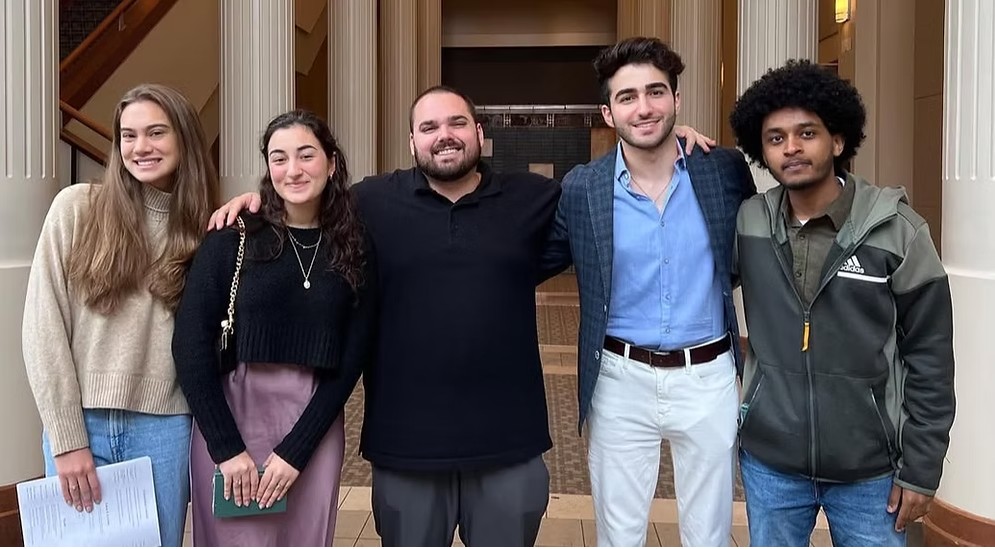
OYM recently had the opportunity to sit down with Jacob Sparks, a campus missionary with Orthodox Christian Fellowship (OCF) serving the colleges of downtown Atlanta. Through Bible studies, reader services, one-on-one mentorship, and even creative solutions like an Uber fund to help students get to church, Jacob is working to bridge the gap between campus life and parish life. In this conversation, he shares how his own journey through OCF shaped his calling to ministry, the challenges of witnessing to Christ in an intense academic culture, and why the most meaningful evangelism often begins with something as simple as going to coffee hour.
OYM: Could you please share a bit about yourself and your history in the Orthodox Church?
Jacob: I was born in 1997 in Charlotte, North Carolina, into a pretty devout Protestant family. I was raised in the PCA—the Presbyterian Church in America—and my dad was actually an ordained elder there. As happens with a lot of devout Protestants, he ended up reading too much Church history for his own good and eventually became Orthodox about sixteen years ago. I was twelve at the time.
Our family had moved to Cumming, Georgia, a suburb of Atlanta, and one Christmas Eve I went with my dad to a Vesperal Divine Liturgy. It was held late at night, around midnight, and I had never experienced anything like it. I had never met a priest before, never seen incense, vestments, or icons, and I had never heard Greek before. All of that hit me at once that night. My dad became Orthodox not long after, and I was left trying to process this completely new world that I had just stepped into.
Long story short, five years later I also read too much for my own good and became Orthodox myself at the age of seventeen, along with my older brother.
After high school, I went off to the University of Georgia. At that point, I had only been Orthodox for about a year and a half. I got involved with OCF—Orthodox Christian Fellowship—as a student and eventually became very active in the chapter there. The parish priest, Fr. Anthony Salzman, became my spiritual father, and OCF became a huge part of my life. I started as a participant, then served as vice president and later president of our chapter.
For me, it was all a very natural process. I didn’t have a big plan—just a growing sense that my life was meant to be in ministry, with Christ and in His Church. I knew that the Orthodox Church was the Church Christ had established, that it preserved the apostolic faith, and I wanted to dedicate my life to serving within it. I honestly couldn’t see myself doing anything else.
After about two years of discernment with my spiritual father, he finally said, “Let’s go talk to the Metropolitan. If he gives you his blessing, you’ll go to seminary. If not, you can do whatever you want.” I agreed. So we went, and sure enough, the Metropolitan gave me his blessing.
I started at Hellenic College Holy Cross (HCHC) in the fall of 2020 and graduated in the spring of 2024. Of course, I got the blessing to go just before COVID hit—so I didn’t quite know what I was getting myself into! But thank God, it was an incredible experience.
During my senior year, I went on the annual St. Helen’s Pilgrimage, where seminarians visit the Holy Land, the Ecumenical Patriarchate in Constantinople, and Thessaloniki. While we were in Bethlehem, I happened to be scrolling through Instagram and saw that OCF was hiring for a new position—Campus Missionary in Atlanta, Georgia.
A friend of mine, Alexandros Pandazis, who had graduated the year before, had taken the first of these campus missionary positions at Texas A&M, so I already knew a bit about it. That night, in a hotel room in Bethlehem, I dusted off my résumé and sent in an application. A few interviews later, they hired me—and thank God, here I am now.
OYM: What is your role now—the title and what it involves?
Jacob: I work as a Campus Missionary for Orthodox Christian Fellowship (OCF) in downtown Atlanta.
Basically, my job has two main goals. First, to help Orthodox college students stay connected to the Church during their college years. And second, to introduce the Orthodox faith to students who might be curious or interested in learning more.
Practically, that means I spend a lot of time on campus—tabling, organizing events, leading reader services, hosting Bible studies, and putting together social gatherings. I primarily serve students at Georgia Tech, Emory University, and Georgia State University, which are the three largest schools in downtown Atlanta.
A big part of my work is also one-on-one connection. Students meet with me to talk about all kinds of things—sometimes pastoral questions, sometimes theological ones—and my role is really to help bring them closer to Christ and the life of the Church.
I’m not a priest or ordained clergy, but I see my role as filling a gap. A lot of parish priests are already stretched thin, with so many responsibilities. My job is to build those bridges between the college campus and the local parish—to connect students to the Church and help them become active participants in its life.
OYM: A lot of our readers are either really familiar with or have participated in OCF. Could you share the story of how you got involved with OCF? Was there a particular moment when you realized that being a campus missionary was your calling?
Jacob: So, to really talk about OCF, I have to go back to when I was a college student.
As I mentioned earlier, I had just become Orthodox toward the end of high school. Before I went off to college, I was talking with my parish priest, Father Barnabas Powell. I had already committed to the University of Georgia, and he told me, “The nearest parish there is St. Philothea Greek Orthodox Church. The priest is Father Anthony Salzman. There’s also an OCF chapter on campus—it’s very active and involved. You should reach out to them and get involved.”
So I did, pretty much right away. For me, it was a no-brainer. I loved the Orthodox faith, I loved the Church, and I wanted to stay connected to it however I could. I got involved in the parish and with OCF, helped plan regional events, attended national gatherings, and even participated in Real Break in the Holy Land—one of OCF’s alternative spring break trips where students focus on their faith instead of the usual college spring break scene. Those experiences were incredibly formative for me.
So I think it was God’s providence and mercy that the campus missionary position in Atlanta—where I’m from—opened up right as I was graduating from seminary. Because of my experience with OCF and my sense that ministry was where God was leading me, it just felt like the perfect fit.
Even if I didn’t have this job, I think I’d still be doing the same kind of work—telling people about the Orthodox faith, helping them encounter the healing and presence of Christ in the Church. That’s just who I am. This position with OCF simply gives me the opportunity and the structure to do what I’ve always wanted to do—especially among college students, right where they are.

Jacob: I think it’s important to start with the word missionary itself, because OCF chose that term very intentionally.
When most people hear the word “missionary,” they think of someone traveling to a foreign country—somewhere largely non-Christian—to evangelize and bring people into the Church. And of course, that’s one kind of missionary activity. But historically, much of the Church’s missionary work has actually been focused on helping already Christianized peoples come into the fullness of the faith.
A good example is when Constantinople sent missionaries to Bulgaria. The Bulgarians had already been evangelized, but the Church saw a need to help correct some errors and bring them more deeply into the apostolic faith. In many ways, that’s how I see my own work—as helping people encounter the fullness of the Orthodox faith, especially here in the southern United States, in Atlanta and the Bible Belt.
There are so many people here who already identify as Christian—mostly evangelical Protestants or Roman Catholics. I grew up in that world myself. They love Christ, they love the Scriptures, and they genuinely want to live devoted lives. But often, what they’ve inherited is a partial version of the faith—something that’s missing pieces of the apostolic teaching and sacramental life of the Church.
So, when I meet students from these backgrounds—or sometimes from secular ones—I often find a real hunger for Christ and for what St. Jude calls “the faith once delivered to the saints.” My role as a campus missionary is to help meet that hunger, not through aggressive or confrontational street-preaching tactics, but through personal encounters, friendship, and showing the love of Christ in a real and approachable way.
On a more practical level, there’s also a structural need for campus missionaries. Across North America, we’re facing a serious clergy shortage—and many priests, especially in large cities like Atlanta, are already stretched thin with pastoral emergencies, sacraments, hospital visits, funerals, and parish administration. All of that work is essential and holy, but it often means that certain groups—like college students—end up slipping through the cracks.
That’s where I come in. My role is to bring the presence of the Church onto the college campus. We hold reader services, Bible studies, and social events, but most importantly, we work to connect students to local parishes and spiritual fathers. We even set up a system in Atlanta where OCF has a kind of “corporate Uber account” to help students get to church—since traffic here is crazy and many of them don’t have cars.
OYM: That’s absolutely wonderful. Accessibility often ends up being a genuine obstacle for a lot of students trying to attend services, especially during Lent when it overlaps with finals season.
Jacob: Absolutely. Yeah, one of the great things about having that centralized ride-share account is that I can actually see when students are using it to go to church. During Holy Week, for example, the usage always goes way up, which is a really good sign—it means students are getting there, participating more, and that’s something we’re always very thankful for.
OYM: That’s great. Thank you for sharing that, because I think a lot of other OCF ministries would love to set something like that up as well.
Jacob: I also believe that the only barrier to coming into the Church should be the barrier of the Gospel itself. St. Paul says in First Corinthians that he wants to know nothing except Christ and Him crucified. He calls the Cross a “scandal to the Jews and foolishness to the Greeks,” right?
So, I think that the only thing people should ever have to wrestle with when it comes to joining the Church is Christ Himself—who He is, what the Gospel means, and what the Church is. Those are the things that are worth struggling with. But something like not being able to spare thirty dollars for an Uber ride? That shouldn’t be the thing keeping someone from coming to liturgy.

Jacob: It might actually be easier to describe what a typical week looks like, and then I can zoom in on a specific day.
So, my goal for each campus I serve is to have at least three events every week. One of those is usually a social or discussion-based event—something with free food, some kind of icebreaker or activity, and then a conversation about a passage of Scripture, a quote from a saint, or a theme from the spiritual life.
For example, at Emory University, we host an event every Wednesday evening called Faith and Falafel. Since Wednesday is a fasting day, we serve free falafel sandwiches for everyone, and it’s become a fun, welcoming space for students to connect and talk about their faith.
We also try to have one reader service per week on each campus—usually the Hours or Small Compline. We actually have a set of four beautiful hand-painted icons that were made just for Atlanta OCF: Christ, the Theotokos, St. John the Baptist, and St. Catherine of Alexandria, who’s our patron saint. We’ll rent a classroom, set up an iconostasis, pray the service together, and then go grab food afterward and just hang out.
And then, every Friday, we host a Bible study. Each semester we focus on one book of the Bible. Last semester, we decided to go light and did the Revelation of St. John—so, you know, no big deal! [laughs]This semester we’re studying St. Paul’s Epistle to the Romans. Obviously, both are pretty dense, but it’s been great—students come ready to learn and wrestle with the text.
In the Bible studies, I try to bring a mix of both the patristic perspective and some academic insights. My undergraduate degree in religion at the University of Georgia focused mainly on historical-critical studies of the New Testament, and since I can read ancient Greek, I like to bring that background into our discussions to help students see the Scriptures in a fuller light.
OYM: What are some of the challenges you face as an OCF missionary, and how do you deal with or overcome them?
Jacob: There have definitely been a few major challenges since I started doing this a little over a year and a half ago. One big one is the academic culture at schools like Georgia Tech and Emory—it’s extremely intense.
Georgia Tech is one of the top engineering schools in the United States, and Emory is probably the best liberal arts university in Georgia—honestly, not far behind places like Harvard, Yale, or Vanderbilt in terms of academic reputation. So the students at both schools, Orthodox and non-Orthodox alike, are incredibly driven and high-achieving. Many of them are double majors, doing independent research, or leading clubs.
That kind of environment can easily lead students to get lost in their own academic success and lose sight of what’s larger and more important. One story that really stuck with me was about a former OCF president at Georgia Tech—a brilliant guy who, after finishing his engineering degree, went to Greece to work as a manual laborer for a year and even served in the Greek military to gain citizenship. He told me he did it because he’d seen how dehumanizing the academic rat race could be—the constant striving to get the highest-paying job or be the best at everything.
So one of the challenges I face is helping students reorient their priorities toward Christ. I don’t mean to say that academic excellence and deep faith are incompatible—far from it. But I do worry when school becomes an excuse: “I couldn’t go to Liturgy this Sunday because I had a paper due,” or “I was studying for an exam.” There may be times when missing is unavoidable, but I think we all have to ask ourselves: Is Christ worth getting a lower grade for? I believe He is. So helping students see that gently and compassionately has been one of my biggest challenges—and also one of my main callings in this ministry.
Another challenge, more practical, is transportation. That’s actually one of the reasons we created the OCF Uber card in the first place—to make church more accessible for students who don’t have cars.
And then, on a personal level, one of the harder parts of this work is dealing with discouragement. Especially during my first semester—before I really knew students’ schedules—I would sometimes set up reader services on campus and no one would show up. That was tough. But I had to remind myself that even if no students came, those prayers still mattered.
Praying on campus—physically in that space, in front of the icons—transforms the place. I really believe that. Just as our church buildings are meant to be beautiful because they participate in the sanctification of the world, our goal isn’t to keep the Church inside the walls—it’s to bring Christ’s presence everywhere, including our campuses.
OYM: What’s some advice you would give to a young person who wants to start their own ministry—or, maybe more relevant to your experience, get involved in ministry rooted in the Orthodox faith? You could also speak a bit to young people who are trying to balance academics with their faith.
Jacob: I think the most important advice—and I know it sounds cliché, but it’s absolutely true—is that you need to have a spiritual father you’re close with. Someone you go to confession with, someone you feel comfortable around, and someone you can go to for advice even outside the confessional.
That relationship, along with prayer, fasting, and discernment, is how we begin to understand what God is calling us to do. It’s rare that God speaks to us directly and says, “I want you to do this.” Of course, that happens at times in Scripture and in the lives of the saints, but more often, God speaks to us through the Church, through our spiritual fathers.
So if we’re living a life of prayer and repentance, however imperfectly, what God wants for us will become clear. In my own case, it became evident that I was being called to go to seminary and serve in full-time ministry. That sense of calling was confirmed first by my spiritual father, and later by my Metropolitan, who gave me his blessing to attend seminary.
If someone feels drawn toward ministry, I would absolutely encourage them to talk with their spiritual father and begin discerning that through prayer. But I’d also say that ministry isn’t limited to people who go to seminary or work for the Church full time. There are so many ways to serve within your local parish.
Sometimes it’s as simple as asking your priest, “What’s something we could be doing here that we’re not? What’s something you’d like to see happen?” Or maybe it’s about using a gift or talent you already have.
For example, I can’t bake to save my life—but I’m very grateful for the pious men and women who do! The people who bake prosphora, artoklasia loaves, or koliva for memorials are offering a real ministry to the Church. The act of baking that bread is itself a prayer, an offering to God.
So I think the key is to be open—to offer whatever gifts, money, or time we have to God, instead of holding them tightly as “mine.” Bring those gifts to the Church, discern through your spiritual father (and maybe your bishop, if seminary’s on the table), and trust that if you stay connected to the Church, God will reveal what He wants you to do.
It might not come as a voice from heaven, but God really does reveal Himself to us through our circumstances, our relationships, and our willingness to say yes to Him.
OYM: At OYM, we’re a ministry that serves young people—especially those coming out of university—who are trying to find their place in the Church. Many of them feel lost or lack guidance as they enter the “real world,” and there’s often pressure from the secular culture around them. We know a lot of our readers have various gifts and want to use them for good. What advice would you give to someone who wants to start their own ministry or use their gifts to serve the Church? You touched on this earlier, but feel free to elaborate or expand.
Jacob: This might sound like an odd or even irrelevant answer, but honestly, I think the first thing someone should do is go to coffee hour.
And I don’t just mean showing up and standing in the corner with the three people you already know. I mean really being there—having conversations with people who are older than you, younger than you, people you wouldn’t normally talk to. Getting integrated into the life of the community.
Because once you do that, the opportunities for ministry will naturally start to present themselves. Or, if you already have an idea for a ministry, you might meet other like-minded people who would want to join you. From there, you can go to your priest or parish council and talk about how to get it started in that parish.
To give an example from my own life—before I ever worked for OCF or ran Bible studies on campus, my spiritual father asked me to lead a Bible study at his parish one summer. He knew I was interested in biblical scholarship and that I had a background in it from my religion degree at the University of Georgia, where I focused on textual criticism of the New Testament.
It was a small thing—just something he asked me to do—but it happened because we knew each other. He knew my strengths and thought it would serve the community. And honestly, the experience I gained from leading that parish Bible study became the foundation for how I lead Bible studies with OCF today.
So much of ministry starts with relationship. The Church is a family—that’s not just a metaphor. St. Paul calls the faithful “brethren” in nearly every letter, and he speaks of himself as a spiritual father. Families are people we love, spend time with, and share life with. And one of the most basic ways we do that is by sharing food together.
I mean, what is the Eucharist if not the ultimate meal of communion—Christ offering His own body and blood so that we can be united to Him and, through Him, to one another? Coffee hour, in its own small way, is an icon of that same reality.
So if someone feels out of place in their parish—maybe they don’t know many people or the community seems different from them—I’d say: start by going to coffee hour. Talk to people. Build relationships. Because once you become part of the life of the parish, the ministries God wants you to be part of will start to make themselves known.
OYM: That’s great—very practical too. Do you have any concluding thoughts you’d like to share with our readers? Anything on your mind based on our conversation?
Jacob: Speaking of practical things—if you’re reading this, please pray for me, and for everyone involved in ministry.
And pray for yourself, too. Ask God what He’s calling you to do, and then really listen—with discernment and humility—to whatever He reveals.
I don’t think I have much more to add beyond that. People much wiser than me—the saints of the Church—have already shown us what the spiritual life looks like and how it should be lived. For the rest of us, it’s really just a matter of whether we’re willing to take up our cross and follow Christ, and how far we’re willing to go in doing that.