
Source: Archons of the Ecumenical Patriarchate
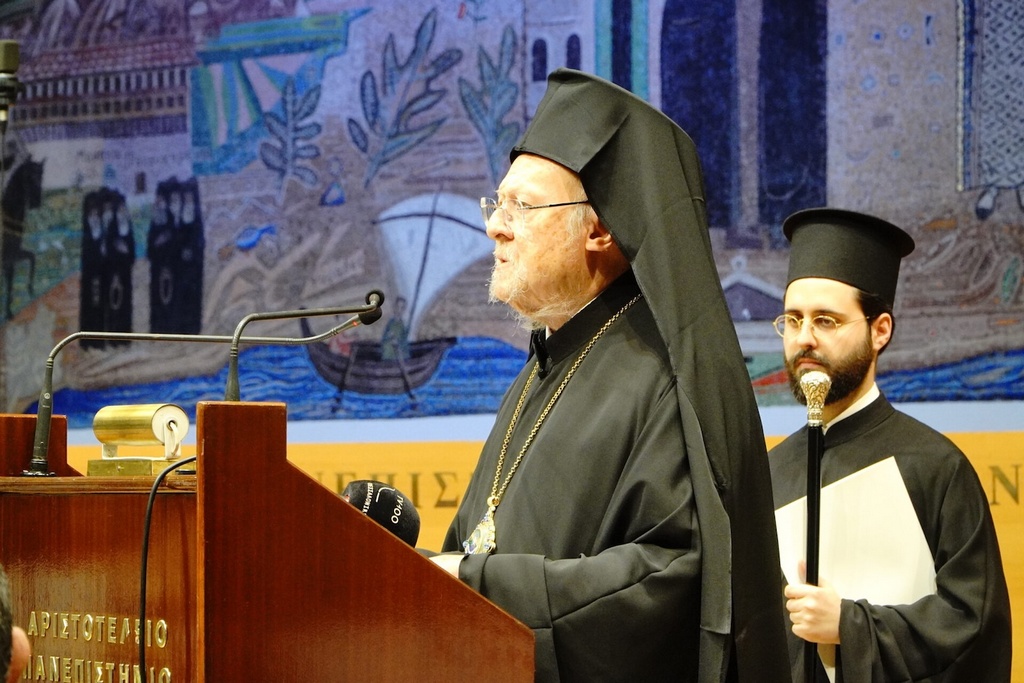
Throughout his lengthy and transformative ministry as Ecumenical Patriarch, His All-Holiness Ecumenical Patriarch Bartholomew has consistently emphasized the central importance of dialogue in search of unity among Christians and harmony among all people of good will. As he accepted an honorary doctorate from Dimitrie Cantemir Christian University in Bucharest, Romania in October 2025, His All-Holiness provided a comprehensive exposition of why dialogue is not an option, but a necessity, and a fulfillment of the will of our Lord and Savior Jesus Christ.
Countering claims that dialogue was simply a tool for attaining practical ends, His All-Holiness emphasized that “dialogue, for us Christians, is neither a political strategy nor a pragmatic tool of diplomacy.” On the contrary, he explained that dialogue is “a spiritual and theological imperative, a reflection of the very mystery of the Triune God, in Whom diversity and unity coexist in perfect communion and harmony by the primacy of love. When we encounter one another with prayerful respect and openness, seeing one another as living icons of the one God, we participate in that same divine life of communication and self-giving.”
His All-Holiness went on to say that engaging in dialogue was simply to follow the example of the Lord Jesus Himself: “In His earthly life, our Lord, God, and Savior Jesus Christ, the Incarnate Logos of God, stretched out His hands to all, inviting all into dialogue with Him, especially with those on the margins, be it a consequence of social rejection and isolation or social privilege and power. Christ encountered all people without prejudice from the Samaritan woman and the bleeding woman, to the lepers and the blind, the Roman centurion and the Pharisees, to Gentiles and Jews, to the faithful and the sinful.”
The Ecumenical Patriarch stressed the fact that these encounters of the Lord were meant to serve as, among other things, models for the Church to emulate: “Thus, the Holy Gospel, at its heart, is the story of God entering into dialogue with humanity and through humanity, seeking not condemnation but transformation, forgiveness, and salvation (cf. John 3:17). Consequently, the mission of the Church is nothing else than to proclaim the love of God in every moment of encounter manifested in dialogue and service of God and our neighbor.”
As is therefore altogether fitting, the Ecumenical Patriarchate has from the very beginning stood at the forefront of modern efforts at dialogue: “Since its 1920 Encyclical ‘Unto the Churches of Christ Everywhere,” the Ecumenical Patriarchate has been at the forefront of this call for dialogue, most notably through the modern ecumenical movement.” This was by no means simply a matter of preference or a historical accident: “As such, we have always understood the call to dialogue and unity not as a luxury, a preference, or an option, but as the fulfillment of Christ’s prayer, ‘that they may all be one, as You, Father, are in Me, and I in You; that they also may be one in Us, that the world may believe that You sent Me’ (John 17:21).”
Today, His All-Holiness reminded his audience, the Ecumenical Patriarchate continues to engage in dialogue with numerous Christians of other faith traditions: “The participation of the Ecumenical Patriarchate in the foundation of the World Council of Churches in 1948 and in various bilateral dialogues, with the Roman Catholic Church, the Anglican Communion, the Lutheran World Federation, and many others up to the present, is evidence of our Church’s efforts to live into Christ’s call of discipleship which has led us on an ecumenical journey marked by hope, truth, and perseverance.”
Patience, His All-Holiness also stated, was required: “Some may say that we are making slow progress in our ecumenical journey, that theological dialogue has reached an impasse. We must remember that true dialogue is a pilgrimage of love, not a negotiation of terms or a weighing of interests which, if it were so, would contradict the very nature of the Faith as incarnated and dynamic. As we journey with our neighbor, patience, humility, and truth-telling no matter the circumstances are imperative to true and fruitful dialogue. To paraphrase Saint John Chrysostom: ‘We do not conquer our brothers by argument, but by love.’”
The Ecumenical Patriarch also stated that for the Church of Constantinople, the imperative to dialogue was all the more urgent given the geographical and political circumstances of the Ecumenical Patriarchate: “For centuries, the Ecumenical Patriarchate has upheld its ministry of unity and synodality both within the Orthodox Church and outside of its ecclesial boundaries. Geographically and theologically situated at the crossroads of East and West, the Mother Church of Constantinople has learned to live in dialogue by necessity and by conviction. Even under constrained and difficult circumstances, the Ecumenical Patriarchate has never ceased to extend its hand in friendship to other Christians, to other faiths, and to all people of goodwill, just as it was affirmed by the Holy and Great Council of the Orthodox Church convened in June 2016 on the island of Crete.”
Dialogue, His All-Holiness concluded, was “not an abstract ideal, but a concrete act of hope.” He said that “in a world increasingly marked by polarization, fear, and isolation, dialogue remains the language of reconciliation, the language of the resurrection.”
The Archons of the Ecumenical Patriarchate remain grateful to God for the incalculable blessing of being able to follow His All-Holiness in speaking this blessed language of reconciliation and resurrection.