
Source: The National Herald
Most Americans, even within our community, know little about the once-vast Christian populations of the Near and Middle East – communities that once outnumbered the Christians of Europe. Today, they survive only as scattered remnants, mostly single-digit minorities east of the Mediterranean except in Lebanon; even there, the numbers dwindle. Among the most endangered are the indigenous Palestinian Christians, whose extinction now seems possible.
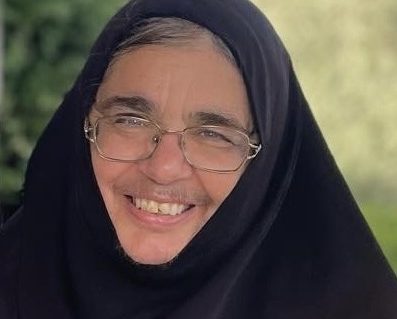
I recently spoke with Mother Agapia, a Russian Orthodox nun – an American who has spent most of her adult life in Jerusalem and the surrounding hills. Her voice carries both serenity and sorrow: the calm of prayer layered over decades of witnessing loss.
Born into a Greek Orthodox family in New Jersey, she discovered the Russian Orthodox tradition while studying in Michigan. She joined a small monastic community in Jordanville, NY, and later received a blessing to go to Jerusalem. In 1996, she entered the Convent of Saint Mary Magdalene on the Mount of Olives. “My first year felt like heaven,” she told me. “Prayer, obedience, liturgy, and the rhythm of bells.” The serenity of those early days did not last.
When I asked about the Russian Church’s role in the Holy Land – a role little known or understood in the United States – she responded with a concise history. The Greek Orthodox Patriarchate of Jerusalem is the canonical guardian of all Christian holy sites. In the nineteenth century the Russians, under Archimandrite Antonin Kapustin, bought extensive lands and built the Church of Saint Alexander Nevsky near the Holy Sepulchre. They functioned under the overall authority of the Greek Orthodox Patriarchate, but their wealth and numbers brought Russian influence as well. After the Russian Revolution, British-mandate authorities placed these properties under the ‘White Russian’ Church Outside Russia (ROCOR), cooperating with the Greek Patriarchate. When Israel became a state in 1948, it transferred the properties within its borders to the Moscow Patriarchate in gratitude for Stalin’s early recognition of the new Jewish state. Only those in Jordanian-annexed territory remained under the exiles. “We have always been part of Jerusalem’s fabric,” she said, “but rarely in control of our own thread.”
In 1998, Mother Agapia was assigned to administer a girls’ school in Bethany – al-Azariya in Arabic – the village of Lazarus, whom Christ raised from the dead. Founded in the 1940s for Christian girls, it had by then become overwhelmingly Muslim. “We had about three hundred students,” she said, “mostly Palestinian girls from families just trying to live normal lives.” Her convent lay two miles away, over the Mount of Olives. “The first abbess used to ride a donkey to class,” she smiled. The school still taught, to all its students, scripture and languages beneath icons and crosses hung on every wall. “No one ever objected,” she said. “In that time, we all still believed peace was possible.”
The period after the Oslo Accords in 1993, she remembered, felt almost hopeful. Palestinians and Israelis mingled freely; the wall did not yet exist. “People talked about peace,” she said. “Palestinians worked in West Jerusalem, and Israelis drove to Jericho on weekends for cheaper produce. You could imagine a future.” She remembers Elder Theodosios Makkos, a Greek priest revered by Muslim neighbors for saving young King Hussein during an assassination attempt decades earlier. “He was everyone’s hero,” she said. “We were respected because we respected them.”
Then came 2000. “Everything changed when Ariel Sharon went up to the Temple Mount,” she recalled. The Second Intifada erupted. Bethany lay in Area B – an area with no Palestinian police, no fire service, only a powerless local mayor. “They jack-hammered the road to Ramallah. Teachers couldn’t reach the school; some slept in classrooms. At three in the morning, jeeps came through shouting for everyone to stay indoors.” She paused. “You realize it doesn’t take many soldiers to control twenty thousand people if you keep them afraid.” Classes, prayers, even movement between convent and school became acts of courage. “Fear replaced prayer,” she said, “and faith became endurance.”
Not all her stories are grim. She spoke warmly of the quiet Russian-speaking Israelis who fill the convent chapel on Saturdays. “Many of them came under the Law of Return granting refuge to anyone who had one Jewish great-grandparent – and often an Orthodox mother still lights candles. They come quietly, whispering Slavonic hymns. They are Israeli by passport, Russian by culture, Orthodox by heart.” Their presence, she said, unsettles Israel’s tidy sense of religious identity. “They worship in silence, because their faith doesn’t fit the categories.”
When I asked about Western Christians, her tone sharpened. “American Christian Zionists,” she sighed, “love Israel but forget the Church that Christ left behind.” She spoke of pilgrims who disdain the Holy Sepulchre to pray instead at the ‘Garden Tomb’, a nineteenth-century invention that flatters their theology. “They support Israel politically,” she said, “but they don’t see the people who keep the lamps burning at Christ’s tomb. One day they’ll find the churches still standing – but empty.”
Over her twenty-five years in Jerusalem, Agapia has watched the city turn from pluralism to piety enforced. “Tel Aviv still feels European,” she said, “but Jerusalem belongs to the rabbis now.” Bus lines separate men from women; streets close on the Sabbath. “The politicians who were once on the fringe now run the country. Jerusalem used to breathe. Now it tightens.” Yet despite also being themselves victims of the ultra-religious, secular Israelis “just look away when Christians are harassed.”
Each return brings new shock. Apartments that once housed Christian or Muslim families now fly Israeli flags. “A Jewish family moves in, and soldiers guard the door,” she said. The intimidation feels both visible and legal. Around Jaffa Gate, church lands are under perpetual litigation. In Silwan, rebranded as the City of David, Palestinian homes are bought or seized one by one, funded by wealthy Americans like Irving Moskowitz and Sheldon Adelson, and by organizations such as Ateret Cohanim, which registers in the United States as a 501(c)(3) charity devoted to “redeeming Jerusalem.” “They call it redemption,” she said quietly, “but they mean replacement.”
Beyond the walls, the landscape itself testifies. When she first came to Bethany, Ma’ale Adumim was a small hilltop settlement; now it sprawls like a city. Four-lane highways carve through what were once open hillsides. “They call it development,” she said, “but it’s conquest by paperwork.”
Her voice softened when we spoke of numbers. “In 1948 Christians were ten percent of the population. Now, maybe two.” Israeli officials blame Muslim hostility or migration, but she sees exhaustion – families trapped between bureaucracy and hopelessness. “You can measure the decline in baptisms, in marriages, in courage.” Pilgrimage money once kept monasteries alive; now it barely keeps lights on. “It isn’t persecution in the old sense,” she said. “It’s erosion – a steady wearing away.”
She described the separation wall as “the scar across the Holy Land.” From her convent she can see it winding like a gray serpent through olive groves, looping around aquifers and farmland. “It doesn’t trace a border,” she said, “it cuts through families.” What once was a ten-minute walk between Bethlehem and Ramallah is now an hour’s drive through checkpoints. “We used to carry icons and bread to each other’s homes,” she said. “Now we carry ID papers.” Even Palestinian citizens of Israel are warned not to cross. She told of a Greek-American scholar who studied at Hebrew University for years but never dared visit Bethlehem because he was told it was dangerous. When he finally did – in Mother Agapia’s company – he wept as locals greeted him in Greek. “That’s what the wall does,” she said. “It divides souls as much as land.”
In the end, her story returns to faith. “We are not relics,” she insists. “We are the descendants of the first believers.” She remembers a gathering of young Christians near Jacob’s Well. One spoke of leaving to study medicine abroad; the others urged him to stay. “They know what they’re losing if they go,” she said. Some who study in Greece or Cyprus come home determined to serve as priests. “But the pressures – economic, political, psychological – are immense.”
Most Christians in America, she adds, have no idea such communities still exist. “They think we’re talking about ruins, not people.” Her warning is gentle but chilling: if the world remains indifferent, the Holy Land will become a museum of Christianity – its altars polished, its churches restored, but its believers gone. “The stones will outlast us,” she said, “but without the people who pray among them, they’ll have nothing left to echo.”