
Source: Christianity Today
Perplexed by America on Syria, Russian evangelicals and Middle East Christians debate if Moscow really cares.
JAYSON CASPER
War was swirling in Syria. Rebels were pressing. And Maan Bitar was the only hope for American help.
“Because I am evangelical, everyone thinks I have channels of communication,” said the pastor of the Presbyterian Church in Mhardeh. “Syrians believe the United States has the power to stop the conflict—if it wants to.”
In the early years of the civil war, Bitar’s Orthodox neighbors were desperate to convince the US and its allies to end support of rebel forces. Mhardeh, a Christian city 165 miles north of Damascus, was being shelled regularly from across the Orontes River.
But salvation came from a different source. Russian airpower turned the tide, and Syrian government-aligned troops drove the rebels from the area.
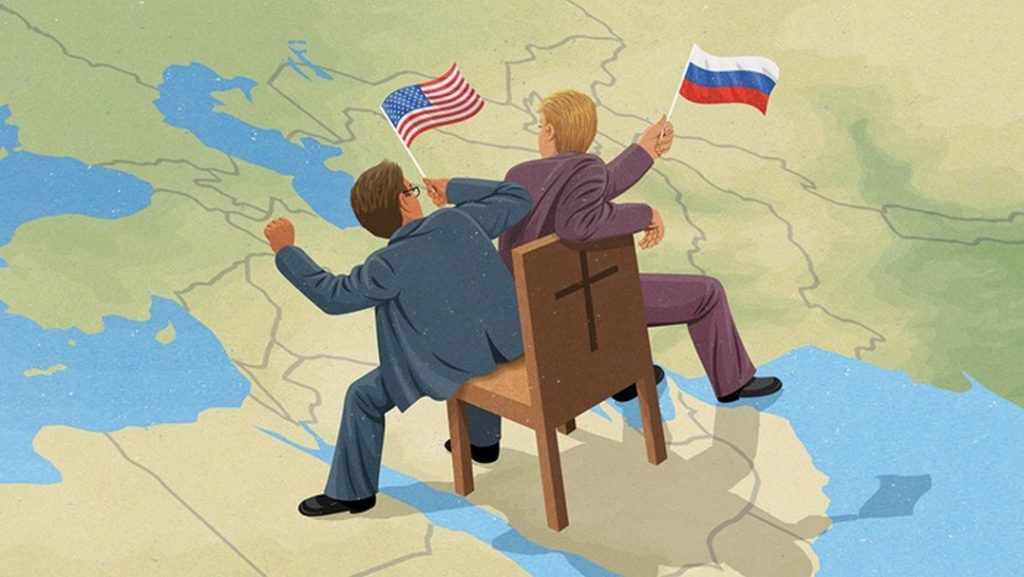
Russian intervention on behalf of Mideast Christians has pricked the conscience of many American evangelicals. Long conditioned to Cold War enmity, the question is entertained: Are they the good guys in the cradle of Christianity? Or are persecuted Christians just a handy excuse for political interests?
“The news tells us Russian troops are bringing peace to the region, said Vitaly Vlasenko, ambassador-at-large for the Russian Evangelical Alliance. “Maybe this is propaganda, but we don’t hear anything else.”
Created in 2003, the alliance represents all evangelical denominations in Russia. Before assuming his position, Vlasenko worked 11 years with local Baptists in their external relations department.
President Vladimir Putin, recently reelected with evangelical support, “is seen as playing a big role to protect the Christian faith,” said Vlasenko, “and a sense of international brotherhood is deep within the heart of Russian Christians.” He emphasized the historic bond between the region’s Eastern Orthodox churches and the 19th-century Russian wars in their defense against the Ottoman Turks.
By contrast, Russia’s Protestants are more locally minded and concerned to secure their own religious freedom in worship and evangelism, said Vlasenko. “But most evangelicals are like the Orthodox: supportive of Russia’s efforts to protect Christians in the Middle East.”
One example is Sergei Riakhovskii, lead bishop of the Pentecostal Russian Union of Christians of Evangelical Faith.
A member of several governmental councils to help convey the concerns of religious citizens, his church has forged strong connections with Syrian Protestants and organized several food convoys to aid the displaced.
“I still don’t understand the actions and statements of some American politicians,” said Riakhovskii. “If it were not for Russia, Christians in Syria might not have survived at all.”
Vlasenko cited local polls which show two-thirds of Russians view the United States as their enemy. Evangelicals are more open, believing Americans want peace.
But the US, viewed widely as an evangelical country, leaves them very confused.
“American policy has created chaos, giving oil to the fire of Islamic terrorism,” he said. “It is hard for Russian evangelicals to understand this.”
By contrast, Russian policy in the Middle East seeks to prevent the spread of radicalism, lest it spill over into its own Muslim citizens. Therefore, Russia sees itself as putting out fires—and expanding regional influence. Following President Donald Trump’s announcement to support Jerusalem as the capital of Israel, Moscow quickly offered to replace Washington’s role in brokering peace.
A recent Pew Research Center survey of five nations in the region found that about two-thirds of respondents support greater Russian involvement in the Middle East, compared to 10 years earlier. But though the survey did not include Syria or Iraq, only 35 percent of respondents viewed Russia positively. (Approval of the US was only 27%.)
But whereas a common Orthodox faith paves the way for good relations, American evangelicals have less understanding of traditional churches, said Salim Munayer, head of the Jerusalem-based Musalaha reconciliation ministry.
Russians, meanwhile, engage Palestinian businesses in the pilgrimage sector. And Russia’s oldest NGO has revived its pre-Soviet investment in local schools through the Imperial Orthodox Palestine Society, founded in 1882.
“Like local Christians, the Russians have real ties to the land, which they view as an icon—a place of veneration,” said Munayer.
“But we also need to remember that imperial powers use religious reasons to have a foothold.”
Russia, in many Christian eyes, is a balancing power to Israel-focused American interests, Munayer said. But local believers should not align too closely with either.
“Otherwise, we will bind ourselves in the trap of political interests, getting manipulated by one side or the other,” he said.
Still, Russia’s Syrian intervention is generally viewed as positive. “Many people believe it is good to have Russian reengagement in the region,” said Munayer. “But we know they will also pull out when it is politically convenient.”
Like Munayer, Philip Madanat of Jordan believes local sentiment esteems Russian policy without buying the religious argument. It is the regime, not the Christians, they care about.
But the evangelical specialist in religious movements sees another factor at play: cross-pollination.
Thousands of Mideast Christians went to study in Russia during the Soviet era, he said. Madanat’s own uncle was secretary-general of the Jordanian Communist Party.
They returned with esteem for the nation that enabled their education, and played key roles in Middle East business and political development.
The children of this generation are now tuned culturally to America, he said, especially in Jordan with its strong US ties. But the fathers’ influence lingers, and has galvanized behind Putin’s charisma.
“We see him as someone who wants to recapture Russia’s lost glory, which was Christian,” Madanat said. “This is attractive to many people here.”
Munib Younan agrees there is an emotional connection to Russia given its Syrian policy and American bias towards Israel.
Recently succeeded as bishop of the Evangelical Lutheran Church in Jerusalem and the Holy Land, Younan stood with Middle East church heads to warn Trump not to move the US embassy.
But he has no opinion if the Russian or American government is “better.”
“Frankly, I don’t see any difference. I don’t know if they care for us or not,” Younan said. “Everyone claims it, but I don’t see anything tangible.”
Outside nations have their own interests, while local Christians are an integral part of their people, he said. They need justice, not protection.
Meanwhile, the struggle between outside nations—including Turkey, Iran, Israel, and the Gulf states—is tearing the region apart.
“Syria is a cake divided,” he said, “and the losers are the people.”
Back in Mhardeh, Bitar asserts these people are looking for anyone to bring them peace. And if Russian evangelicals are right, this is the same desire of Americans.
So within the soul-searching of Christian solidarity and cold geopolitics, Bitar, finally, can meet the assumption of his Orthodox neighbors.
“America can have many friends if she changes her policies,” he said. “But if she doesn’t, let us look to Russia.”
Jayson Casper is a Cairo-based correspondent for Christianity Today.