
Close Menu
    Facebook X (Twitter) Instagram
    Trending
    • #Giving Tuesday – Support Orthodox Christian Laity!
    • Together We Thrive: OCL Annual Conference & Year-End Giving Campaign
    • Archon Officers Participate in Historic Pilgrimage to Nicaea
    • Ecumenical Patriarch Bartholomew and Pope Leo recite the Creed together during 1700th Anniversary of Nicaea
    • Mission Center Board Convenes
    • The “Orthodoxy as Masculinity” Narrative
    • Walk with Us: Orthodox Volunteer Corps (OVC)
    • St. John Chrysostom’s Legacy: From Antioch to America
    Orthodox Christian Laity
    Facebook X (Twitter) YouTube
    • Home
    • OCL
      • About OCL
      • Leadership
      • OCL News
      • OCL Publications
      • Focused Study and Research Topics
      • OCL Archives at DePaul University
    • Orthodox News & Links
      • Orthodox News Stories
      • Headlines & News Archives
      • Governance & Unity
        • Governance Top Stories
        • Governance & Unity Essays
        • Grassroots Unity in Action
      • OCL Forums
      • Orthodox Christian Laity News
      • Web Links
    • Audio & Video
      • Audio Index
      • Video Index
    • Contact
    • Make a Donation
    Orthodox Christian Laity
    You are at:Home»Orthodox News»Why Is Poverty-Stricken Romania Building So Many Churches?

    Why Is Poverty-Stricken Romania Building So Many Churches?

    0
    By Webmaster on August 7, 2013 Orthodox News, Orthodox News Top Stories
    Share
    Facebook Twitter LinkedIn Pinterest Email Telegram WhatsApp Copy Link
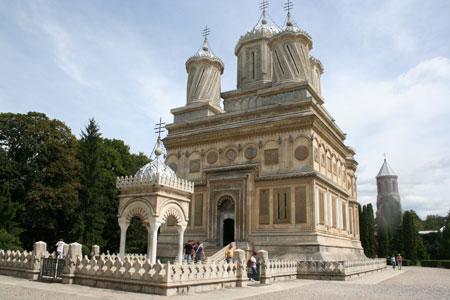
    Curtea de Arges Monastery http://www.atlantaserbs.com
    Curtea de Arges Monastery http://www.atlantaserbs.com

    Source: International Business Times

    By Palash Ghosh

    The Eastern European nation of Romania, one of the poorest states in the European Union, takes its religious faith very seriously. An overwhelmingly Eastern Orthodox nation (which claims at least 86 percent of the population as adherents), Romania has undertaken an aggressive campaign to build an extraordinary number of churches across the country, regardless of expense.

    According to a BBC report, about 10 new churches are built every month in the country – or one every three days — with a huge cathedral currently under construction in the center of the capital city of Bucharest. When it is finished, the 125-meter (410-foot) Cathedral for the People’s Salvation is expected to become the tallest house of worship in southeastern Europe (larger than former Communist dictator Nicolae Ceausescu’s massive Palace of the People, which stands next to it). The rapid expansion of churches reflects the resurgence of the Orthodox Church in the country’s political and cultural life, almost 25 years after the fall of the repressive Ceaușescu regime.

    However, some in Romania question the wisdom of spending enormous funds from the public treasury to construct so many churches in a nation where one-fifth of the population lives below the poverty line and almost one-fourth of people under 25 are jobless. Moreover, earlier this year, the Social Democratic government of Prime Minister Victor Ponta unveiled a new series of austerity measures, on top of four years of aggressive spending cuts, wage and pension reductions and increasing poverty – all in exchange for a €20 billion ($26.6 billion) loan from the International Monetary Fund and the European Union in 2009.

    But apparently the Romanian government has not reduced the money it gives to the Orthodox Church. According to reports, state officials hand out more than 100 million euros annually to the church to pay for priest salaries and other expenses, including the renovation of existing church properties and the construction of new churches. Churches also receive funds from local government councils, state-controlled companies and the parishioners themselves. Remus Cernea, head of the country’s Green Party and an MP, complained to the BBC: “In Romania we have a big problem between church and state. My view is that if the church wants to build something it’s OK until the money for the building of this church is the money of the people, of the state — public funds.”

    Cernea contends that the church is too closely linked to senior government officials. “In many cases politicians give public funds to churches and in exchange the priests support them in electoral campaigns,” he said. “Often you see the construction companies who build the churches owned by people who are very close to the politicians. So it’s a kind of circle of money.”

    In addition, the proliferation of churches is particularly perplexing in light of the country’s negative population growth rate (an annual decline of 0.2 percent, said the World Bank).

    But perhaps Romania’s recent history explains this frenzy in church-building. Romania’s church hierarchy had a torturous relationship with the Communists. While Ceausescu’s Marxist regime damaged and destroyed many churches, many clerics went along with the state in order to avoid purges. In any case, since 1989, after the fall of the Communist regime, the Orthodox Church has enjoyed a huge recovery.

    Victor Opaschi, Romania’s minister of religious affairs, explained that the government was obligated to return the church to prominence. “The Communists took from the church and it lost nearly all its property,” he said. “Now the state is trying to compensate for this by giving back a small proportion of what it has taken.”

    Nowhere in Romania is the obsession with churches greater than in the northeastern town of Târgu Ocna. According to Actmedia, a Romanian business news agency, this town of about 14,000 people boasts some 27 places of worship (in another words, 19.3 churches per every 10,000 residents).  In comparison, the southern U.S., the so-called Bible Belt, has about 15.4 churches for every 10,000 residents, according to Associated Press. Most of the holy sites in Targu Ocna are more than 100 years old, with some — including St. Paraschiva Church and Raducanu Fortified Church — well over 200 years old.

    “The high number of worship sites in the town reflects the intense public life and a series of historical events that took place in this town, which has seen an outstanding cultural effervescence for over three centuries,” Mayor Stefan Silochi told AGERPRES agency.

    Related Stories
    Romania’s costly passion for building churches – BBC

    [subscribe2]
    Share. Facebook Twitter Pinterest LinkedIn Tumblr Email WhatsApp Copy Link
    Previous ArticleWorries Grow About Fate Of Kidnapped Syrian Bishops
    Next Article Pilgrims gather in Kodiak to honor St. Herman

    Related Posts

    December 1, 20251 Min Read

    Together We Thrive: OCL Annual Conference & Year-End Giving Campaign

    November 22, 20253 Mins Read

    Mission Center Board Convenes

    November 20, 20253 Mins Read

    Walk with Us: Orthodox Volunteer Corps (OVC)

    Leave A Reply Cancel Reply

    This site uses Akismet to reduce spam. Learn how your comment data is processed.

    Sign the Declaration for Orthodox Unity – click here…

    Register for OCL's Annual Conference - October 11, 2025

    Sign the Declaration for Orthodox Christian Unity

    Enter the Slogan Contest

    Share this page
    DISCLAIMER

    All articles represent the views of the authors and  not necessarily the official views of Orthodox Christian Laity (OCL). They are posted to encourage thoughtful discussion on topics and concerns relevant to Orthodox Christians living in a pluralistic society. OCL encourages your comments.

    Stay Informed!

    Subscribe to our Newsletter

    WE WELCOME YOUR INPUT AND SUPPORT!

    Your donation impacts and helps advance the unity of the Orthodox Church of America.

    DONATE NOW

    THANK YOU FOR YOUR CONTINUED SUPPORT!

    Upcoming Events
    Notice
    There are no upcoming events.
    Recent Comments
    • George Warholak on Ecumenical Patriarch Bartholomew and Pope Leo recite the Creed together during 1700th Anniversary of Nicaea
    • Dn Nicholas on Ecumenical Patriarch Bartholomew and Pope Leo recite the Creed together during 1700th Anniversary of Nicaea
    • Dana C Purnell on Ethiopian Bible is the oldest and complete bible on earth
    • Peter on Abp. Elpidophoros installed as National Council of Churches board chair
    • james wiliams on Video: A Vision for Orthodox Christianity’s Future in North America
    • Veras Coltroupis on Abp. Elpidophoros installed as National Council of Churches board chair
    • Joe Forzani on Ancient Christianity (Free Course) – Hillsdale College Online
    • Joe Forzani on Ancient Christianity (Free Course) – Hillsdale College Online
    • sandy myers on Ethiopian Bible is the oldest and complete bible on earth
    • Peter on Unity in the Orthodox Church
    OCL Archives Online
    Project for Orthodox Renewal
    renewal-resize
    OCL Digital Newsletter

    Subscribe to our Newsletter

    MAKE A DONATION

    Sign the Declaration for Orthodox Christian Unity

    Facebook
    Twitter
    YouTube

    St. Symeon the New Theologian and St. Photini are the Patron Saints of OCL

    footer-fnl

    Orthodox Christian Laity
    PO Box 6954

    West Palm Beach, FL · 33405
    561-585-0245

    ocladmin@ocl.org (or) orthodoxchristianlaity@gmail.com

    Sponsored by Ann Souvall in memory of husband George

    DISCLAIMER: All articles represent the views of the authors and  not necessarily the official views of Orthodox Christian Laity (OCL). They are posted to encourage thoughtful discussion on topics and concerns relevant to Orthodox Christians living in a pluralistic society. OCL encourages your comments.

    ©2025 Orthodox Christian Laity (OCL) ·  Login

    Type above and press Enter to search. Press Esc to cancel.