Source: Public Orthodoxy
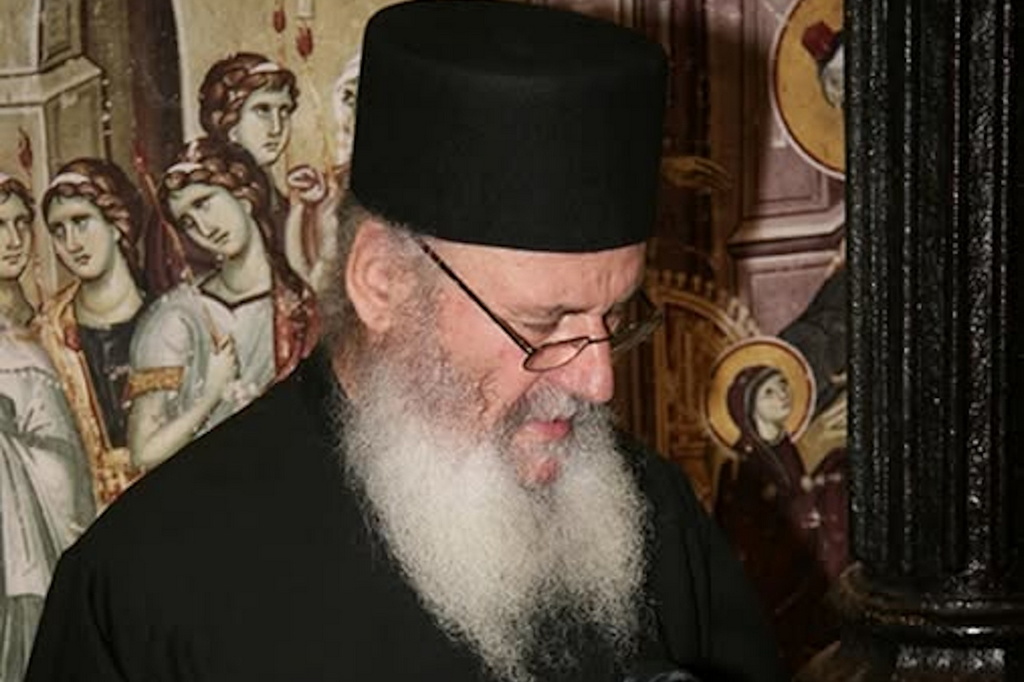
You cut through the silvery—gold sea at the foot of Mount Athos to make the funeral service of Archimandrite Vasileios Iverites,[1] and through countless dizzying thoughts, your mind is nailed for a moment on the hymn of the Vespers on Palm Sunday: “Today the grace of the Holy Spirit has gathered us together…”[2]
For forty years, the figure of Elder Vasileios has been engraved in you, so familiar that you felt you were not taking a trip to Mount Athos but returning to it. You often felt, when he spoke, that you were not comprehending his words but sharing immediately in his own experience of the otherworldly and transcendent, which articulated and enriched them. His speech and writing in present tense resemble liturgical texts, in the sense of time as “a moving image of eternity”[3] which in the Church places all beings in an “ever-moving repose” and “stationary self-moving.”[4]
In his presence, you breathed a freedom of a different order, one not confined to logical assertions. His face radiated a grace of such firsthand power and charm you forgot yourself and were reminded of the way St. Dionysius the Areopagite describes the ecstasy of divine love in On the Divine Names.[5] Rarely does a human being have the power to attract you in such a transcendent way, radiating a gentle goodness and beauty which cannot be described but only participated — a participation surprising and strange, yet desirable as completely familiar.
He did not issue instructions but rather spoke to you in the manner of a sort of Heraclitus in Christ, like the Oracle of Delphi, which neither speaks nor hides, but “signifies.”[6] His style was a sort of negating of affirmations, and an affirmation of negations, as articulated by St. Maximus the Confessor in the Mystagogy[7]—a higher mathematics of another logic, an Orthodox dialecticism in reverse. As Archimandrite Vasileios writes in his Impressions, “When a saint speaks to you about Hell, you smell the fragrance of paradise. When a misguided person describes paradise to you, you freeze from the cold of Hell.”[8] It is an unparalleled form of wit, built of dizzying contrasts, and the intertwining of negative and affirmative discourse.
Elder Vasileios was a philosopher, a scientist, a craftsman, an intellectual, and a poet—not in the sense of a bearer of fragmented, specialist knowledge, but rather as a receiver of the concentric manifestations of the One “of whom there is need” (Luke 10:42). He was a theologian, not as a “God-talker” but as a revealer—in as much as you could bear it—of God the Logos, Christ. As a liturgist, he did not draw attention to himself but revealed the rational worship of the Holy Eucharist as a hierurgized theurgy.
He loved you so much that as he dealt with you, you felt your being take on a value and meaning that you alone could not give it. He was the reason why, as a spectator of holiness, you felt the desire to become a participant. At times, you felt as though the radiance of divine love on his face was reflecting within yourself, bathing you in such a light of freedom that you did not want to resist the dew of the Spirit.
He did not assail the logicality of your free will but freed you from the irrational reasoning of your involuntariness. He did not impart information to you, but experience. He did not shape your thinking but initiated you into true freedom. He did not seek to give you something of his own, but to help you commune with the Source of All. He did not refer you to the writings and achievements of his spirit but introduced you to the wealth of others—of the great ones.
He did not speak to you so that you would understand, but so that you would take action. He did not guide you as a follower but led your mind to rest. He neglected nothing and no one but saw in everyone and everything their Christ-likeness and God-likeness. For even evil is dependent on the Good, as it draws its being from it, as the Areopagite testifies.[9] He was not interested in enrolling you in a school of thought but in helping your mind to be at leisure (scholē), to be still: “Be still and know that I am God…”[10]
He did not judge you for what you are but discerned what Christ wants you to become. He did not tidy you up in small matters but stretched you in great matters. He did not solve your intellectual aporias but gave you ascetic experience. He did not teach you the divine but experienced it and revealed it to you according to your own ability to endure it. He did not preach the Uncreated to the created but served as a bridge between them.
You are grateful to him not for the answers he gave you, but for the unexplainable things he uttered to you. You grieve at his passing; but you rejoice in the certainty that he is present, as he promised a monk at the Monastery of Panagia Portaitissa shortly before the end: “I will leave, but I will be returning here. I will be watching over everything, without you bothering me – without me bothering you!”
It was necessary that he depart, in order that you might realize that the second person singular of his spoken and written words was a cover and a concealment of his own first-person experience.
“Now all things are filled with Light,”[11] Elder Vasileios!
The author extends his gratitude to Alex Petkas (Dallas) and Nathaniel Wood (Public Orthodoxy) for helping with translating a rather difficult Greek text originally published in Kathimerini.
[1] Archimandrite Vasileios (Michail Gontikakis, 1936–2025) was the former Abbot of the Holy Monastery of Iviron, Mount Athos.
[2] Σήμερον ἡ χάρις τοῦ Ἁγίου Πνεύματος ἡμᾶς συνήγαγεν…
[3] Plato, Timaeus 37d.
[4] Maximus the Confessor, Questiones Ad Thalassium, PG 90, Scholia 44; 781a–c: στάσιν ἀεικίνητον λαβοῦσα τὴν ἀπέραντον τῶν θείων ἀπόλαυσιν καὶ κίνησιν στάσιμον τὴν ἐπ᾽ αὐτοῖς ἀκόρεστον ὅρεξιν.
[5] Dionysius the Areopagite, De Divinis Nominibus, PG 3; 712a: ἔστι δὲ καὶ ἐκστατικὸς ὁ θεῖος ἔρως οὐκ ἐῶν ἑαυτῶν εἶναι τοὺς ἐραστάς, ἀλλὰ τῶν ἐρωμένων.
[6] Heraclitus, Fragment D41 (B93): ὁ ἄναξ οὗ τὸ μαντεῖόν ἐστι τὸ ἐν Δελφοῖς οὔτε λέγει οὔτε κρύπτει ἀλλὰ σημαίνει.
[7] Maximus the Confessor, Mystagogia, PG 91; 664bc.
[8] Ἀρχιμανδρίτης Βασίλειος, Ἀποτυπώματα [Imprints, in Greek], ῾Ιερά Μονὴ Ἰβήρων, Ἅγιον Ὄρος, 2025, (21).
[9] Dionysius the Areopagite, De Divinis Nominibus, PG 3; 716c: οὐ πάντη κακὸν τὸ κακόν, ἀλλ᾽ ἔχει τινὰ τἀγαθοῦ, καθ᾽ ἣν ὅλως ἔστι, μοῖραν.
[10] Psalm 46:10.
[11] Paschal Canon, Ode 3, opening of the second troparion: Νῦν πάντα πεπλήρωται φωτός.