
Source: Hellenic College | Holy Cross Greek Orthodox School of Theology
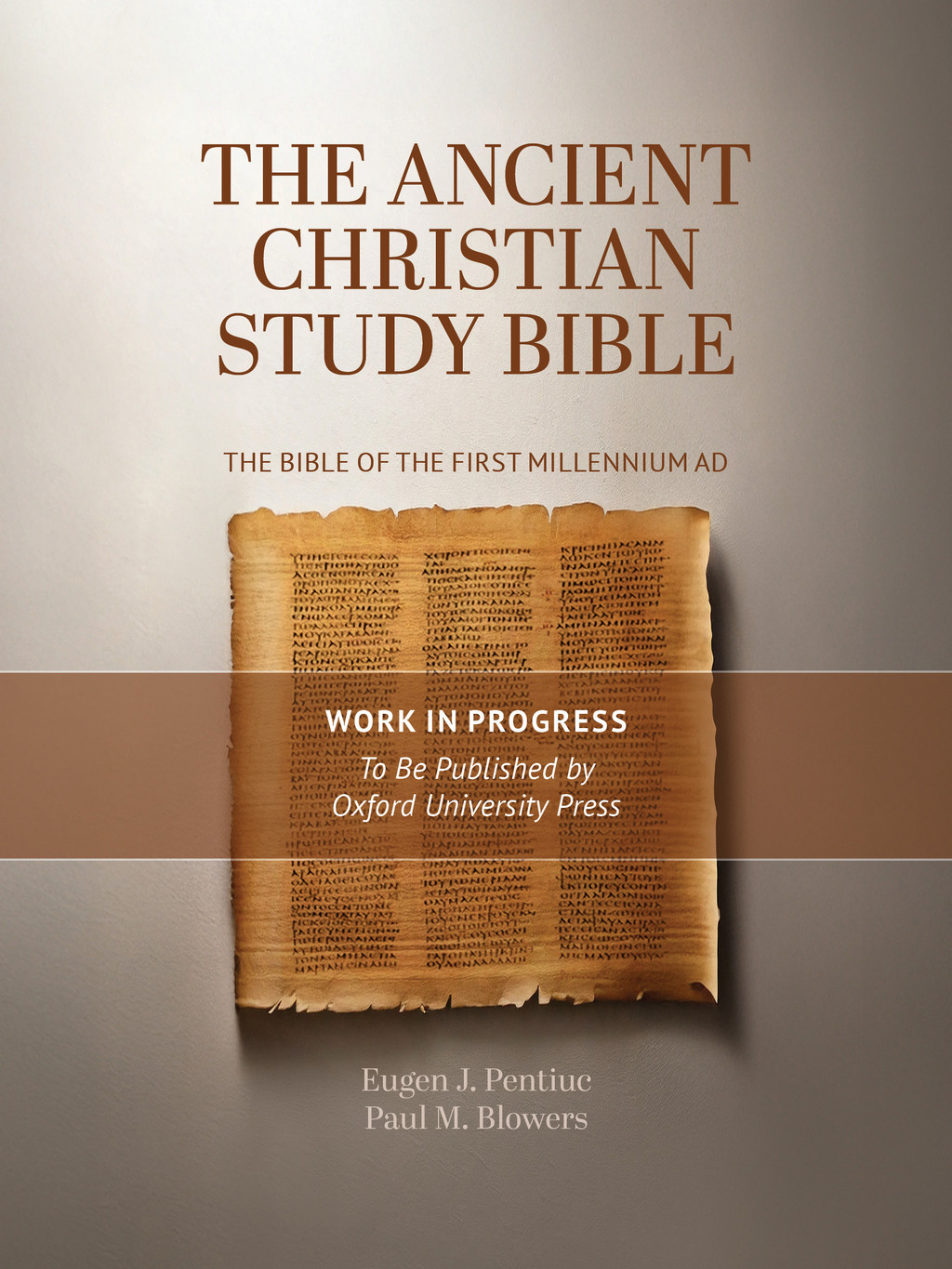
In the summer of 2024, Oxford University Press (OUP) issued a contract for a new study Bible entitled The Ancient Christian Study Bible (ACSB), with the following Editorial Board:
Editors-in-Chief:
Fr. Eugen J. Pentiuc, Archbishop Demetrios Distinguished Professor of Biblical Studies and Christian Origins and Dean of Holy Cross Greek Orthodox School of Theology, Brookline, MA Paul M. Blowers, Dean E. Walker Professor of Church History, Emmanuel Christian Seminary, Milligan University, TN
Associate Editors:
Athanasios Despotis (Bonn University: New Testament), Mary Farag (Princeton Theological Seminary: Early Christian Studies), David Stark (Faulkner University: Hermeneutics), Agnethe Siquans (University of Vienna: Old Testament), Samuel Pomeroy (University of Tennessee: Patristics)
Fifty-three leading international scholars will contribute their expertise to the ACSB project to prepare a new authoritative study Bible, which will stand alongside the other three others already published by OUP:
- The New Oxford Annotated Bible (NOAB) edited by Michael D. Coogan
- The Catholic Study Bible (CSB) edited by John J. Collins, et al.
- The Jewish Study Bible (JSB) edited by Marc Zvi Brettler, et al.
And now the fourth study Bible to be published by OUP: The Ancient Christian Study Bible: The Bible of the First Millennium AD.
“A study Bible is a book of consummate scholarship that distills the best of current research and knowledge for contemporary readers and their posterity. This new Ancient Christian Study Bible will capture the insights of the modern academy and the wisdom of the ancient Church to lead readers deeper into the meaning of Scripture and the contemplation of God’s Word, Jesus Christ,” said HCHC President Dr. Demetrios Katos. “It is the brainchild of the Dean of our Theological School, Fr. Pentiuc and there is nothing more gratifying than knowing one of our own conceived this project and will lead it to completion.”
With an ecumenical focus, evidenced through its scope and contributors, the ACSB will appeal to a broad audience seeking excellence in scholarship deeply rooted in ancient Christian biblical interpretations, as penned by the Church fathers and ecclesiastical writers of the first millennium of church history.
The ACSB will use as textual bases the Septuagint text (Vaticanus Codex) for the Old Testament, and the Byzantine Textform (Patriarchal Text, Constantinople, 1904) for the New Testament.
In addition to the translation initiative, what makes the ACSB unique among other OUP Study Bibles, and other similar products on a global scale, is the inclusion of synthetic patristic notes. These notes are focused on pericopes and are not a line-by-line commentary. They are scholarly, but accessible, summaries of dominant strands of early Christian understandings of the biblical text. The synthetic patristic notes represent 80 percent of all annotations. It can be further understood in the following breakdown:
(1) Textual Notes, showing the major theological differences between the Septuagint and Hebrew Text, Peshitta (Syriac), Vulgate (Latin), and later Jewish Greek translations such as Aquila, Symmachus, and Theodotion, emphasizing variant differences within the Septuagint textual transmission among various codices (Vaticanus, Sinaiticus, and Alexandrinus) and Greek manuscript fragments, with respect to the Old Testament, and the variety of Greek readings, regarding the New Testament;
(2) Exegetical Notes, assisting the reader to more accurately understand the plain-historical meaning by reconstructing the historical, cultural, and literary context of each biblical pericope; and
(3) Patristic Notes, showing the reader how the Scriptures were interpreted by the Church fathers and ecclesiastical writers in the first millennium. Hermeneutical creativity and Nachleben (i.e., the use of the ancient interpretations in supporting the Church’s teachings) will be used as the criteria for selecting patristic interpretations.
Building on earlier efforts (e.g., Orthodox Study Bible, Thomas Nelson, 2008, for which Fr. Pentiuc was a General Editor), ACSB will offer a brand-new English Bible translation from the Greek Old Testament (Vaticanus) and the New Testament Patriarchal Text accompanied by copious patristic annotations – all contained in a single volume.
This landmark project will also integrate other supplementary material borrowed from the latest NOAB edition, such as, essays, maps, diagrams, and tables, and a substantive selection of new essays fitting for a patristic annotated Bible, thus enabling the reader to more fully understand Scripture in its original context as well as in the tradition of the ancient church.
The stated goal of the ACSB is to “connect the Greek text of the Bible with patristic annotations for a modern English-speaking educated public.” In addition, the ACSB will be the premier patristic Study Bible for use by Orthodox clergy, scholars, students and faithful, as well as those interested in ancient Christian interpretation of Scripture.
The ACSB project is now on phase two: translating the Greek Bible into English and writing the annotations.
Contributors
(Translators/Annotators) Book(s)
Valentin Andronache 1 John
Athanasios Antonopoulos Acts
Daniel Ayuch Luke
Michael Azar Hebrews
Dan Batovici 1, 2 Peter
Leslie Baynes Revelation
Adam Bean Ecclesiastes
Bruce Beck Jonah
Anthony Bibawy 1, 2 Chronicles
Paul M. Blowers Genesis 1–12
Nenad Božovič 2 Maccabees
James Wallace Buchanan 2 Corinthians
Jeff Childers Tobit
Sara Contini Leviticus
Evangelia Dafni Sirach
Miriam DeCock James
Athanasios Despotis John
Sotirios Despotis 1, 2 Timothy, Titus
Michael Dormandy 2, 3 John
John Anthony Dunne Esther
Oliver Dyma Joel, Obadiah, Nahum, Habakkuk, Zephaniah, Malachi
Laura Locke Estes Genesis 12–37, Jude
Mary Farag Coptic, Arabic annotations for Matthew, Luke, Revelation
Alberto Ferreiro, Micah, Haggai, Zechariah
Justin Gohl Psalms, Song of Songs, Psalms of Solomon
Michael Graves Exodus
Najeeb T. Haddad 1 Maccabees, Colossians
Jordan Henderson 4 Maccabees
Samuel Johnson Matthew
Christos Karagiannis 1, 2 Kings
Christos Karakolis 1, 2 Thessalonians
David Kiger 1, 2 Samuel, Ezra, Nehemiah
Matthew Kraus Numbers
Michael Legaspi Proverbs, Job, Wisdom
Aashu Alexander Mattackal Ephesians
Brian Matz 1 Esdras
Martin Meiser Galatians
Alex Mihaila Joshua
So Miyagawa Deuteronomy
Jeremiah Coogan Mark
Porfyrios Ntalianis Amos
Daniel Olariu Daniel (Additions to Daniel: Bel and the Dragon, Susanna)
Athanasios Paparnakis
Jeremiah (Epistle of Jeremiah), Baruch, Lamentations
Maria Pazarski 3 Maccabees
Eugen J. Pentiuc Hosea
Constantin Pogor Judges
Samuel Pomeroy Genesis 38–50
Mark Reasoner Romans, Philippians
Agnethe Siquans Ruth, Judith
David Stark Philemon
Laurence Vianès Ezekiel
Clifton Ward Isaiah
Chris L. de Wett 1 Corinthians
Essays Writers
Paul M. Blowers: Greek Patristic Interpretation of the Bible
Athanasios Despotis: Ancient Greek Philosophy’s Impact on Ancient Christian Biblical Interpretation
Mary Farag: Biblical Interpretation in Oriental Churches (Coptic, Ethiopic, Syriac, and Armenian)
Eugen J. Pentiuc: The Biblical Canon in Eastern Byzantine Church
Samuel Pomeroy: Christian Reading, Studying, and Praying the Greek Psalter; and Latin Church Fathers and Biblical Interpretation
Agnethe Siquans: Hermeneutics and Methods of Patristic Biblical Interpretation
David Stark: Reading Scripture through the Tradition in the Twenty-First Century
An accessible one-volume, ACSB is expected to be published by the end of 2027.