
Source: Public Orthodoxy
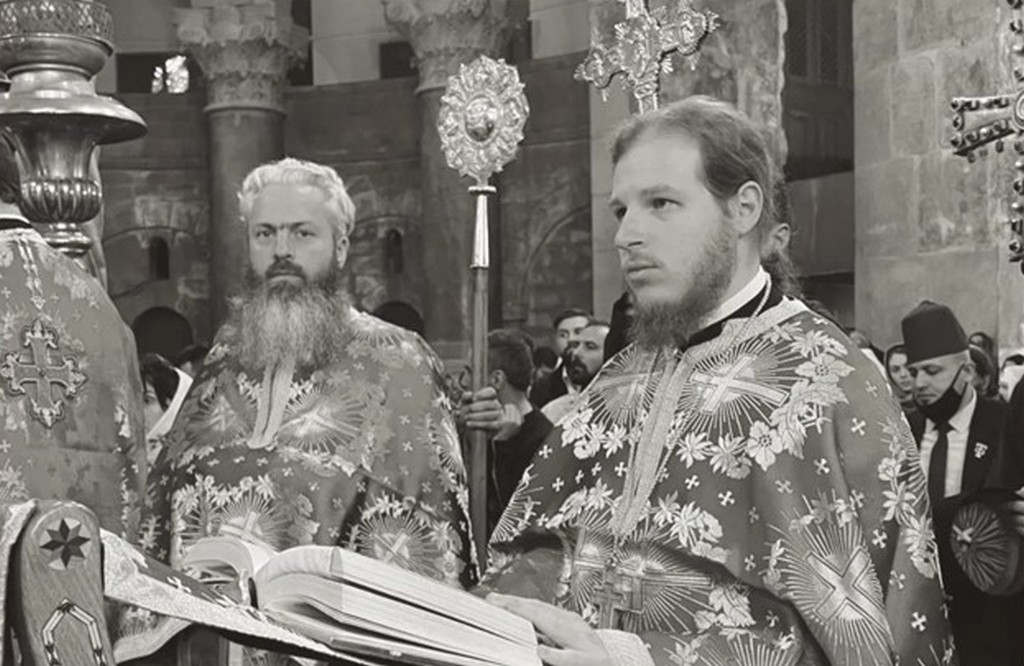
On February 7th, 2023, still a priest of the Russian Orthodox Church, I boarded a plane and left the Holy Land, where I was serving as a member of the Russian Ecclesiastical Mission in Jerusalem (REM). Only after landing in Antalya (Turkey) did I publish a post on social media in which I announced my departure from the Russian Orthodox Church (ROC) and my intention not to return to Russia. This was preceded by months of heavy reflection and, I will not hide, moral uncertainty.
I became a practicing Orthodox Christian in 2008, when I was studying at the Polytechnic University in St. Petersburg. After entering the St. Petersburg Theological Academy, I had “anti-intellectual” sentiments at first. But already in during my masters studies, analyzing the ecclesiology of Metropolitan John (Zizioulas) of Pergamon, I felt a renewed affection towards knowledge, this time humanistic, and I’ve seen my future as primarily connected with academia. After completing my masters degree at the Theological Academy and entering the postgraduate program, I was sent first to Greece to study the language and then to Cyprus for one more masters program.
While in Cyprus, I received an offer to continue my ministry in Jerusalem. The reasons were simple: my being a hieromonk and fluent in modern Greek. At that time, I knew close to nothing about the REM, but I accepted the offer gladly. From the age of 12, I’d been coming to Israel to visit my grandparents for the summer, until my grandmother’s death.
Ministry in Jerusalem did not stop me from working on my masters thesis in Cyprus and encouraged me to continue my research, specializing in the ecclesiology of St. Augustine. My work was aided by learning about the life of the Jerusalem Orthodox Church and of the different Christian communities of the Holy Land. In my Hebrew courses, I enjoyed interacting with fellow students of very diverse cultural and religious backgrounds.
The very idea of violence, the idea of war per se, is foreign to me, as it probably is to many Christians. However, the world is full of violence, and armed conflicts are somewhere out there all the time. I must confess that not all of them concern me in the same way. There are certainly some particularly sensitive people who always very much affected by the news of a tragedy, wherever it occurs. Many of us are probably saddened by injustice and cruelty, but, by and large, do not think deeply and seriously about wars. In other words, we have a choice to remain internally unattached to a tragedy, and moreover, this right to remain a non-participant is usually passive.
But where are those boundaries? When can I not dismiss the war anymore? When it is no longer possible to remain uninvolved? While it is possible not only to remain passively uninvolved in military actions on the opposite side of the world, and sometimes even not to know about them at all, the Russian-Ukrainian war, which has been going on in fact for several years and which entered its hot phase on February 24th of 2022, has become an extremely acute problem for me.
When the open warfare broke out, the culture of hatred filled literally everything, and it was impossible to remain unaffected by it. It became incompatible with my Christian conscience. The worst manifestation of this culture was the justification of murder and even the blessing of murder by the ROC.
The ROC clergy have been stripped of their “passive right of non-participation” in the culture of hatred after the first prayer on the war in Ukraine was circulated and is still recited in some Moscow Patriarchate parishes outside Russia. In general, the prayer was streamlined and contained only hints of wishes for military victory, but one phrase stood out: “Forbid the foreign nations, who want to fight and oppose Holy Rus’, and overthrow their plans.” Prayer for a Christian is truly an action, requiring us to be involved in the words pronounced, and often contains doctrinal elements. Therefore, even such a prayer required, at the very least, a special intellectual effort to convince oneself that the confusing phrase referred not to the “collective West” but to the Russian troops invading Ukraine.
I regret that I did not have the courage or moral strength to publicly confront what I did not agree with. Therefore, I read this prayer almost all the time, inside myself conducting the very mental exercises that attributed the words about foreign nations to the Russian army. I could only allow myself not to recite it when I served at the metochion of REM in Jericho, where there was no one who could notice it and report it to my superiors. At every liturgy and morning prayer service in the Mission this prayer was always recited, including when I was the officiating priest. My actions were dictated by only one desire: not to give away my views and not to enter into an open conflict with other members of the Mission.
But as time went on, this prayer and then the Patriarch’s words in support of the war, the awarding of Church honors to the participants of the invasion, and the absence of words of compassion and condolences to the Ukrainians who suffered from the military actions—all of this troubled my conscience and led to the realization of my personal involvement in what was happening. Every day it became clearer and clearer that my Christian conscience demanded a more active anti-war stance.
Yes, I was scared for a long time. I could hardly admit it to myself, I hid behind a wall of sarcasm, but I was still afraid. It was painful and shameful for me to stay silent in response to everything that was being done and said around me on behalf of the Russian Church. I was also afraid to say anything in response, because I believed that I would be ostracized. So, I built up the pain in myself, suppressing the desire to speak according to my conscience, breaking through when I talked with those who understood me. These were mostly my longtime close friends from Russia, the majority of whom did not belong to the clergy. Although even among my classmates from the Academy there were those who were against the war, and even those who signed the famous letter of 300 clergymen, I did not dare to speak to them, not wanting to put them in danger with my precarious talks. But even to communicate with those whom I trusted and whose safety I did not doubt, I went far away from the Mission so that no one could hear me. All the while I was truly saved by my Jerusalem friends and classmates, some of whom were not even Christians, but who showed sympathy and support that was not always available from my co-believers.
I finally decided to leave the ROC after the Easter of 2022. However, the leaving itself was not easy.
For some time, I hoped, probably out of desperation, to mitigate the consequences of the coming changes, to prepare the beginning of a new life. But, unfortunately, due to my limited recourses, none of this was possible; it only delayed my departure and gave me time to ruminate. And rumination means doubts. Maybe things would still change, and I should wait it out? But again and again I witnessed disheartening conversations, usually among the clergy of the Mission, which deprived me of all hope. One day the priests who had spoken out against the war and who had been removed from their posts were remembered, it was said that they had gone the wrong way, and were always strange in general. I did realize that they would say the same thing about me, that I was “strange, a fool, lost my way, sold myself out to the enemies.”
It is frightening to find oneself alone outside the familiar and comfortable space, having given up the desires, thoughts, plans that one has cherished for years. Yes, one should not attach great importance to plans, to make God laugh at them, but humanly speaking, it is not so easy.
I am quite aware of my somewhat privileged position. I was “lucky” to be raised by my parents in the spirit of freedom and respect towards the others. Early enough, I had the opportunity to travel outside the former Soviet Union to Israel. A good education, first in a secular and then in an ecclesiastical institution, as well as the knowledge of several foreign languages, also cannot be considered anything but a privilege. All these, as well as friends and a loving and supportive family, allowed me to carry out my plan to leave the ROC and not return to Russia. Once in Antalya and after staying with friends for a while, I was able to go to Mount Athos, where I recovered a little and had my first hope of regaining my lost inner peace. Afterwards I moved to one of the EU countries, where I am awaiting a decision on a place for a long-term stay.
Today I try not to make any long-term plans, because I’m not sure yet how circumstances will turn out. But I can speak of hope: I’d like to stay in Europe and finish my dissertation on St. Augustine, which I began six years ago.
Up until recently, I was very worried: will there be an opportunity to continue my priestly ministry? But now I can say that I am not really that concerned. If such an opportunity comes sooner or later, I will be glad. However, right now I am most interested in continuing my education, as well as in monastic life combined with academic work.
I firmly stand with Ukraine. Unfortunately, there is practically nothing I can do now to help its brave inhabitants, but I am constantly praying for the peace that can ensure and guarantee an end to the violence, and the sooner it comes, the more lives, literally and figuratively, will be saved.
2 Comments
But is there not corruption in the Ukraine? Is not Hunter Biden implicated in that Barisma corruption?
Mr Warholak,
Please be informed: Ukraine is a sovereign nation. It is the nation of Ukraine, not “the Ukraine”.