
Source: Greek Orthodox Archdiocese of America
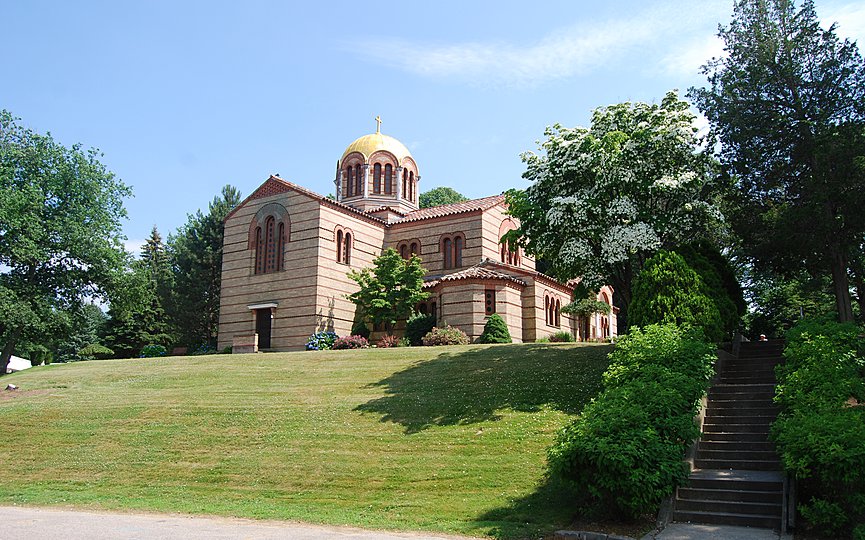
BOSTON – From now on, the entrance of service dogs into churches across the Archdiocese in the U.S. will be permitted – meaning specially trained dogs that accompany and guide people with special needs, such as the blind. To this end, a decision was made during the recent meeting of the Archdiocesan Eparchial Synod on Saturday, September 13, at Hellenic College-Holy Cross School of Theology in Brookline, MA allowing service dogs to enter churches during the Divine Liturgy and other sacred services.
Specifically, Archbishop Elpidophoros invited two Archdiocesan staff members – Theo Nicolakis, who recently assumed the new title of Director of Ministries of the Archdiocese, and George Tsougarakis, the Archdiocese’s legal counsel – who presented the matter of service dogs to the members of the Synod so that no discrimination would occur against people facing vision issues.
A thorough discussion took place during the Synod, in which practical questions were raised, such as what would happen if a service dog were to urinate or defecate inside the church during the Liturgy. Another issue raised was what would occur if members of the congregation were allergic to dogs – whether service dogs or otherwise.
The two staff members assured the Synod that these dogs are trained not to urinate or defecate while on duty. Archbishop Elpidophoros therefore insisted that a decision be made and that a formal policy be established regarding the access of service dogs in churches. In the end, an agreement was reached.
It was stated by hierarchs that, should such dogs urinate or defecate during the Divine Liturgy or the celebration of Sacraments, they would no longer be permitted entry. It should be noted that the matter of dogs was not on the official agenda, and the Synod members were caught by surprise, as no prior preparation or preliminary discussion had taken place.
Additional Matters Discussed by the Eparchial Synod
Concerning Hellenic College-Holy Cross and the ‘vision’ of transforming it into a University of the Holy Cross, toward the end of the session Archbishop Elpidophoros said that a draft plan had been prepared to make the School a university, but that it was still at a preliminary stage and nothing concrete existed yet. He further added that it remains to be seen whether the necessary funds can be raised.
When Synodal hierarchs pointed out that there already exists a detailed promotional brochure bearing the signature of the School’s president, Demetrios Katos, which presents the matter as a fait accompli – showing the Theological School as a department of the University, and indeed in third place – Archbishop Elpidophoros is reported to have replied: “Yes, I know, but there is nothing specific to report today.”
Katos did not appear to brief the Synod on the progress of the School. He only appeared at the luncheon, thanked the members of the Synod for their presence at the School, and announced that their meal was donated by former president George Cantonis.
Archbishop Elpidophoros requested that all the Metropolitans each donate one icon to the chapel of the Holy Cross at the School. The total amount required, as The National Herald has already reported, amounts to five million dollars.
At the beginning of the session, letters from the Patriarchate regarding canonizations were read. Archbishop Elpidophoros also referred to the upcoming visit of Patriarch Bartholomew. Additionally, in a videoconference, George Demos from California and a representative from Atlanta spoke about dance groups, since Archbishop Elpidophoros wants a national dance troupe to be established under the Archdiocese. It was mentioned that the Metropolis of San Francisco Folk Dance and Choral Festival has financial reserves of two and a half million dollars.
Meanwhile, The National Herald has learned from reliable sources that the School is in a difficult financial situation, contrary to claims otherwise – so much so that it is struggling to meet its payroll obligations. The same sources report that renewed consideration is being given to selling a large part of the School’s land for twenty million dollars to an environmental organization sensitive to ecological protection. “It should be clarified that these matters were not discussed at the Synod; they are exclusive information obtained by The National Herald and are beyond doubt.
On Sunday, September 14, the Archdiocese issued the following communiqué:
“Yesterday, September 13, His Eminence Archbishop Elpidophoros presided over the regular fall session of the Holy Eparchial Synod, which convened at Hellenic College-Holy Cross Greek Orthodox School of Theology in Boston. Under the shadow and blessing of the Precious Cross and in a spirit of joy on the eve of the visit of His All-Holiness Ecumenical Patriarch Bartholomew to the United States, the Eparchial Synod examined current matters concerning the life of the Church.
The Holy Eparchial Synod was informed by His Eminence Metropolitan Constantine of Denver regarding the volatile situation that has arisen around the monastery of Saint Iakovos ‘New Studion’, located in Piedmont, OK. The monastery was founded in 2018 and until recently was under the omophorion of the Patriarchate of Georgia, under the spiritual guidance of His Grace Bishop Saba. On March 20, 2025, according to an official document from Bishop Saba, the former abbot Athanasios (Clark), as well as Abbot Christophoros (Khadasok) of the Holy Spirit Monastery in Maryland, were deposed by the Patriarchate of Georgia and returned to the status of simple monastics
Furthermore, on February 27, 2025, the aforementioned former abbot Athanasios Clark joined the self-proclaimed ‘Greek-Palestinian Orthodox Church’ in Pottsville, PA, under the similarly self-proclaimed “Archbishop Aimilianos.”
The faithful Orthodox Christians are hereby cautioned that this church is not a member of the Assembly of Canonical Orthodox Bishops of the USA. Consequently, it lies outside the canonical order of the Orthodox Church in our country, and our faithful must keep in mind the serious canonical consequences that this entails, should they consider having any contact or relationship either with the aforementioned monastic community or with its leaders.
The Holy Eparchial Synod then examined the reports of the Synodal Committees and, among other things:
- Approved the advancement of the Traditional Folk Dance Festivals to a National Ministry.
- Adopted a policy regarding service animals in our churches as a first step to ensuring that all parishes are accessible to those suffering from physical disabilities.
- Was informed by the President of the School of Theology that, in response to a request of the Holy Synod, a theological studies program in the Spanish language has already been created.
- Revised the list of candidates eligible for election to the episcopacy, which will be sent to the Ecumenical Patriarchate for final review and approval.
- Decided to establish the Sunday of the Sower as the day dedicated to Sunday school teachers and religious educators.
The gathering of the synodal hierarchs in Boston culminated with a concelebration of the Divine Liturgy in the Chapel of the Holy Cross on Sunday, September 14, the feast day of the School of Theology.
From the Chief Secretariat.”