Close Menu
    Facebook X (Twitter) Instagram
    Trending
    • #Giving Tuesday – Support Orthodox Christian Laity!
    • Together We Thrive: OCL Annual Conference & Year-End Giving Campaign
    • Archon Officers Participate in Historic Pilgrimage to Nicaea
    • Ecumenical Patriarch Bartholomew and Pope Leo recite the Creed together during 1700th Anniversary of Nicaea
    • Mission Center Board Convenes
    • The “Orthodoxy as Masculinity” Narrative
    • Walk with Us: Orthodox Volunteer Corps (OVC)
    • St. John Chrysostom’s Legacy: From Antioch to America
    Orthodox Christian Laity
    Facebook X (Twitter) YouTube
    • Home
    • OCL
      • About OCL
      • Leadership
      • OCL News
      • OCL Publications
      • Focused Study and Research Topics
      • OCL Archives at DePaul University
    • Orthodox News & Links
      • Orthodox News Stories
      • Headlines & News Archives
      • Governance & Unity
        • Governance Top Stories
        • Governance & Unity Essays
        • Grassroots Unity in Action
      • OCL Forums
      • Orthodox Christian Laity News
      • Web Links
    • Audio & Video
      • Audio Index
      • Video Index
    • Contact
    • Make a Donation
    Orthodox Christian Laity
    You are at:Home»Orthodox News»The Turkish Kristallnacht

    The Turkish Kristallnacht

    0
    By Webmaster on September 7, 2015 Orthodox News, Orthodox News Top Stories
    Share
    Facebook Twitter LinkedIn Pinterest Email Telegram WhatsApp Copy Link
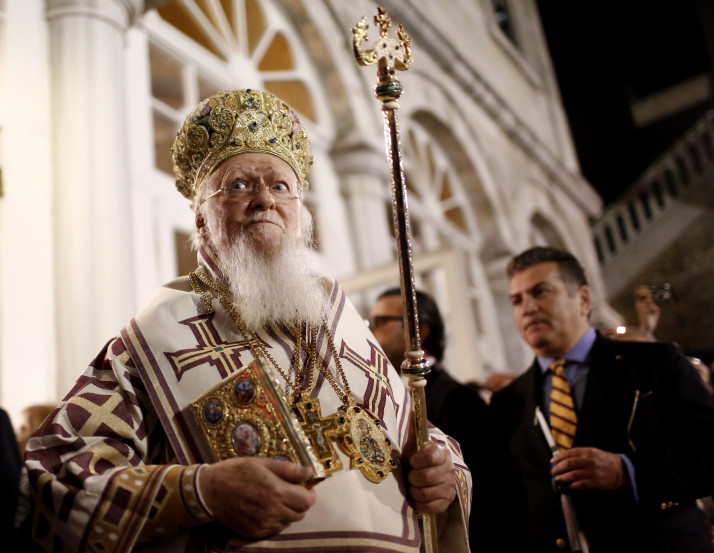
    Ecumenical patriarch Bartholomew I, spiritual leader of Greek Orthodox world, at the St. George Church in Istanbul | EPA
    Ecumenical patriarch Bartholomew I, spiritual leader of Greek Orthodox world, at the St. George Church in Istanbul | EPA

    Source: Politico

    Sixty years after its pogroms against ethnic Greeks, Turkey grapples with its ugly history.
    By AYKAN ERDEMIR

    ANKARA — A belated commemoration — 60 years late, in fact — was held on September 6 at Istanbul’s Panagia Greek Orthodox Church. It was in memory of the victims of the 1955 pogrom targeting the Polites, short for Konstantinoupolites, namely the Greeks of Istanbul.

    This was the first divine liturgy-cum-memorial service ever to remember what’s known in Turkey as “the events of September 6 and 7.” In what some refer to as the “Kristallnacht in Constantinople,” 71 churches, 41 schools, eight newspapers, more than 4,000 stores and 2,000 residences were looted or destroyed overnight. The human toll and suffering were even more catastrophic, with more than 30 dead, 300 injured and 400 raped. As one Greek Orthodox community leader recently argued, the greatest damage of the pogrom was to the ideal of equal citizenship in Turkey, not only for the Polites but also for the country’s other non-Muslim minorities.

    * * *

    The 1955 pogrom was not a clash of civilizations pitting Muslims against Christians. On the contrary, amid rising Turkish-Greek tension over the future status of the then British colony of Cyprus, the riots were carefully planned by the Turkish government to cleanse Istanbul of the approximately 100,000 Polites, who were excluded from the Turkish-Greek population exchange of 1923-24. Chauvinist thugs, as history has repeatedly demonstrated, happen to be an imperfect tool for social engineering. As one assailant told a Greek Orthodox victim of the 1955 pogrom, the thugs had permission “not to kill but only to break things.” By the time martial law and curfew were declared in Istanbul the next day, however, the death toll exceeded 30. Of the stores looted by the out-of-control mobs, only 59 percent belonged to the targeted Polites, with the remaining establishments belonging to the Armenians and Jews.

    This crime against humanity on such a scale has, until recently, been swept under the carpet in Turkey. As is also the case with the 1934 Thrace pogroms against Turkish Jews and countless pogroms against the members of the Alevi faith, the 1955 pogrom targeting the Polites has not been part of Turkish school curricula. Turkey’s Greek Orthodox families have also refrained from discussing the issue even in the privacy of their homes out of fear, as one friend has said to me, that “the walls have ears.”

    Fortunately, the times and generations seem to be changing in Turkey. In an era of vastly expanded communication, the state is no longer capable of keeping a lid on dirty secrets of the country’s past. Turkey now has a plethora of organizations and initiatives dedicated to uncovering past atrocities and making amends with persecuted minorities, whether it’s the Armenians, the Greeks, the Syriacs, the Jews or the Alevis. Last year, for example, a blogger made 210 graphic photos of the 1955 pogrom available online, conveying the savagery of the atrocities to wide audiences better than any written text can do. Just a decade ago, an exhibit of some of these photos in an Istanbul art gallery on the 50th anniversary of the 1955 pogrom was attacked by far-right thugs. In the battle of ideas, young hooligans with sticks fail to be a match for Turkey’s new middle classes armed with servers, blogs and smartphones.

    Grassroots enthusiasm for equal citizenship and pluralism in Turkey is indeed praiseworthy. It is, however, still the responsibility of government officials to move things forward so that events like the 1955 pogrom are never repeated again. The Islamist Justice and Development Party (AKP), unfortunately, has had a very ambivalent attitude vis-à-vis Turkey’s minorities and their fundamental rights and freedoms. In 2011, then-prime minister Recep Tayyip Erdoğan’s restitution decree for minority foundations was seen as an inadequate but nevertheless positive step for improving the conditions of Turkey’s minorities, including the Greek Orthodox community. Unfortunately, there seem to be major shortcomings in the content and implementation of the decree, as various minorities continue to complain about their unresolved claims.

    To make matters worse, AKP officials, just like generations of politicians before them, see Turkey’s minorities as pawns to be traded for additional rights for Turkish Muslims abroad. The Halki Seminary of Istanbul, a leading Orthodox institution for training clergy, has remained closed since 1971, and Erdoğan has made it very clear that it can be back in service only when a mosque is open for service in Athens. Such complete disregard for fundamental rights and freedoms of Turkey’s minority citizens and an unashamed tit-for-tat policy have prompted members of Turkey’s Greek Orthodox minority to protest their status as “hostages of the state” to be bartered for the Turkish Muslim minority’s rights in Greece.

    Sixty years after the 1955 pogrom that devastated their community, Turkey’sPolites continue to live a precarious life. There are still occasional attacks, such as the arson attempt at Istanbul’s Hagia Triada Greek Orthodox church in June, but the Turkish-Greek rapprochement, no matter how flawed, seems to have made life easier for the Greek “hostages” of the Turkish state. Although far from ideal, this modus vivendi appears relatively agreeable within the perspective of the ongoing carnage and mayhem in the Middle East and North Africa. It is unlikely, however, that what appears agreeable to Turkey’s authoritarian politicians would be acceptable to the new generations who are unwilling to settle for anything less than full fundamental rights for all residents of Turkey, without exception.

    Aykan Erdemir is a former member of the Turkish parliament and a nonresident fellow at the Foundation for Defense of Democracies. He currently teaches at Bilkent University, Ankara.

    [subscribe2]
    Share. Facebook Twitter Pinterest LinkedIn Tumblr Email WhatsApp Copy Link
    Previous ArticleSyrian Orthodox Patriarch talks refugee crisis in Laval visit
    Next Article Assembly of Bishops USA 2013 Audit Now Available Online

    Related Posts

    December 1, 20251 Min Read

    Together We Thrive: OCL Annual Conference & Year-End Giving Campaign

    November 28, 20255 Mins Read

    Archon Officers Participate in Historic Pilgrimage to Nicaea

    November 28, 20251 Min Read

    Ecumenical Patriarch Bartholomew and Pope Leo recite the Creed together during 1700th Anniversary of Nicaea

    Leave A Reply Cancel Reply

    This site uses Akismet to reduce spam. Learn how your comment data is processed.

    Sign the Declaration for Orthodox Unity – click here…

    Register for OCL's Annual Conference - October 11, 2025

    Sign the Declaration for Orthodox Christian Unity

    Enter the Slogan Contest

    Share this page
    DISCLAIMER

    All articles represent the views of the authors and  not necessarily the official views of Orthodox Christian Laity (OCL). They are posted to encourage thoughtful discussion on topics and concerns relevant to Orthodox Christians living in a pluralistic society. OCL encourages your comments.

    Stay Informed!

    Subscribe to our Newsletter

    WE WELCOME YOUR INPUT AND SUPPORT!

    Your donation impacts and helps advance the unity of the Orthodox Church of America.

    DONATE NOW

    THANK YOU FOR YOUR CONTINUED SUPPORT!

    Upcoming Events
    Notice
    There are no upcoming events.
    Recent Comments
    • George Warholak on Ecumenical Patriarch Bartholomew and Pope Leo recite the Creed together during 1700th Anniversary of Nicaea
    • Dn Nicholas on Ecumenical Patriarch Bartholomew and Pope Leo recite the Creed together during 1700th Anniversary of Nicaea
    • Dana C Purnell on Ethiopian Bible is the oldest and complete bible on earth
    • Peter on Abp. Elpidophoros installed as National Council of Churches board chair
    • james wiliams on Video: A Vision for Orthodox Christianity’s Future in North America
    • Veras Coltroupis on Abp. Elpidophoros installed as National Council of Churches board chair
    • Joe Forzani on Ancient Christianity (Free Course) – Hillsdale College Online
    • Joe Forzani on Ancient Christianity (Free Course) – Hillsdale College Online
    • sandy myers on Ethiopian Bible is the oldest and complete bible on earth
    • Peter on Unity in the Orthodox Church
    OCL Archives Online
    Project for Orthodox Renewal
    renewal-resize
    OCL Digital Newsletter

    Subscribe to our Newsletter

    MAKE A DONATION

    Sign the Declaration for Orthodox Christian Unity

    Facebook
    Twitter
    YouTube

    St. Symeon the New Theologian and St. Photini are the Patron Saints of OCL

    footer-fnl

    Orthodox Christian Laity
    PO Box 6954

    West Palm Beach, FL · 33405
    561-585-0245

    ocladmin@ocl.org (or) orthodoxchristianlaity@gmail.com

    Sponsored by Ann Souvall in memory of husband George

    DISCLAIMER: All articles represent the views of the authors and  not necessarily the official views of Orthodox Christian Laity (OCL). They are posted to encourage thoughtful discussion on topics and concerns relevant to Orthodox Christians living in a pluralistic society. OCL encourages your comments.

    ©2025 Orthodox Christian Laity (OCL) ·  Login

    Type above and press Enter to search. Press Esc to cancel.