
Source: Public Orthodoxy
RELIGIOUS MATERIALITY IN POST-CHERNOBYL CONTAMINATION
The publication of this essay coincides wit the anniversary of the Chernobyl disaster, Saturday, April 26, 1986.
In March 2020, we were asked to work from home because of the pandemic of coronavirus. We could not even imagine how quickly the situation would escalate to a global lockdown. Looking at the warm and beautiful weather my husband said, “It’s hard to believe that being outside can be dangerous—the world around looks exactly the same, like nothing has changed.”
His words stung me with a flashback: Sonja, one of my informants in Belarus, said the same about the Chernobyl disaster. She told me that it was so hard for her to comprehend that all this familiar beauty can possess danger. The world for her had turned upside down as what used to bring life became a source of mortal danger: water, food, soil, and even human bodies. Radiation, just like a virus today, was described to me as an awakened primal power, an invisible, ancient evil that suddenly started targeting humans for their irresponsibility, greed, and arrogance.
Despite atheistic Soviet policies, some resorted to another ancient power in their hope for protection and healing: Orthodox Christianity. In their anxiety many turned to the churches and relics. People were warned with the language of science not to touch objects, including religious items, as they could emit radiation, but that did not stop the believers. Neither did it stop people nowadays from queuing in churches to kiss relics and taking part in the Eucharist despite the risk of spreading and contracting coronavirus.
Both of the tragic events prove that religious needs cannot be dismissed or just stopped even when they are considered dangerous or undesirable. Moreover, they show how religiosity is wider than just intellectual conviction about dogmas; it also is an urge for physical participation in religious life. Through my research, I saw that, despite often being overlooked, the sensual response to objects and substances might be at the core of the desire to live a religious life.
Take, for example, religious transformations after Chernobyl. Everyday life dramatically changed for evacuees: spaces, distances, sounds, and smells. Many were relocated from their rural homes to the tall buildings of the capital city. It was hard to leave behind relatives, houses, animals, and gardens, but also heirlooms which could not be taken because of the risk of contamination. “I still secretly took my mother’s icon and traditional towels; I would not dare to leave them behind,” Sonja shared with me.


It took me long hours of conversation with women evacuated from contaminated areas to start feeling sharply the connection they had to the “things” that were integral to their spirituality and the ways they lived their Orthodox lives. So, let me say it is one thing for a researcher to understand that believers rely on material things as tools for sacraments or home prayers and a totally different thing to witness how much pain it causes people to leave those things behind, how irreplaceable concrete religious items are.
You can see the importance of materiality with coronavirus as well. It is hard for believers not to gather, but often even more difficult to be sensory deprived in their religious expressions, not to touch or kiss each other as well as not kissing relics and icons. Even though Chernobyl contamination made things a source of danger for decades and centuries, people still do not let their things go so easily. They strive to restore what was lost in an actual or in a symbolic way.
Thomas Tweed wrote about religion as a process of settling. The way we settle after a journey to create a new home is formed by specific religious ways of marking the space around us as proper and suitable: we feel that it is predestined for us. This homemaking is in a way a practice of arranging meaningful objects around ourselves to feel rooted, connected and protected, symbolically “at home.” When some of the essential objects are non-accessible we take various strategies to recreate them in the new environment. After the Chernobyl explosion, the 30-kilometer zone around the reactor was restricted. Many churches became abandoned, many relics were lost.
When objects are gone or unavailable we suddenly realize that the religious experience we had before is not repeatable without them. In such a crisis, things become “hyper-apparent,” to use Birgit Meyer’s term; they become a focal point of our attention. We suddenly realize that things lie in the midst of our everyday religious life, and we struggle to reestablish this life without them.
Following this need, post-Chernobyl cooperation started between scientists and believers to clean and relocate religious objects: not only smaller items like icons, but even buildings, such as the Archangel Michael Orthodox wooden church that was deconstructed, scanned log by log, and relocated to the city of Gomel. The retrieval of old things was complemented by the emergence of new ones. New memorial Chernobyl churches were built to mourn and commemorate the victims, to tell the story of the disaster, and to warn the future generations about the dangers of scientific endeavours. These churches aspire to frame Chernobyl not only in scientific terms, but to integrate it into the religious worldview and suggest the spiritual lessons one should learn from the disaster.
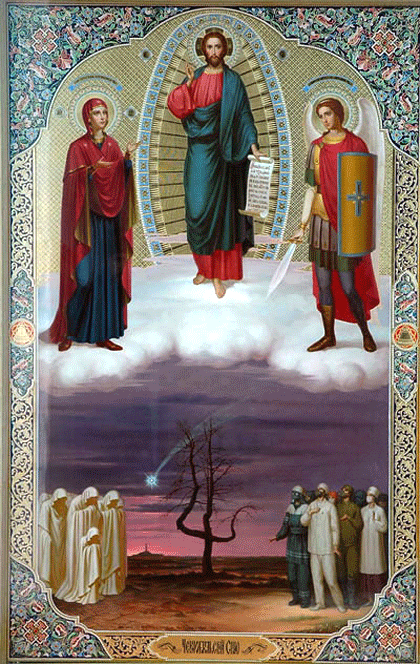

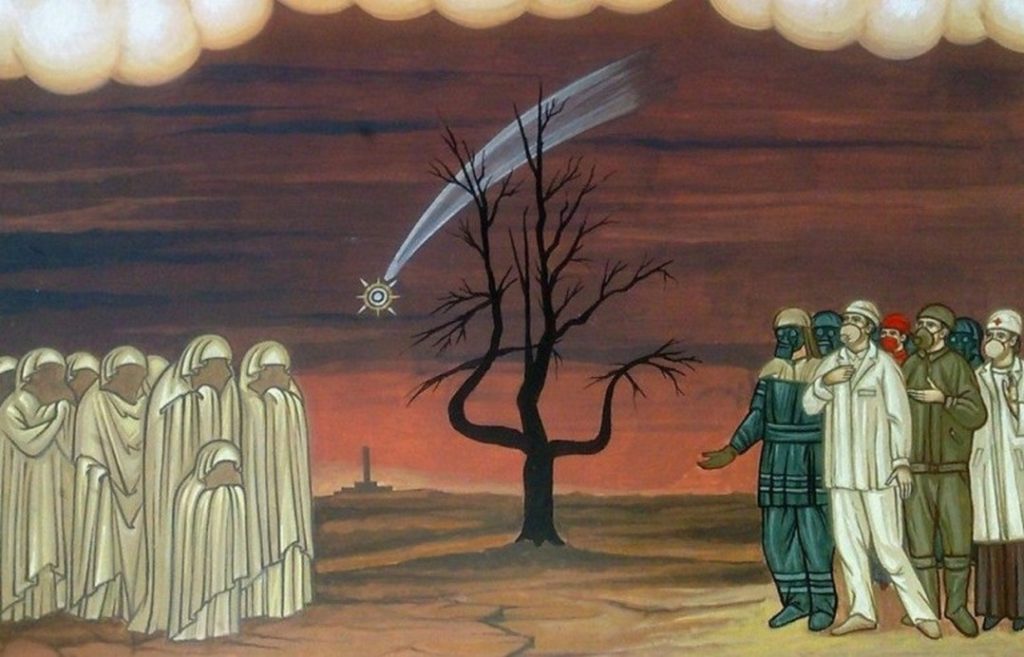
Chernobyl icons. The Saviour of Chernobyl on the left depicts Chernobyl clean-up workers in their uniforms and the souls of the deceased with a nuclear power plant in the background. The Blessing of Children on the right shows Christ, on the background of the damaged nuclear facility, consoling sick children of Chernobyl.
Another example is the emergence of Chernobyl icons that were created out of the experiences of local believers. They bring visions of the disaster into religious imagery, which vary notably in style and composition. These icons are frequently copied, adjusted, and altered to find a shape that relates best to the context and needs of local believers. They are more than artworks; they are ways of communicating and working through the traumatic experiences of disaster with other believers and with the divine. They seek to equip people for a life full of post-Chernobyl challenges, such as radiation-related illnesses, disabilities, migration, social stigma, and reproductive fears.
In the responses to both Chernobyl and coronavirus, hope of acquiring healing and protection through religious spaces and items went hand in hand with the strong faith that “godly things” cannot bring harm. Chernobyl showed that people and beliefs are resilient; people find their ways around the physical danger and tailor their religions to survive in the altered world. Leonard Primiano underlines that it is essential while looking at the religious tradition to accentuate “the power of the individual and communities of individuals to create and re-create their own religion” (“Afterword: Manifestations of the Religious Vernacular: Ambiguity, Power and Creativity,” in Vernacular Religion in Everyday Life: Expressions of Belief, ed. Bowman and Valk, 382–394). In more than three decades of coping with Chernobyl, local everyday religion has been constantly re-shaped and re-constructed, which demonstrates the power of ongoing creative change within the Russian Orthodox tradition and illustrates the ways in which materiality is essential to how religion is lived.
Elena Romashko is a PhD candidate in Religious Studies at the Georg-August-Universität Göttingen, Germany. She is the recipient of the 2020-2021 NEH Dissertation Completion Fellowship in Orthodox Christian Studies at Fordham University.
Public Orthodoxy seeks to promote conversation by providing a forum for diverse perspectives on contemporary issues related to Orthodox Christianity. The positions expressed in this essay are solely the author’s and do not necessarily represent the views of the editors or the Orthodox Christian Studies Center.