
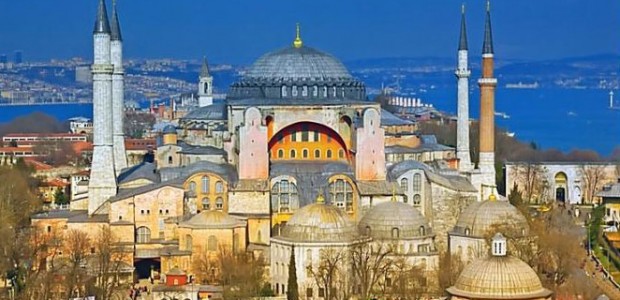
 Source: The National Herald
by Theodore G. Karakostas
PARIS, FRANCE – I recently had the opportunity to visit the beautiful and splendid City of Paris. What an outstanding city, with great Museums such as the Louvre and D’orsay, the Great Cathedral of Notre Dame, the Eiffel Tower, and the great palaces of Versailles.
Paris is not only the location of great sites but is also the seat for the international headquarters of UNESCO (United Nations Educational Scientific Cultural Organization).
Since I was in Paris and having spoken and corresponded with the New York office of UNESCO in the recent past, I decided to pay a visit to its headquarters.
In 1985, UNESCO added the Great Church of Hagia Sophia to its list of World Heritage Sites upon the request of the Turkish government. Last year, Ankara ominously announced plans to convert Hagia Sophia into a Mosque as during the period of the Ottoman Empire. Having submitted messages to UNESCO’s New York office, and having spoken with them last year, nothing happened.
On my visit to the Paris office, I suspected that I would receive a rude reception as I was once hung up on by a diplomat of the New York Office. In any case, I went to the headquarters, where there was some sort of reception for people I can only speculate were diplomats or other important officials of European, Asian, and
African backgrounds. There appeared to be a banquet with food and drink.
I entered the building and politely introduced myself as a writer with a theological degree who wanted to discuss Hagia Sophia of Constantinople. I finally made my way to an adjacent building on an upper lever before meeting a woman who was a UNESCO “Chief.” I politely introduced myself and held out my hand and described my purpose. As such, I began asking questions.
The first question had to do with UNESCO’s silence in response to Ankara’s previously-announced plans for Hagia Sophia. I was told that UNESCO has received many letters and that they have been in touch with the Turkish authorities. UNESCO has not confirmed the plans to convert Hagia Sophia. The encounter was unnecessarily tense, as I could see from this official’s angry facial expressions, and statements that she could not “discuss with me.” She made some brief comments about “universal values” and other irrelevant statements.
I pointed out that Turkey has already converted two other Churches also named Hagia Sophia in Trebizond and Nicea (Iznik) but this did not seem to interest the Chief. She affirmed what one spokesperson from the New York office previously had told me that sovereign countries can do as they like with their monuments. At one point I asked if UNESCO does any work within Hagia Sophia, and she responded in the affirmative.
Apparently, all monuments supposedly “protected” by UNESCO are put on the list by governments and if said governments want to destroy or convert historical monuments then this is apparently fine and well with UNESCO. On the other hand, the Chief did
mention the destruction of cultural monuments in Iraq and Syria and pointed out how nothing can be done there. UNESCO has in fact condemned the destruction in those countries to its credit. I pointed out that just because nothing can be done in Iraq and
Syria that nothing should be done about Hagia Sophia.
Sensing that this Chief was losing patience with me, I decided to proceed with the relevant points I wanted to make. I pointed out that Hagia Sophia’s origins had nothing to do with UNESCO’s “universal values.” Hagia Sophia, I said was the product of the
Gospel, revelation, and Orthodox theology. I pointed out I was of Greek descent and that the Greeks who took refuge during the conquest of Constantinople in 1453 were either slaughtered or taken away into slavery. I also mentioned that Justinian, who built
Hagia Sophia, is a Greek Orthodox Saint and that the rightful heirs to Hagia Sophia are the Greek inhabitants of Constantinople, who live in miserable conditions today.
The UNESCO Chief responded by saying she would not discuss “politics.” I asked if Turkish influence had anything to do with UNESCO’s silence and again she dismissed the question. My last question was to ask what UNESCO was doing about the destruction of the cultural monuments in Cyprus, and she again said she would not discuss anything to do with “politics.” Apparently, criticizing governments who destroy cultural monuments is “politics.”
She asked why I was taking notes, and I said I would like to write a book about Hagia Sophia and I wanted UNESCO’s position. I said flat out Hagia Sophia was doomed because UNESCO would not speak up. At that point, I asked for her name and card, which she refused to give. I politely thanked her for her time and left, but before leaving I mentioned the Christian Armenians, Assyrians, and Greeks and their fates.
It is not often that one gets the opportunity to put forward the national and theological claims to Hagia Sophia on behalf of Hellenism and Orthodoxy before such a prominent official, but they were things that needed to be said. On my return to the United States, I learned that an exhibit based on photographs of the Turkish invasion of Cyprus originally scheduled to be shown at UNESCO headquarters was cancelled as a result of Turkish pressure. But that, I guess, somehow is not politics.
(Theodore G. Karakostas is author of the book In the Shadow of Hagia Sophia)
[subscribe2]