
 Source: First Things
by John Chryssavgis
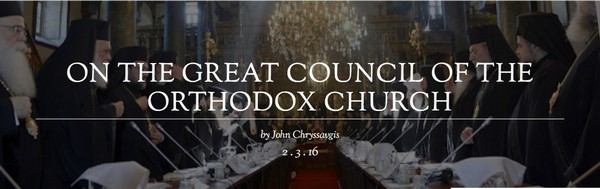
Already there is much talk about the Holy and Great Council of the Orthodox Church. Between now and June 19, 2016, when the council officially opens on the island of Crete, there will be many rumors and much spin. Some will be justified; like other patriarchal institutions, Orthodox Churches are not normally known for their transparency. However, other chatter will be less than helpful. What follow are some brief clarifications on basic questions surrounding the council.
Is the Great Council an Ecumenical Council?
For Orthodox Christians, there hasn’t been an Ecumenical Council since 787, with the Second Council of Nicaea that resolved the problem of iconoclasm, namely the debate about whether icons can or cannot be used for liturgical and devotional purposes. If you’ve been to an Orthodox Church recently, you know who won that argument! However, the Orthodox believe that it is the whole church that must convene—East and West—in order for a council to be considered ecumenical. In a world where Christians are so tragically divided, the Orthodox are reserved about boasting of an ecumenical council. In any case, an ecumenical council is normally recognized retrospectively.
It would perhaps be more appropriate and accurate to consider the Holy and Great Council as a continuation not only of the early ecumenical councils of the first Christian millennium, but also of the later “great” or “greater” councils of the second Christian millennium. Around a dozen or so such councils have convened through the centuries following the “great schism” of 1054 in order to resolve issues of doctrinal, canonical or administrational character.
However, there is indeed something very unique about this council—even beyond ecumenical councils and previous great councils. This is the first time in the history of Christendom that a council of ancient churches that claim apostolic succession has included so many individual and independent (autocephalous, and even national) churches. The early ecumenical councils of the first millennium assembled five churches, while the later great councils often convened with even fewer churches. By contrast, the Great Council that will convene in Crete this June will assemble fourteen recognized (or canonical) Orthodox churches from all over the world. These include the ancient patriarchates of Constantinople (that calls, convenes and chairs the council), Alexandria, Antioch and Jerusalem; the modern patriarchates of Russia, Serbia, Romania, Bulgaria and Georgia; as well as the archdiocesan churches of Cyprus, Greece, Albania, Poland, and the Czech Lands and Slovakia.
Where are the English documents?
Everyone is asking “Where’s Waldo?” about the formal English translations of the official documents. Unfortunately, they don’t exist. It’s hard to believe but amid the noise of endless argumentations and long-standing divisions, the preparatory process of the Holy and Great Council operated since the 1960s in Greek, Russian and French with no provision made for the use of the most global lingua franca. When the Romanian delegation only very recently suggested that English be added to the official languages of the council, the response was that the other languages were a Pan-Orthodox decision at an earlier Preconciliar Consultation; it would take nothing less to amend that. If nothing else, the mentality offers some insight into why more vital, even doctrinal matters would achieve such little headway during deliberations!
There are some English translations out there, but none of them is official. At least not until the Council’s Secretariat from Geneva issues these in due course. Until that time, Greek, Russian, and French documents are available; but remember that the Russian and French versions are translations of the Greek and that, while translations may be sound, to a certain degree they are also interpretations by individual churches. Even with the help of the Holy Spirit, the Orthodox prelates do not speak in multiple tongues simultaneously.
Still, there is some light at the end of the tunnel: The Synaxis of the world’s Orthodox primates, held in Geneva a few days ago (January 21-27, 2016), issued a resolution that English would be officially used during the proceedings of the council and will definitely be one of four official languages for the final message issued at the conclusion of the Great Council on June 26, 2016.
Is Ukraine really a bone of contention?
Thus claimed Erasmus in The Economist. And it certainly is for Moscow; however, not for many others. At the opening of the synaxis Patriarch Kirill in a thunderous tirade brought up the question of the disputed status of the Ukrainian Church to which Bartholomew responded serenely and unapologetically. Thereafter, Ukraine was hardly discussed in further deliberations or formal decisions, and was not mentioned in the final communiqué.
The truth is that, in the wake of the recent synaxis last week, Moscow may just be proclaiming how it would like to think that the primates reacted and what it would like us to think that the primates resolved. For example, Moscow would have us believe that Constantinople cowered to Russian pressure by recognizing that Moscow’s representative in Ukraine, whom Patriarch Kirill chose to include in his entourage of two in Geneva, heads the canonical Church in that country.
However, there was neither any apology from Constantinople for any of its activity in Ukraine, nor any compromise by Constantinople to its honorable desire to end church politics in Ukraine, nor again any promise by Constantinople about diminishing its relationship with the Orthodox faithful of Ukraine. Indeed, Ecumenical Patriarch Bartholomew underscored his historical and canonical right to respond to appeals or concerns from Orthodox faithful in Ukraine as the “daughter church” of Constantinople.
Why is the Council being held in Crete?
Even before the Synaxis of Primates was over, Moscow prided itself on rejecting Constantinople’s proposal of Istanbul as the venue for the Holy and Great Council at the Church of Haghia Irene, which was the site of the Second Ecumenical Council, served as an imperial church since the fourth century, and (unlike other Christian monuments in Turkey) was never converted into a mosque.
The sole reason that the Orthodox Primates changed the venue of the Holy and Great Council was in order to assist Moscow to attend due to current political tensions between Russia and Turkey as well as security concerns about recent terrorist attacks in Istanbul. The change exemplifies the magnanimous flexibility and benevolent commitment of the Ecumenical Patriarch—sustained by the Holy Spirit—required to ensure that the council will convene in June of this year.
Something is certainly stirring in the Orthodox Church. And the sound will be louder and clearer in the weeks and months ahead. The Holy and Great Council is entirely without precedent in the history of Christianity. Some are afraid of its consequences for the purity of Orthodox doctrine; it may shed light on practices in isolated communities, which have long resisted and reacted against the modern ways of the West. But others see this as a unique moment in the life and witness of an ancient church; it is an opportunity for Orthodox theology to speak a prophetic voice of hope and light in a time of anxiety and uncertainty.
As Ecumenical Patriarch Bartholomew reminded the Orthodox primates gathered in Geneva last week, “this is the moment of Orthodoxy.” In the words of Archbishop Anastasios of Albania: “The great council is not a facsimile of an ecumenical council.” Whether described as an ecumenical council, or more aptly labeled a great council, the occasion in Crete next June is not just a new or another council; it is an extraordinary and exceptional event. It is meant to happen. The Spirit is moving. The world is waiting. Let’s see what transpires among the attending bishops.
John Chryssavgis is Archdeacon and theological advisor to Ecumenical Patriarch Bartholomew.