
Source: Public Orthodoxy
Pope Francis’ trip to Egypt (April 28-29, 2017) has been one of the most important and difficult for this pontificate, given the international political situation and the plight of Coptic Christians in Egypt and of all Christians between Africa and the Middle East. It is not easy to look at this trip through one single interpretive lens, and therefore it requires the attempt to read it in the context of the pontificate.
A first level was the trip of Francis as expression of the modern magisterium of the pope of the Catholic Church on the relationship between religion as defensor of human rights and political rights in an age of evident crisis of faith not only in God, but also in our fellow human beings – the crisis of democracy. Interestingly, in his speech to the strongman of Egypt, general Al Sisi, and to the political authorities, Francis quoted from the Universal Declaration of Human Rights of 1948 but also from the Egyptian Constitution of 2014, delivering a blunt reminder to Egyptian political authorities: “It is our duty to proclaim together that history does not forgive those who preach justice, but then practice injustice.” Francis walked a very fine line between the need to avoid the impression of a papal blessing of the post-Islamist regime of Al Sisi in Egypt, more friendly to Christians than the brief period of Morsi on one side, and on the other side the need not to be silent before the disturbing record of the present regime in terms of the respect of democratic rights and of freedom.
The second level was the inter-religious relations. Pope Francis had to deal with the difficult legacy of the Regensburg address of Benedict XVI in 2006, which was a typical example of the divided and mutually opposed and deeply misguided, ideological receptions of Ratzinger’s most important public pronouncements (similarly to what happened to the famous speech on the “two hermeneutics of Vatican II” of December 2005). For hardliner, “occidentalist” Catholics the Regensburg speech was the gold standard of the Catholic response to Islam, while for some Muslims it was the manifestation of the crusading mentality of the Vatican. Despite the attempts to frame Bergoglio’s response to the invitation to the peace conference organized by Al Azhar as “Francis’ Regensburg speech”, the tone and the content were significantly different. In his speech to the international peace conference at Al Azhar, Francis quoted from the Second Vatican Council (the declaration Nostra Aetate on non-Christian religions and the constitution Gaudium et Spes on the Church in the modern world) and from John Paul II’s visits to Egypt in 2000 and from the first interreligious meeting of prayer in Assisi in 1986).
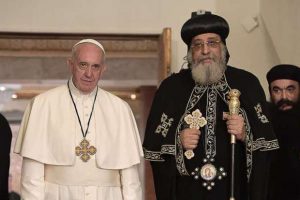
There is then the third level of the ecumenical and ecclesial relations, where the intra-Catholic and the inter-Christian relations are more interconnected than before. There are technical aspects of his visit and agreement with Pope Tawadros II that will have to be evaluated in time, especially about re-baptism: “Today we, Pope Francis and Pope Tawadros II, in order to please the heart of the Lord Jesus, as well as that of our sons and daughters in the faith, mutually declare that we, with one mind and heart, will seek sincerely not to repeat the baptism that has been administered in either of our Churches for any person who wishes to join the other.” In this respect, also pope Tawadros has to deal with the “dubia” raised through the media by his opponents.
What is most important is that Francis’ visit to Egypt has confirmed the complex nature of the ecumenical dimension of this pontificate, where we can see three kinds of ecumenism. The first ecumenism is that of bilateral relations between Churches: commissions of theologians and prelates who discuss documents that the Churches will have to approve or reject, or approve and put in a drawer. Francis sees a role for this ecumenism of bilateral commissions and official joint declarations, but without being driven or bound by this kind of relationship that is typical of the ecumenism of the post-Vatican II period and which has brought significant fruits, especially on the basis of relations of the Catholic Church with Lutherans, Anglicans, and Orthodox, but also with non-Chalcedonian Churches (the 1973 Common Declaration of Pope Paul VI and the Pope of Alexandria Shenouda III). Francis is aware of the different roles of the official ecumenical dialogues and of the ecumenical dialogue that is related to his “ecclesiology of the people”: an ecclesiology of the people endowed with an infallibilitas in credendo (exhortation Evangelii Gaudium of November 24, 2013, par. 119) – the people’s infallibility in the foundations of its faith. The ecumenical relations between different Churches need solemn acts and official texts, but without the reception of them by the people they would be meaningless. Francis knows that post-Vatican II ecumenism has been made and received by the lay Christian faithful and that there is no hermeneutical re-discussion of Vatican II that can stop this progress.
Then there is a second type of ecumenism, of which Francis has often spoken: “the ecumenism of blood” (from the beginning of his pontificate: see his interview with Andrea Tornielli of the Italian newspaper La Stampa, 14 December 2013), the brotherhood and sisterhood of Christians of every church and theological tradition in the face of persecutions, especially in the Middle East, Africa, and Asia. On this score, it is significant that the Ecumenical Patriarch, Bartholomew I, joined Francis in Egypt in a show of solidarity with Coptic Christians. Martyrdom as a theological source is redefining ecumenism more than the theological and ecclesiastical systems in the West can comprehend. The issue of refugees escaping persecution is a humanitarian and political issue, but also an interfaith and ecumenical one. From discussions about “Eucharistic hospitality” (giving communion to Christians who are members of another Church, not Catholic-Roman) we have moved on to the problem of hospitality tout court of those who (including many Christians, Catholics and not) flee from death and destruction: it is not a theologically less relevant question than that of Eucharistic communion. Christianity is now put to the test more by its response to the humanitarian crisis of today than by the dogmatic obstacles in the full communion between Churches.
Finally, there is the third type of ecumenism, the one it is most difficult to speak in the Catholic Church, for it is the most difficult and delicate: intra-Catholic ecumenism, among Catholics of devotions and different “obediences” and idiosyncratic identities. Francis insistently called to dialogue and rejection of sectarianism between Churches, but also within the Catholic Church. Francis has repeatedly appealed to the various Catholic movements to coexist in local churches without temptation to occupy spaces or claim primogeniture rights. His trip to Egypt was a powerful reminder against the Catholic temptation to see Christianity through a West vs. East lens: it has been a subtle message against the Catholic “Orientalization” of the Eastern Churches – the temptation to see in them something like a museum of exotic, pre-modern and anti-modern Christianity – as well as against the Catholic “Occidentalization” of itself – Catholicism as an essentially Western religion. In this sense, Francis’ ecumenism is challenging different kinds of Catholics certainly not less than non-Catholic Christians.
Massimo Faggioli is Professor of Theology and Religious Studies at Villanova University.