
Source: Public Orthodoxy
A SURVEY OF LITURGICAL SOURCES
by Rev. Dr. Nicholas Denysenko
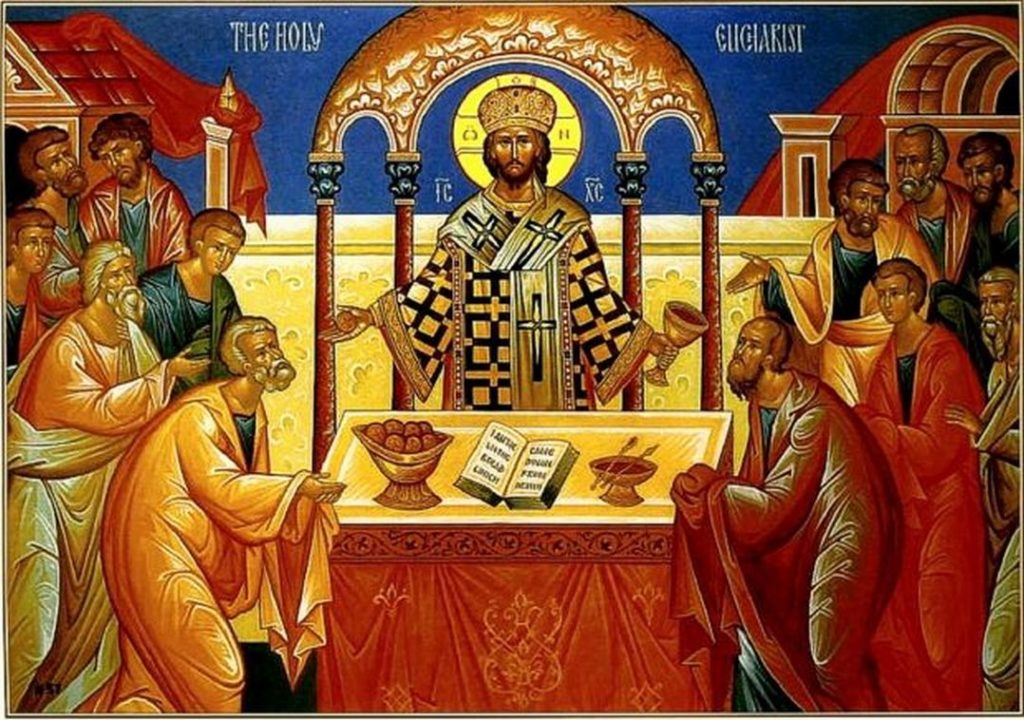
The global COVID-19 crisis has ignited a number of difficult discussions among Christians. The method used to distribute Holy Communion is fiercely debated. In the Churches that remain open, many Protestants and Catholics are withholding the cup, so faithful are receiving in one kind only, the body of Christ. In Orthodox communities, clergy and laity are discussing the possibility of trying new methods for distributing Holy Communion that prevents the spread of disease through a common spoon. This issue has generated emotional statements claiming that it is impossible for the Eucharist to make anyone sick because of the true presence of the Incarnate Christ. Most Orthodox synods have issued guidelines on how to maximize prevention of infection in church, and the Churches are in agreement on communion: it is impossible for the body and blood of Christ to make anyone sick. The corollary to this defense of the faith is that no changes to the method of distributing communion are permitted, with two exceptions. The Romanian Church permits faithful to bring their own spoons from home, and the Orthodox Church of Ukraine allows clergy to administer communion to laity via intinction, hand-to-hand.
In the remainder of this essay, I will test both assertions by pointing to a selection of historical antecedents. My investigation will demonstrate that the Church has used numerous methods for distributing Holy Communion, and that her steadfast belief in the true presence of Christ in the Eucharistic elements does not come with the promise of guaranteed protection from illness.
The Elements of Communion: Diversity and Evolution
One of the most frequently repeated clichés about Eastern liturgy is that it used to be uniform, and remains relatively unchanged from its apostolic origins. Liturgical historians have demonstrated that the liturgies of both East and West coexisted as a collection of diverse traditions from the very beginning. In fact, the New Testament accounts of Jesus’ supper with his disciples manifest this diversity. For example, the Lukan account mentions a cup both before and after the supper, and Luke’s ordering of the ritual supper differs from his synoptic siblings. Furthermore, Matthew and Mark record Jesus’ words on drinking from the cup as partaking of the “blood of the covenant,” a direct reference to Moses sealing God’s covenant with the Hebrew people by sprinkling blood on them in Exodus 24. Conversely, Luke and Paul record Jesus as referring to the cup as “the new covenant in my blood,” drawing from Jeremiah 31. These initial examples simply show us that the local apostolic communities born from evangelical preaching contained subtle differences in the details of the last supper that permeated their liturgical practices. From the beginning, there was no liturgical uniformity in the Church.
Liturgical diversity prevailed across Christianity from its origins through the medieval period. The Eucharist began to change as it evolved from a small, domestic gathering to a large, public event following the Peace of Constantine in 313 CE. In the Christian East, it was customary for the people themselves to bring the offerings of bread and wine to be used for the Eucharist.
The Churches of East and West continued the practice of distributing communion to all—clergy and laity—in both kinds. The Orthodox Church changed this practice by making communion with a spoon the predominant practice by the eleventh century. The famous late Byzantine liturgist, Robert Taft, described the rite of communion in Constantinople during which small tables accommodated multiple large diskoi holding the consecrated bread, which was given by a minister to the communicant. When the Church introduced the spoon to communion, Taft referred to this change as an innovation that met resistance for some time. Eventually, this method of distribution became permanent, though only for the laity, as the clergy continue to receive in both kinds, separately.
The mass publication and dissemination of liturgical books with the printing press made the process of making local revisions more difficult. The use of the spoon to distribute communion has, therefore, remained intact in the Churches of the Byzantine Rite, and has contributed to the perception of its liturgical rites as unchanging. The Liturgy of St. James calls for the laity to receive communion in both kinds, separately, but this liturgy is rarely celebrated in the Orthodox Church. The Armenian Church has retained its practice of distributing communion via intinction—by dipping the bread into the wine in the cup and giving it to the communicant. Taft notes that communion was occasionally given via intinction in Jerusalem and also in the West, but outside of the liturgy, for communion of the sick.
The Western Church began to change the method for distributing Holy Communion in the ninth century. Concerned about spillage and irreverence, the Church instituted the practice of the priest placing the body of Christ directly on the tongue of the kneeling communicant while assistants held a cloth to catch any falling pieces below. The Church introduced the fistula as an intermediate change. The fistula is a metal straw through which the communicant would receive the consecrated wine. Reducing the chances of spillage was the primary motivation for withdrawing the cup from the laity as well.
The Roman clergy continued to receive communion in both kinds while the laity received the bread only, sharing the clergy/laity distinction with the Byzantine Church. Luther referred to the withdrawal of the cup from the laity as the first Babylonian captivity of the Church, a means of enhancing the clergy’s power over the laity, and he restored the cup as part of his program of liturgical reform. The Roman Church permitted laity to receive from the cup in Sacrosanctum Concilium of Vatican II, while occasionally withdrawing the cup during health crises- most recently in 2009, during the H1N1 epidemic.
The preceding examples survey a sampling of the methods used for distributing communion in the global Church and show that receiving communion in both kinds separately was the most common method for both clergy and laity until the Byzantine Church established the spoon in the eleventh century, and the Roman Church withdrew the cup from the laity in the ninth century. The history also mentions variants, like intinction through dipping in the cup, and intinction for the sick.
Two trends prevail: first, there is no uniform rite that attempts to copy the order recorded by Jesus’ supper with his disciples. Second, the Church introduces changes for practical reasons (communing the sick) and theological ones (preventing spillage and exhibiting reverence for the elements of communion). Theologians began to assure Christians of the true presence of Christ in the Eucharist in the fourth century, and these texts serve as the building blocks of a theological narrative claiming that it is impossible for a person to become ill from communion. We now turn to the relationship of sacramental realism and illness in the second part of this essay.
Note that this section of the essay compares Holy Communion with the Theophany waters because both rituals call for recipients to consume them via drinking. Obviously, the anointing of the sick is the established ecclesial rite for healing of soul and body. My exclusion of this sacrament here is due to the absence of consumption in the act of eating and/or drinking.
Bread, Wine, and Water
When Jesus celebrated the supper with his disciples, the apostles recorded his famous words of power: “…this is my body…” “this is my blood.” Early Christians heeded Jesus’ commandment to assembly in his memory and celebrate the Eucharist. As early as the second century, Justin Martyr explains that “the food over which the eucharist has been spoken becomes the flesh and blood of the incarnate Jesus, in order to nourish and transform our flesh and blood.”
Christian pastors amplified the true presence of Jesus in the elements of bread and wine. The fourth-century bishop and mystagogue St. Ambrose of Milan, instructing those to be baptized, assured his flock that the bread becomes the body of Christ:
“Let us reason this out. How can something which is bread be the body of Christ? Well, by what words is the consecration effected, and whose words are they? The words of the Lord Jesus…the priest…uses the words of Christ. Therefore, it is Christ’s word that brings this sacrament into being.”
St. Cyril, bishop of Jerusalem in the mid to late fourth century, also promotes sacramental realism. Invoking the same words of Jesus uttered at supper, Cyril assures neophytes (recently baptized) that “we receive as of the body and blood of Christ.” Cyril’s next statement exhibits a strong sacramental realism when he claims that Jesus’s body and blood have been “given into our bodily members,” so that communicants “become ‘sharers of the divine nature’,” an implicit reference to sacramental theosis. Cyril’s instructions on the reverence neophytes are to exhibit while receiving communion foreshadow the extraordinary caution one must exercise when handling the body and blood of Christ. They must be “careful,…watching closely so as not to let a crumb of what is more precious than gold and precious stones fall from you.” He instructs neophytes to receive communion in the hand, “as intending to receive the King,” and he tells them to anoint themselves with the blood of Christ.
It is noteworthy that mystagogues like Cyril did not limit the sacramental realism to the elements of holy communion. He uses the same method of argumentation to claim that the myron used for post-baptismal chrismation is not mere oil: “For just as the bread of the Eucharist, after the invocation of the Holy Spirit is no longer ordinary bread, but the body of Christ, so also this holy myron is no longer ordinary…after the invocation, but it is the gift of Christ and the Holy Spirit being accomplished by this divinity.” Referring to the chrism, Cyril instructs the neophytes twice to “keep it pure,” exhibiting the same kind of reverence for chrism as expressed toward the body and blood of Christ.
The sacramental realism of Ambrose and Cyril abounds throughout the Christian tradition of late antiquity into the medieval period. Communicants adopt new ritual gestures of kneeling, receiving communion on the tongue, and, in the East, kissing the cup containing the Lord’s body and blood.
The late fourteenth-century Byzantine mystagogue St. Nicholas Cabasilas expresses a sacramental realism similar to his predecessors, Saints Ambrose and Cyril. Cabasilas asserts that anointing with Chrism “brings in the Lord Jesus himself,” and states that the Lord’s blood runs through our veins when we receive Holy Communion. Cabasilas was sensitive to the true presence of Christ in the Eucharist to the point of distinguishing the Great Entrance of the Divine Liturgy from the one of the Presanctified. Reverent gestures are appropriate only when the king enters at the Presanctified Liturgy; one need not kneel for the unconsecrated gifts at the Divine Liturgy.
The traditions of East and West differed, but referred to a common belief: Christ is truly present in the elements of Eucharistic bread and wine, in the Holy Chrism, and also in the waters sanctified on Theophany. The mystagogical tradition explains the reception of holy communion as an intimate sharing of life with Christ himself.
What happens at Holy Communion?
The Eucharistic prayers themselves ask God to grant specific things to those who partake. These blessings are found in the epicletic components of the prayers.
The Byzantine version of St. Basil’s anaphora asks God for unity into the fellowship of the Holy Spirit, to partake without judgment or condemnation, and to find mercy and grace with all the saints. The Liturgy of St. John Chrysostom is similar, asking for vigilance of soul, fellowship with the Spirit, the fullness of the kingdom, boldness, and for deliverance from judgment and condemnation. The Liturgy of St. James—celebrated infrequently in the Byzantine tradition—asks for sanctification of souls and bodies. The anaphoras of saints James and Basil include the sick in their intercessions. The priority of the prayers is clear, however: they ask God for inclusion in the communion (fellowship) of the Holy Spirit, to share life with God. The liturgical theology of the Eucharist is eschatological, an act of entering into the life of God ever more deeply. These prayers neither ask nor promise that God heal all illnesses or protect people from illness.
The Blessed Waters of Theophany: Protection from Disease and Healing
In contrast to the Eucharistic prayers, the elaborate prayer from the blessing of Theophany waters explicitly requests “protection against disease” and for the “cleansing of souls and bodies.” The protection from disease petition also occurs in the blessing of baptismal waters, whereas the cleansing of souls and bodies is particular to the Theophany prayer. The rite of the Theophany blessing contains numerous examples of the Church asking God for bodily healing, most powerfully in the “Creator of the Waters” prayer that was once part of the Byzantine and West Syrian rites. This prayer asks God to grant deliverance from all sickness to those anointed with the waters. Its existence in the Byzantine rite dates to the eighth century, as it is included among the prayers in the Codex Barberini 336. The belief that the Theophany waters grant protection from disease and healing of illnesses is not confined to the past. To this day, people partake of the waters via drinking, sprinkling, and anointing, with the expectation that God will heal their diseases. The evidence suggests that, aside from the anointing of the sick, the Theophany waters are the primary source for bodily healing, followed by Holy Communion.
Holy Things That Spoil and True Presence
The liturgical evidence demonstrates the Church’s firm confession that Christ is truly present in both the consecrated bread and cup and the Theophany waters. It seems illogical and counterintuitive to suggest that earthly elements filled with Christ’s true presence could spoil and therefore become harmful.
History and current practice address this vexing issue. In his homily on baptism preached in 387 CE, St. John Chrysostom claims that the waters sanctified on Theophany are free from spoilage for up to two or even three years. The presence of Christ elongates the lifespan of the water, but it eventually needs to be replenished. Dositheus, a monk of the Philokalu monastery in Constantinople suffering from epilepsy, died after partaking of the Theophany waters in 1325 CE. Constantinople’s synod instructed the monastery to be more diligent in preserving the water blessed on Theophany in the future. In other words, even the sanctified waters eventually spoil.
The same is true of the Eucharistic elements. The Church sets aside Holy Thursday for consecrating the reserved sacrament used for the healing of the sick throughout the year. There would be no need to replenish the sacrament if it was not subject to spoilage. The problem of spoilage applies to the intincted lamb set aside for the Liturgy of Presanctified Gifts. Occasionally, these lambs grow mold and become spoiled if they are not exposed to enough air. The Church instructs clergy to bury or burn water or reserved sacrament that has spoiled for one reason or another. It is not a matter of Christ’s absence from the sacrament. Christ remains fully and truly present, but the material items of divine mediation remain material alongside Christ’s divinity and are therefore subject to decay and spoilage. In such instances, pastors are called upon to convoke liturgical assemblies that ask God to consecrate new offerings of water, bread, and wine for the sanctification of the people.
The lesson of this excursion into history is that God is the author of healing and salvation. The Church confesses that God is truly present and asks God to heal and sanctify us when we partake of these holy gifts. The Church also entrusts to us material things that spoil and calls upon us to replace them when they are no longer usable. Most importantly, the two sacraments examined here ask God for remission of sins and unification in the communion of the Holy Spirit above all things. These are the marks of the new humanity the Church becomes in Baptism and the Eucharist: God’s people are cleansed of their sins and united with God and the communion of saints in the Holy Spirit.
Originally published on March 19, 2020.
Rev. Nicholas Denysenko is Emil and Elfriede Jochum Chair at Valparaiso University.
Public Orthodoxy seeks to promote conversation by providing a forum for diverse perspectives on contemporary issues related to Orthodox Christianity. The positions expressed in this essay are solely the author’s and do not necessarily represent the views of the editors or the Orthodox Christian Studies Center.
2 Comments
So is this article implying a deadly disease can be spread to the faithful by the shared spoon of Holy Communion or not?
It was reported a few years ago that a bishop was inspecting churches and practices of priests in his Diocese. A certain Sunday, he visited a church early in the morning, before the priest had arrived and inspected items in the Altar and found the priest had forgotten to consume the remaining Communion the previous Sunday, and the Chalice smelled bad, because the Communion was spoiled! What can we make of that?