
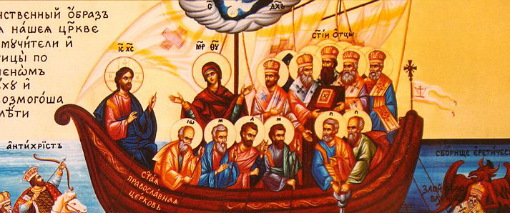
 Source: First Things
by Ivan Plis
October was not a month of especial cooperation in the global Eastern Orthodox communion. Protesting the appointment in March of an archbishop for Qatar by the Church of Jerusalem, the Church of Antioch withdrew its participation from “all the Assemblies of Canonical Orthodox Bishops abroad.” The Antiochian Patriarchate claims sole authority over the small Gulf state though at present it has no parishes of its own there. The assemblies affected by this decision include the canonical episcopal council in North America, which counts several Antiochian bishops among its officers.
Meanwhile, following a visit to Indonesia by Serbia’s Patriarch Irinej, the Greek Orthodox Metropolitanate of Singapore expressed dismay that “the Church of Serbia never informed the local canonical Orthodox Metropolitan.” This comes after a series of incidents over the summer in which its sister see in Hong Kong unilaterally excommunicated clergy of another legitimate Orthodox jurisdiction serving in the Philippines.
A 2009 meeting in Chambésy, Switzerland appointed Orthodox regional assemblies to resolve issues like these. Its goal was to reach a modus vivendi in canonically fresh territory through gradual cooperation, seeking to carry out Christ’s commandments and minister to the whole world. Why, despite such good will, have occasional clashes persisted?
Orthodox Christians in the United States (along with Western Europe) enjoy a relatively well-established church infrastructure, and even before Chambésy our hierarchs have collaborated on everything from college ministry to pastoral discipline to social witness. We are learning to overcome the legacy of generations of canonical setbacks, including decades in which sister congregations had broken communion with one another. Many of these outward wounds have been healed, most notably the 2007 restoration of communion between the Russian Church Abroad and those churches which recognized the Church of Russia during the Soviet era.
But despite this reconciliation among local brethren, we still lack a permanent resolution to the patchwork of canonical Orthodox bodies that hold overlapping authority in the Americas, Western Europe, Asia, and Oceania. Chambésy addressed all these lands except Asia, since the existing bishops on the ground were so sparse that they could hardly constitute an assembly of their own. Hence the recent controversy.
Besides violating Orthodox ecclesial order, these disputes also portray Orthodoxy in the most unflattering light imaginable. I have already mentioned over half a dozen Orthodox governing bodies in passing. When he providentially encounters the Church, small in numbers as it is, the unfamiliar American must first navigate all kinds of terminological and organizational hurdles: “Is that church up the street Greek Orthodox, Russian Orthodox, or something else? Why are those different, and why should I care, since my grandparents came to America from Norway and Vietnam?”
I set aside the question of whether he will feel welcome if he does, in fact, choose to visit an unfamiliar church with a strange name. St. Paul has a name for an impediment like those encountered by our hypothetical inquirer: skandalon.
There are plenty of obstacles to order and witness on the home front as well. The Patriarchate of Jerusalem, which Antioch has accused of overreach in the Gulf, has long been dominated by ethnically Greek hierarchs; only one Orthodox Palestinian currently holds episcopal office in the Holy Land. This has led to disaffection for the Church among many Orthodox-born Palestinians and Jordanians, some of whom have fled for other churches. And Antioch faces upheaval of its own, as the newly-elected Patriarch John (in Arabic, Youhanna) seeks to lead a Church for all Syrians in the midst of a divisive and deadly civil war. In a bitter twist, the Church of Antioch has just withdrawn from North America’s Assembly of Bishops, which oversees International Orthodox Christian Charities (IOCC)—one of the only relief agencies still active inside Syria’s borders.
The Chambésy process is the worst form of Orthodox church government for the 21st century, except for all the others. The Ecumenical Patriarch of Constantinople has the power to bring bishops together, but he cannot force them to accept an unwelcome edict. When disputes arise, they must be resolved honestly by brother bishops and their flocks, even if the solutions are slow to come.
Last Saturday the Antiochian Orthodox Church commemorated St. Raphael of Brooklyn. Born in Beirut and educated in Syria, Turkey, and Russia, he humbly and tirelessly served the diverse Orthodox flock in America in the early 20th century as their bishop. Even if churches of Slavic rite celebrated his memory back in February, he is a reminder to all Orthodox in this land that despite our formal divisions, we remain one body in Christ.
While our Church is hampered by human weakness and pettiness, much of the world is still what Protestants would call a mission field. The Orthodox Church has great riches, if like Fr. Raphael we allow ourselves to overcome our own ethnic allegiances and allow Christ to shine forth.
Ivan Plis is an Orthodox Christian in the Washington, DC area. Image via Wikimedia Commons.
[subscribe2]
2 Comments
It is time for the Assembly of Bishops who meet in the United States to make their meetings canonical. They need to declare that they are a self governing church and the synod of the Church in the United States. They are bishops in a specific geographic area. They then need to elect a Patriarch from this synod and then proceed to reorganize the church structure in the United States along with the clergy and laity. Orthodox Christianity in the United States or in any other geographic area in the non traditional Orthodox Christian geographic areas are not colonies of Orthodox Traditional Patriarchates. The Assembly of Bishops needs to declare itself the Synod of Bishops and move ahead. This is the Orthodox Way.
YES!!! A thousand times, yes.
Amen, and Amen. Let it be so.