
Source: Orthodox Observer
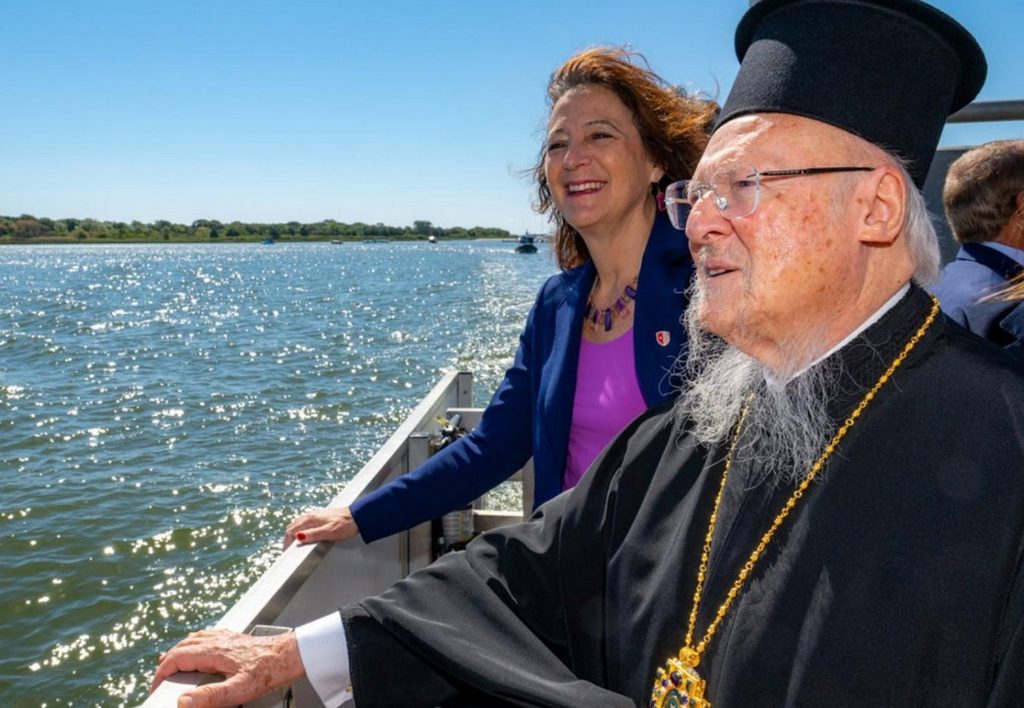
Yesterday morning, His All-Holiness Ecumenical Patriarch Bartholomew went aboard the R/V Peconic-Southampton from Stony Brook University’s marina to tour an inlet of Shinnecock Bay, in the east end of Long Island.
Aboard a trawler, His All-Holiness heard from some of the university’s researchers. The Ecumenical Patriarch was joined on the tour by hierarchs, clergy, and faithful, including His Eminence Archbishop Elpidophoros of America.
The event highlighted the environmental advocacy of the Ecumenical Patriarch, as well as the vital role Stony Brook has had in preserving the bay’s aquatic ecosystem.
A Marvel of Environmental Restoration
Dr. Chris Gobler and Dr. Ellen Pikitch are scientists from Stony Brook University’s School of Marine and Atmospheric Sciences, and have conducted research on the bay’s ecology for over a decade. Aboard the boat, they shared about the impacts humans have had on the coastal estuary.
Among scientists, Shinnecock Bay is known as a marvel of ecological restoration. The estuary earned the status of a “Hope Spot” by Mission Blue, the environmental non-profit aimed at safeguarding ocean habitats. This status designates Shinnecock Bay as a global example of successful ecosystem restoration, demonstrating that environmental damage can be reversed.
“These are special places identified as critical to the life of the ocean,” said the university’s president Andrea Goldsmith, sharing that the bay has been transformed into “clear waters now hospitable once more to a thriving marine ecosystem.”
Some of the key triumphs of the university’s restoration efforts were the restored hard clam population—diminished by the overharvesting of clams—and the return of seagrass meadows to the bay’s shallow floor. Another achievement by scientists working in the region was the fading of its brown tide—an algal bloom, caused by a high concentration of microscopic algae that is harmful to marine life and ecosystems.
Historically, Long Island supplied up to two-thirds of the U.S.’s hard clams, but overharvesting since the 1980s led to clam population collapse, harmful algal blooms, and ecosystem decline. Starting in the 1990s, scientists at Stony Brook University studied the bay and initiated restoration efforts in 2012.
Brown tide occurred frequently in Shinnecock Bay from 1985 until 2017, when the university’s revitalization of hard clams in the region helped successfully eliminate the harmful algae bloom.
“After about five years, we started to see the brown tides recede. They disappeared. We haven’t seen a brown tide in such a long time,” said Pikitch. “Now we’re seeing a rebirth of the entire ecosystem.”
In their effort to revitalize the waters of the bay, scientists began planting the adult hard clams in spawner sanctuaries—protected no-take zones with high clam density—to enable successful reproduction and repopulate the bay. The university’s researchers planted 50,000 of these clams packed closely together, to enable repopulation of the water’s built-in filtration system.
In 2011, Shinnecock Bay produced only 200 bushels of clams. Now, more clams are harvested from Shinnecock Bay than any other estuary across the south shore of New York. Gobler reports that in 2024, 12,000 bushels of clams were harvested from the estuary.
“They began to repopulate the bay, take over the entire bay, and very importantly, began to filter the water in the bay,” said Gobler. “By filtering the water, they kept the water clean and clear.”
A Legacy of Scientific Voyages
The boat tour at Stony Brook Southampton draws reference to previous symposia convened by the Ecumenical Patriarch, such as those on the Bosphorus Strait, the Mississippi River, and the Adriatic Sea, and the likes of which that have platformed the research of climate and environmental scientists since the early 1990s and ultimately led to a joint declaration on the environment signed by His All-Holiness and Pope Francis in 2017. The declaration warned of the severe consequences of ecological imbalance, and urges people of faith to make meaningful changes to protect creation for future generations.
It is for this commitment to environmental stewardship that the Ecumenical Patriarch received the Stony Brook Council University Medal—the highest honor the institution can award.
The event, called “Oceans of Hope: The Green Patriarch Recognizes Stony Brook Southampton’s Marine Sciences Mission,” drew a crowd of researchers, clergy, and local leaders into the campus’s auditorium. Stony Brook University President Goldsmith offered remarks before presenting the award.
Goldsmith says that the Green Patriarch has brought climate change to the forefront. “He has ignited conversation, not only the science of climate change, but also the moral implications of this most pressing challenge,” said Goldsmith.
“Let us never wane in our efforts, for every drop of water is a precious gift of God,” said the Ecumenical Patriarch after he received the university’s award.
Evidence of Climate Change and Continued Research
“What we’re witnessing now is clear evidence of the effects of climate change,” said Gobler in his 2025 “State of the Bays” address. Gobler is a distinguished professor and endowed chair of coastal ecology and conservation.
Environmental researchers confirm that 2024 was the hottest year ever recorded worldwide, shattering the record set just the year before. Driven by the continued buildup of greenhouse gases in the atmosphere and amplified by a stronger El Niño, average global temperatures climbed to levels unexpectedly-high for short-term climate projections. Scientists say the relentless string of record-breaking years underscores the quickening pace at which the world is experiencing climate change and the mounting urgency for nations to forgo fossil fuel emissions.
Metrics such as the increased levels of nitrogen in the waters of the bay cause algal blooms and result from alternating or unstable precipitation patterns. These result from the extreme or unpredictable weather events caused by climate change.
According to Stony Brook University, extreme weather patterns associated with climate change were evident in 2024. A record-setting rainfall reportedly destroyed dams and forced the closure of local shellfish harvests across Long Island. During that month, the pathogenic bacteria commonly known as “flesh-eating bacteria” reached levels unusually high for local waters.
“Water is our source of life and well-being,” said the Ecumenical Patriarch in his acceptance speech. He then quoted ancient Greek playwright Euripides. “The sea washes away all mankind’s evils—but the sea, the oceans, the rivers, and the streams now need our help.”
Photo by Archons/Orthodox Observer/J. Mindala