
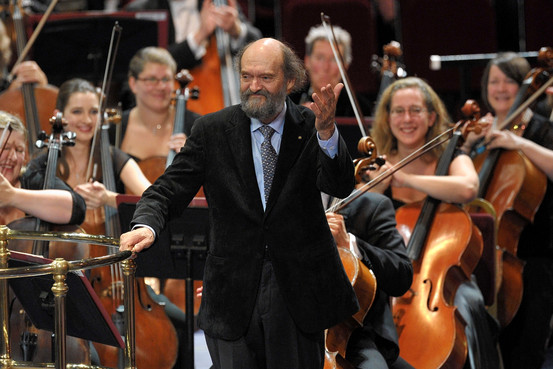
Source: The Wall Street Journal
Concerts to celebrate the most-performed classical-music composer alive
By STUART ISACOFF
You may not know the name, but you’ve heard his music. Estonian composer Arvo Pärt’s alluring, hypnotic “tintinnabuli” (“bell-like”) style has resonated with listeners world-wide—the database Bachtrack reports that Mr. Pärt is now the most performed living classical composer. The haunting music in the trailer for the film “Gravity”—a perfect complement to the image of astronauts adrift, its piano pattern suggesting a cosmic clock as floating violin tones and spacious pauses convey a sense of human frailty—is his 1978 work, “Spiegel Im Spiegel” (Mirror in the Mirror). “It is a landmark bit of sound that has found its way into films, digital media and popular culture,” says Jeffers Engelhardt, a Pärt expert who teaches at Amherst College.
Yet there is so much more to this composer. In the next few weeks, “The Arvo Pärt Project”—the inspiration of Peter Bouteneff and Nicholas Reeves, faculty members at St. Vladimir’s Orthodox Theological Seminary in Yonkers—will bring the composer to Washington and New York. Tõnu Kaljuste, whose recording of Mr. Pärt’s “Adam’s Lament” won this year’s Grammy Award for Best Choral Performance, will conduct the Estonian Philharmonic Chamber Choir and the Tallinn Chamber Orchestra in works by Mr. Pärt, offering separate programs at the Kennedy Center on May 27 and at the Phillips Collection on May 29. The ensembles will then appear at Carnegie Hall on May 31. And on June 2, the choir will perform the composer’s intricate “Kanon Pokajanen” (1997), based on the Orthodox canon of repentance, at the Metropolitan Museum of Art’s Temple of Dendur.
All of these works reflect the blossoming of a style Mr. Pärt developed after a long compositional pause in the 1970s, during which he rejected his earlier use of contemporary approaches, including 12-tone techniques, and instead embarked on the study of early music, especially Gregorian chant. At the time, he had been criticized by the Soviet authorities for his modernism. But Mr. Pärt, age 78, told me by phone from Estonia that it would be a misinterpretation to attribute the decision to reassess his craft to these political pressures. “The change in my compositional style,” he said, “grew out of a seed I felt within.”
The transformation coincided with his embrace of the Eastern Orthodox Church, though he says he considers his faith a “very personal and multilayered” subject, and therefore prefers not to discuss it. Nevertheless, as Mr. Bouteneff explains, the very elements of tintinnabuli style can be understood through a spiritual lens. There is, on the one hand, an unfolding melody and, on the other, a repeating pattern of notes derived from a simple triad, a three-note basic harmony. As they interact and sometimes collide, the melody, Mr. Bouteneff says, can be seen as earthly suffering, and the chord arpeggio as eternal consolation. In the style’s simple, clear textures, the solitary reverberations of each ring out like church bells.
Mr. Pärt suggests alternative imagery: “Breathing in and out, crying tears of sorrow and tears of joy, falling down and rising up again—it is all life. And art can also speak in this language. This is the syntax of art—its secret. And all this is what life teaches us.”
“The thing that struck me when I first heard this music at age 18,” remembers Mr. Reeves, “is that I should not be sitting—I should be standing. I cried. It’s not like a Beethoven sonata, where you are on a journey, watching how a theme develops. With Pärt, it is the opposite—you are emptying everything out, accessing a space that may be cluttered because people are always talking over it.”
It’s little wonder this composer, whose style has been called “Mystical Minimalism,” would appeal to members of the seminary. “Nicholas and I talked about our mutual admiration of Pärt in 2011,” Mr. Bouteneff remembers. “We were on fire with the idea of bringing him to St. Vladimir’s to be honored, and to have a concert at Carnegie Hall. We thought the administration would consider it too risky, too ambitious. But to our joy, our dean, Father John Behr, and our chancellor, Father Chad Hatfield, agreed.”
Mr. Bouteneff made use of a connection he had forged in 1990, when he met Mr. Pärt in England at the monastery of Archimandrite Sophrony, who had studied with the monk of Mount Athos, Staretz Silouan, the man whose poetic writings serve as the basis for Mr. Pärt’s “Adam’s Lament.” Messrs. Bouteneff and Reeves, along with Father Hatfield, traveled to Estonia to make their case. Once the composer agreed to the idea, however, the real hurdles loomed.
“Nicholas and I, who are academics and teachers and choir directors, suddenly had to become fund-raisers,” Mr. Bouteneff says. “The Estonian government helped, offering to fly the orchestra and choir over at their expense. And we had to find American sources—people of means who felt strongly about choral music, or Pärt, or Estonian culture.”
And yet large numbers of music lovers with no religious or cultural affiliation to the composer have embraced his music. Why is that? “I cannot explain it,” Mr. Pärt says. “Of course I am surprised. It is a mystery. Yet, when a listener recognizes in him- or herself something of a certain piece of music, it means there is something in common between the creator and the listener—that we are in some way similar, and we may be friends.” And perhaps that is why Mr. Pärt chooses not to discuss the meaning of these pieces in personal terms. As Mr. Kaljuste, the conductor, put it: “This music is like a blank piece of paper. Different people’s souls write different interpretations on it.”
Mr. Isacoff’s latest book is “A Natural History of the Piano” (Knopf/Vintage).