
Close Menu
    Facebook X (Twitter) Instagram
    Trending
    • #Giving Tuesday – Support Orthodox Christian Laity!
    • Together We Thrive: OCL Annual Conference & Year-End Giving Campaign
    • Archon Officers Participate in Historic Pilgrimage to Nicaea
    • Ecumenical Patriarch Bartholomew and Pope Leo recite the Creed together during 1700th Anniversary of Nicaea
    • Mission Center Board Convenes
    • The “Orthodoxy as Masculinity” Narrative
    • Walk with Us: Orthodox Volunteer Corps (OVC)
    • St. John Chrysostom’s Legacy: From Antioch to America
    Orthodox Christian Laity
    Facebook X (Twitter) YouTube
    • Home
    • OCL
      • About OCL
      • Leadership
      • OCL News
      • OCL Publications
      • Focused Study and Research Topics
      • OCL Archives at DePaul University
    • Orthodox News & Links
      • Orthodox News Stories
      • Headlines & News Archives
      • Governance & Unity
        • Governance Top Stories
        • Governance & Unity Essays
        • Grassroots Unity in Action
      • OCL Forums
      • Orthodox Christian Laity News
      • Web Links
    • Audio & Video
      • Audio Index
      • Video Index
    • Contact
    • Make a Donation
    Orthodox Christian Laity
    You are at:Home»Orthodox News»Pope Recalls ‘Authentic Spirit’ of Vatican II on Anniversary

    Pope Recalls ‘Authentic Spirit’ of Vatican II on Anniversary

    0
    By Webmaster on October 11, 2012 Orthodox News, Orthodox News Top Stories
    Share
    Facebook Twitter LinkedIn Pinterest Email Telegram WhatsApp Copy Link

    Source:  AmericanCatholic.org

    By FRANCIS X. ROCCA

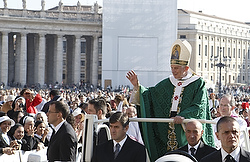
    VATICAN CITY (CNS) — Marking the 50th anniversary of the opening of the Second Vatican Council and the start of a special Year of Faith, Pope Benedict XVI called on Catholics to revive the “authentic spirit” of Vatican II by re-proposing the church’s ancient teachings to an increasingly Godless modern world.

    The pope spoke at a special Mass in St. Peter’s Square Oct. 11, half a century to the day after the opening ceremonies of Vatican II. About 400 bishops from around the world, including 15 of the 70 surviving members of the 1962-65 council, attended. Orthodox Ecumenical Patriarch Bartholomew of Constantinople and Anglican Archbishop Rowan Williams of Canterbury attended as special guests.

    The observances featured ceremonies recalling milestones of Vatican II, including the enthronement of a book of the Gospels used at the original gathering and a re-presentation of the council’s final “messages” to various categories of lay Catholics, such as artists, workers and women.

    Vatican II, Pope Benedict said, had been “animated by a desire … to immerse itself anew in the Christian mystery so as to re-propose it fruitfully to contemporary man.”

    He noted that Blessed John XIII, in his speech at the opening of the council, called for both the safeguarding and the effective teaching of the “sacred deposit of Christian doctrine … this certain and immutable doctrine, which is to be faithfully respected, (and) needs to be explored and presented in a way which responds to the needs our time.”

    “The council fathers wished to present the faith in a meaningful way,” the pope said, “and if they opened themselves trustingly to dialogue with the modern world it is because they were certain of their faith, of the solid rock on which they stood.”

    One of the council fathers, retired Bishop William J. McNaughton of Inchon, Korea, traveled to the anniversary Mass from his home in Methuen, Mass. Speaking recently to Catholic News Service, he recalled the procession of more than 2,200 bishops into St. Peter’s Basilica on the council’s first day.

    “Because television cameras from all over the world were taking pictures, all the lights were on in the basilica,” said Bishop McNaughton, 85. “I thought I was at the gate of heaven.”

    The commemoration was less spectacular and less well-attended than the 1962 event.

    “The many empty seats here, five minutes before the beginning of the Mass, show that we have many challenges, like decreasing interest in the church,” Capuchin Father William Henn, an American who teaches at Rome’s Pontifical Gregorian University, told CNS.

    Pope Benedict’s homily celebrated Vatican II but deplored much of what followed in its wake.

    Many Catholics misunderstood or ignored the council’s teachings under the influence of secular culture and “embraced uncritically the dominant mentality, placing in doubt the very foundations of the deposit of faith, which they sadly no longer felt able to accept as truths,” he said. “Recent decades have seen the advance of a spiritual ‘desertification.'”

    Fifty years ago, history offered glimpses of a “life or a world without God,” he said. “Now we see it every day around us. This void has spread.”

    Yet, the pope said, a “thirst for God, for the ultimate meaning of life” is still evident in “innumerable signs,” including the growing popularity of religious pilgrimages.

    “How come so many people today feel the need to make these journeys?” he said. “Is it not because they find there, or at least intuit, the meaning of our existence in the world?”

    Calling for a revival in the church of the “yearning to announce Christ again to contemporary man,” the pope stressed that any new evangelization “needs to be built on a concrete and precise basis, and this basis is the documents of the Second Vatican Council.”

    He reaffirmed past statements rejecting any expansive notions of a “spirit of Vatican II” that might be used to justify innovations diverging from traditional doctrine.

    “I have often insisted on the need to return, as it were, to the ‘letter’ of the council — that is to its texts — also to draw from them its authentic spirit,” the pope said. “The true legacy of the council is to be found in them.”

    The pope also reiterated one of his most prominent teachings about Vatican II, that it must be understood in continuity with the church’s millennial traditions, not as a radical break with the past.

    “The council did not formulate anything new in matters of faith, nor did it wish to replace what was ancient,” he said. “Rather, it concerned itself with seeing that the same faith might continue to be lived in the present day, that it might remain a living faith in a world of change.”
    – – –

    Contributing to this story was Sarah Delaney.

    Share. Facebook Twitter Pinterest LinkedIn Tumblr Email WhatsApp Copy Link
    Previous ArticleIn Their Own Words: History of Orthodox Christian Laity – Reflections of the Presidents (1987-2012)
    Next Article What lies beneath: Sinai’s hidden texts

    Related Posts

    December 1, 20251 Min Read

    Together We Thrive: OCL Annual Conference & Year-End Giving Campaign

    November 22, 20253 Mins Read

    Mission Center Board Convenes

    November 20, 20253 Mins Read

    Walk with Us: Orthodox Volunteer Corps (OVC)

    Leave A Reply Cancel Reply

    This site uses Akismet to reduce spam. Learn how your comment data is processed.

    Sign the Declaration for Orthodox Unity – click here…

    Register for OCL's Annual Conference - October 11, 2025

    Sign the Declaration for Orthodox Christian Unity

    Enter the Slogan Contest

    Share this page
    DISCLAIMER

    All articles represent the views of the authors and  not necessarily the official views of Orthodox Christian Laity (OCL). They are posted to encourage thoughtful discussion on topics and concerns relevant to Orthodox Christians living in a pluralistic society. OCL encourages your comments.

    Stay Informed!

    Subscribe to our Newsletter

    WE WELCOME YOUR INPUT AND SUPPORT!

    Your donation impacts and helps advance the unity of the Orthodox Church of America.

    DONATE NOW

    THANK YOU FOR YOUR CONTINUED SUPPORT!

    Upcoming Events
    Notice
    There are no upcoming events.
    Recent Comments
    • George Warholak on Ecumenical Patriarch Bartholomew and Pope Leo recite the Creed together during 1700th Anniversary of Nicaea
    • Dn Nicholas on Ecumenical Patriarch Bartholomew and Pope Leo recite the Creed together during 1700th Anniversary of Nicaea
    • Dana C Purnell on Ethiopian Bible is the oldest and complete bible on earth
    • Peter on Abp. Elpidophoros installed as National Council of Churches board chair
    • james wiliams on Video: A Vision for Orthodox Christianity’s Future in North America
    • Veras Coltroupis on Abp. Elpidophoros installed as National Council of Churches board chair
    • Joe Forzani on Ancient Christianity (Free Course) – Hillsdale College Online
    • Joe Forzani on Ancient Christianity (Free Course) – Hillsdale College Online
    • sandy myers on Ethiopian Bible is the oldest and complete bible on earth
    • Peter on Unity in the Orthodox Church
    OCL Archives Online
    Project for Orthodox Renewal
    renewal-resize
    OCL Digital Newsletter

    Subscribe to our Newsletter

    MAKE A DONATION

    Sign the Declaration for Orthodox Christian Unity

    Facebook
    Twitter
    YouTube

    St. Symeon the New Theologian and St. Photini are the Patron Saints of OCL

    footer-fnl

    Orthodox Christian Laity
    PO Box 6954

    West Palm Beach, FL · 33405
    561-585-0245

    ocladmin@ocl.org (or) orthodoxchristianlaity@gmail.com

    Sponsored by Ann Souvall in memory of husband George

    DISCLAIMER: All articles represent the views of the authors and  not necessarily the official views of Orthodox Christian Laity (OCL). They are posted to encourage thoughtful discussion on topics and concerns relevant to Orthodox Christians living in a pluralistic society. OCL encourages your comments.

    ©2025 Orthodox Christian Laity (OCL) ·  Login

    Type above and press Enter to search. Press Esc to cancel.