Source: Rod Dreher’s Diary
The Irish monk St. Columba, who died in 597, brought Christianity to Scotland, first by establishing a monastery on the Isle of Iona. That monastery was repeatedly attacked by Vikings in following centuries, and monastic life eventually died out. Among the Orthodox, there is a tradition that Columba prophesied the eventual desolation of monastic life on Iona, but said it would return shortly before the Second Coming of Christ. (For the record, I read that this alleged prophecy does not appear in the Life Of St. Columba, circa 697, which collected the wonderworking saint’s prophecies.)
If the return-to-Iona prophecy is valid, then it has been fulfilled. The Free Press writes about a Romanian Orthodox monk who has re-established Orthodox monasticism on the Isle of Iona. Excerpts from Huw Paige’s piece:
Orthodox Christianity is the branch of the Christian faith that split from Roman Catholicism in the Great Schism of 1054. It retains the early creeds, sacraments, and saints of Western Christianity; but where the Western faith has diverged, its theology, liturgy, and rhythms of life have remained unchanged. Services are largely chanted rather than spoken. Monks and nuns still follow ancient ascetic disciplines. And Christmas falls not on December 25 but on January 7, in accordance with the old Julian calendar.
Well, that’s not strictly true. It is for the Slavic Orthodox churches, generally, but the Greeks and others follow the “New Calendar” (Gregorian). Not sure why this Romanian monastery follows the Old Calendar; it might be part of a small Old Calendarist group within the Romanian Orthodox Church. Anyway:
Father Seraphim says his purpose came to him in 2010, after praying in the crypt of Father Sophrony—the Russian monk who founded the UK’s principal Orthodox monastery in 1959 and was recently canonized as a saint. He asked for a sign of what to do next, and when he emerged into the light, his phone rang.
On the line was the parish priest in Glasgow. He had just heard about an old church on the Isle of Mull. It was teetering on the edge of abandonment: Situated in a place with no permanent residents—Orthodox or otherwise, it would be lost unless someone was mad enough to take it over and turn it into a monastery. Step forward Father Seraphim, then 30. “I had just prayed literally less than a minute before about a way forward,” he remembered. “So I took that as a sign that maybe God is taking me towards this place.”
Funny, but I booked a pilgrimage in 2015 to his fledgling monastery on Mull, but didn’t make it in the end. I had forgotten about Father Seraphim and his project. Not only has the original Mull monastery thrived, but it has a daughter house on nearby Iona.
In some ways, the timing of Father Seraphim’s mission could not have been more fortuitous. According to Reverend Boniface Carroll, an Orthodox priest and anthropologist at University College London, much of Orthodoxy’s recent growth can be traced to the enforced stasis of the Covid years. “Any time people are threatened with having to rethink their worldview,” he said, “we see people opening up to new questions.”
Back on the island of Iona, the monks emphasize that Orthodoxy is not a political project but a spiritual one: a tradition focused on cultivating an intimate, unbroken relationship with Christ. A recent report from the Institute for the Impact of Faith in Life on shifting religious beliefs in the UK attributed a “striking number of new or returning adherents” to Christianity to a move towards “experiential and personalized belief.” Such a description applies neatly to Orthodoxy.
Last bit:
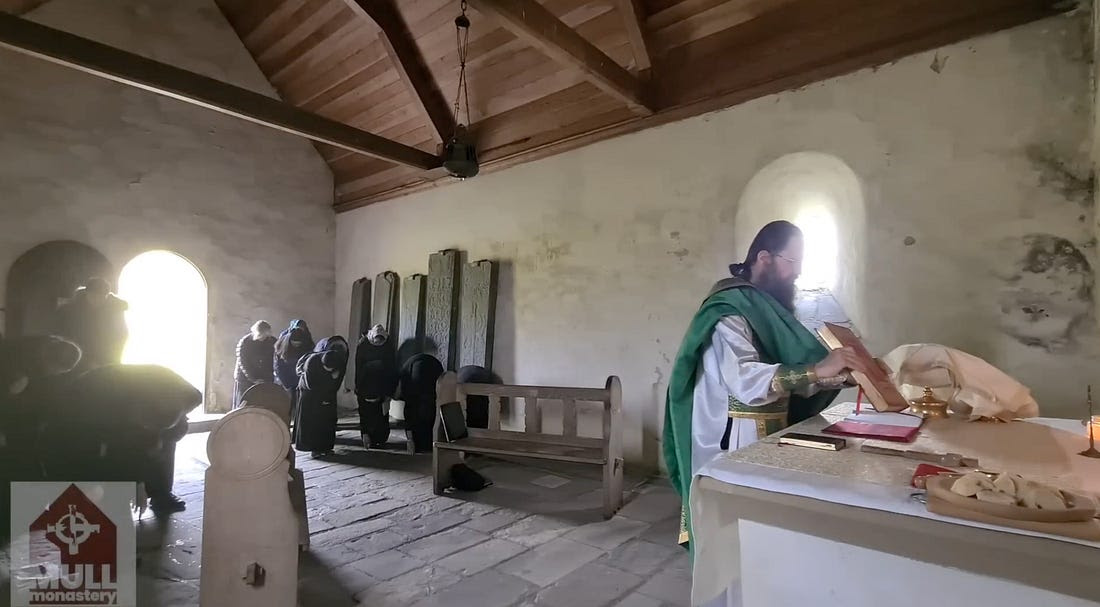
Other than on special days of worship, the monastery’s days follow a common pattern. The morning begins an hour or so after dawn with matins (morning prayers) in the monastery’s chapel, a shepherd’s hut standing in the center of the guesthouse’s small garden. This is followed by breakfast: On the regular fasting days of Wednesday and Friday, this involves a vegetarian spread of toast, jam, and leftovers from the night before; during the rest of the week, there are omelets and cheeses. Orthodoxy is full of such requirements: from ritual prostrations to weeks-long fasts before Christmas and Pascha (Easter). It is this seriousness—the combination of discipline and beauty—that draws many new converts.
Declan Collins, 28, is one relatively recent convert, having found his faith six years ago. For him, attending church was “the culmination of an intellectual journey,” prompted by watching the YouTube videos of an Orthodox icon carver. “I’m not really sure of anyone I know who hasn’t got to it online in some kind of capacity,” he said. While he emphasized the difficulty in summarizing theoretical and spiritual ideas for nonbelievers, he sees Orthodoxy fundamentally as “a way of transformation of the person towards being more loving.” He described it as “a complete way of life.”
Read the whole thing. Iona has a very special place in Celtic monasticism — and as the Celtic monks were thriving when the Church was united, both Catholics and Orthodox can claim them as their own.
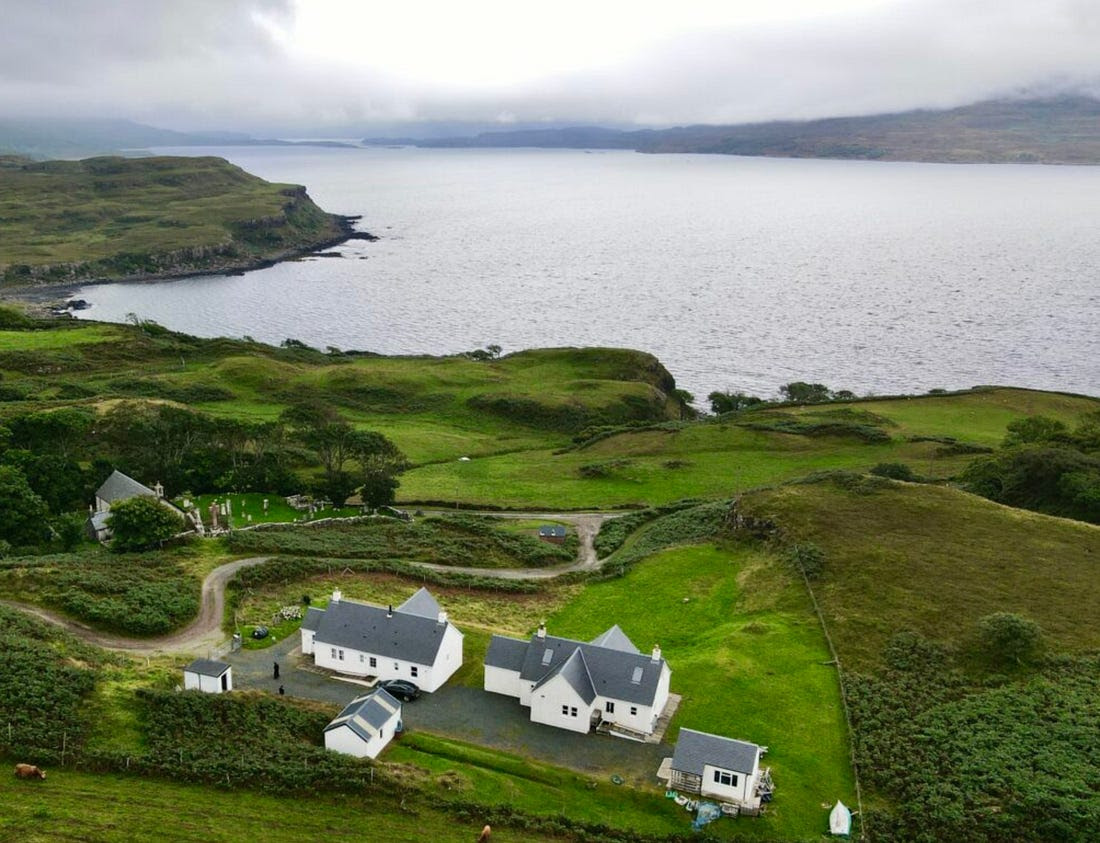
The nuns live on the original settlement on Mull, and the monks in a hermitage on nearby Iona, established in 2022. Here’s a link to Fr Seraphim’s YouTube channel. Here’s a photo of the church, monastery, and guest cottages on Mull. I’ve got to get there one of these days. Why not book a pilgrimage yourself? Here’s the website of the Mull monastery.
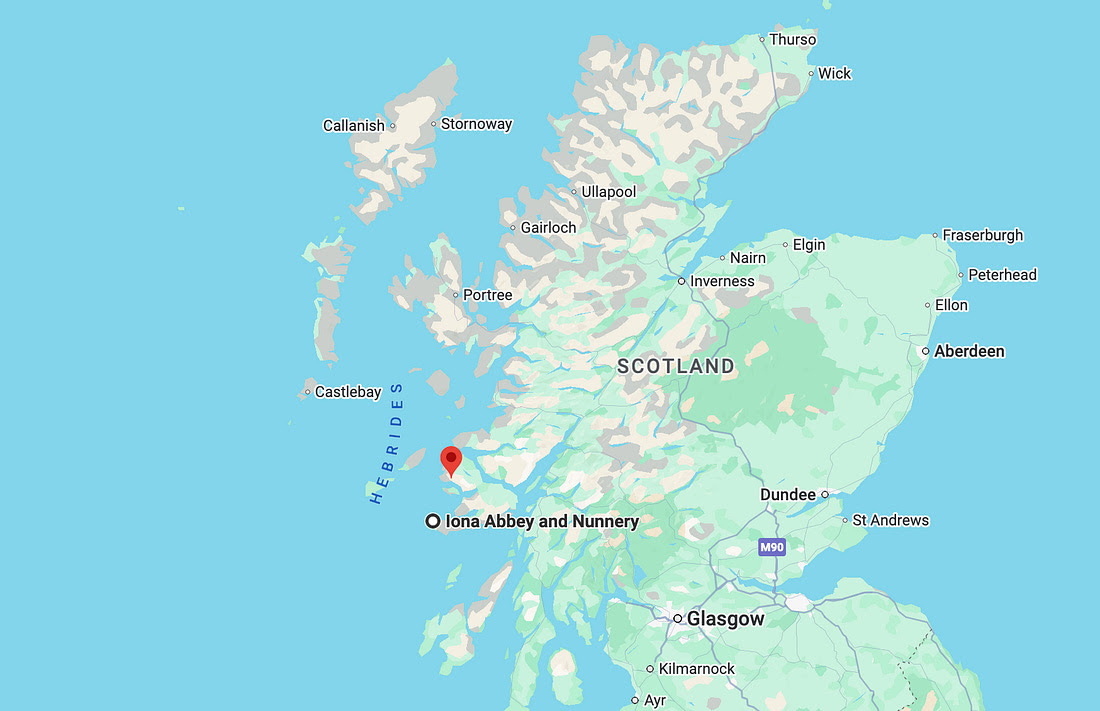
And here is a screenshot from Google Maps to situate you. The red marker is where the Mull monastery is; the Iona monastery is labeled. Did you know that Iain McGilchrist lives not far away, on the Isle of Skye? No wonder it’s so hard for him to travel!