
Source: Archons of the Ecumenical Patriarchate
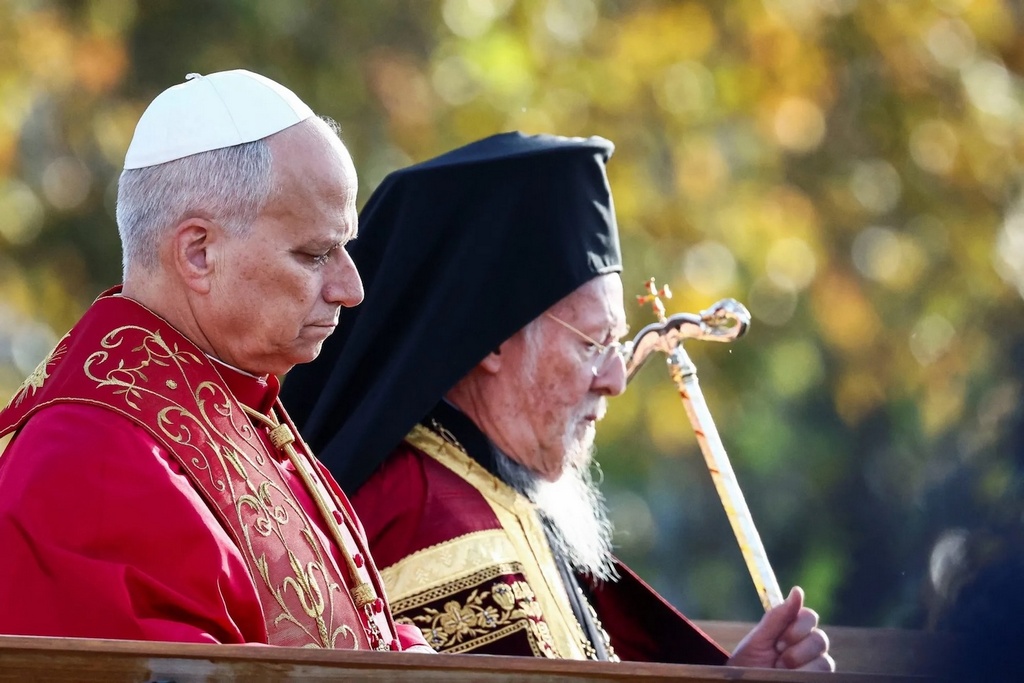
History was made on Friday, November 28, 2025, when His All-Holiness Ecumenical Patriarch Bartholomew and His Holiness Pope Leo XIV met in the ancient city of Nicaea, the site of the First Ecumenical Council in 325 AD, in order to commemorate the 1700th anniversary that historic gathering, one of the pillars and foundations of the Christian Faith in both the East and the West.
On the shores of Lake Nicaea, the likely site of the Church of the Holy Fathers, where the Council of Nicaea was convened, His All-Holiness and the Pope spoke about the legacy of the First Ecumenical Council and the abiding need for Christian unity. Adding to the significance of the gathering as a prophetic call for Christian unity was the fact that also present was His Beatitude Pope and Patriarch Theodore II of Alexandria and All the East, as well as Hierarchs from the Orthodox Churches of the Syrians, Copts, and Armenians, and leaders of Protestant and Anglican Churches.
In his address, Ecumenical Patriarch Bartholomew spoke first to those assembled Hierarchs, saying: “We are deeply moved that you have all responded positively to our humble invitation to honor through this joint pilgrimage the memory and legacy of the First Ecumenical Council held here, at Nicaea, seventeen hundred years ago.”
His All-Holiness then emphasized the enduring importance and sacred example of the Council of Nicaea: “Despite so many intervening centuries, and all the upheavals, difficulties, and divisions they have brought, we nevertheless approach this sacred commemoration with shared reverence and a common feeling of hope. For we are gathered here not simply to remember the past. We are here to bear living witness to the same faith expressed by the Fathers of Nicaea.”
The Ecumenical Patriarch added that “the power of this place does not reside in what passes away, but in what endures forever. In Nicaea, history bore witness to eternity, to the fact that our Lord and Savior Jesus Christ is true God of true God, consubstantial with the Father (ὁμοούσιος τῷ Πατρί). Enshrined in the Nicene Creed, such expressions distill and present to all the faith of the Apostles.” He called upon those present to a renewed commitment to unity: “Having the fervor of the faith of Nicaea burning in our hearts, ‘let us run the course’ of Christian unity ‘that is set before us’ (cf. Hebrews 12:1); let us ‘hope to the end for the grace’ that is promised ‘at the revelation of Jesus Christ’ (cf. 1 Peter 1:13); and, finally, ‘let us love one another, that with one mind we may confess: Father, Son, and Holy Spirit, Trinity consubstantial and undivided.’ Amen!”
In his own remarks, Pope Leo thanked His All-Holiness for his “great wisdom and foresight” in inviting Church leaders to come together to celebrate the anniversary of the First Ecumenical Council. He noted that in determining the nature of Christ, the Creed of Nicaea guards against the risk of “reducing Jesus Christ to a kind of charismatic leader or superman, a misrepresentation that ultimately leads to sadness and confusion.”
The Pope asked: “But if God did not become man, how can mortal creatures participate in His immortal life? What was at stake at Nicaea, and is at stake today, is our faith in the God who, in Jesus Christ, became like us to make us ‘partakers of the divine nature.’” Echoing the Ecumenical Patriarch’s call to unity, His Holiness said: “Faith ‘in one Lord Jesus Christ, the Only Begotten Son of God, born of the Father before all ages… consubstantial with the Father’ (Nicene Creed), is a profound bond already uniting all Christians.” He called for a deepening of that unity through “adherence to the Word of God revealed in Jesus Christ, under the guidance of the Holy Spirit, in mutual love and dialogue.”
Pope Leo noted also that “the desire for full communion among all believers in Jesus Christ,” which has been frequently stated in many quarters in the context of discussion of his meeting with the Ecumenical Patriarch in Nicaea, “is always accompanied by the search for fraternity among all human beings.” He warned, however, against “the use of religion for justifying war, violence, or any form of fundamentalism or fanaticism. Instead, the paths to follow are those of fraternal encounter, dialogue and cooperation.”
At the Phanar on November 29, 2025, His All-Holiness and the Pope signed a Joint Declaration that reiterated their commitment, on behalf of both Churches, to the ultimate restoration of full communion, and their mutual rejection of using religion to justify violence.
The Declaration stated: “The commemoration of the 1700th anniversary of the First Ecumenical Council of Nicaea, celebrated on the eve of our meeting, was an extraordinary moment of grace. The Council of Nicaea held in 325 AD was a providential event of unity. The purpose for commemorating this event, however, is not simply to call to mind the historical importance of the Council, but to spur us on to be continuously open to the same Holy Spirit who spoke through Nicaea, as we wrestle with the many challenges of our time.”
In this Declaration, the Ecumenical Patriarch and the Pope pledged to continue their common effort to resolve the issues that divide the two ancient Churches, notably, the date of Easter. “It is our shared desire,” the Declaration says, “to continue the process of exploring a possible solution for celebrating together the Feast of Feasts every year.” They hailed the historic removal in 1965 of the mutual excommunications of the leaders of each Church, which were first put in place since 1054, and added: “We give thanks to God that this prophetic gesture prompted our Churches to pursue ‘in a spirit of trust, esteem and mutual charity the dialogue which, with God’s help, will lead to living together again, for the greater good of souls and the coming of the kingdom of God, in that full communion of faith, fraternal accord and sacramental life which existed among them during the first thousand years of the life of the Church.’”
The Joint Declaration also says that “the goal of Christian unity includes the objective of contributing in a fundamental and life-giving manner to peace among all peoples.” In this context, the Declaration firmly rejects religious violence, and concludes on a hopeful note: “While we are deeply alarmed by the current international situation, we do not lose hope. God will not abandon humanity.”
In an interview about the Pope’s visit, Ecumenical Patriarch Bartholomew emphasized that “this reminds the faithful that we are stronger and more credible when we are united in our witness and in responding to the world’s challenges.”
In our dedication to supporting and defending the Ecumenical Patriarch as he carries out his global mission, the Archons of the Ecumenical Patriarch are likewise striving for that sacred unity.