
Close Menu
    Facebook X (Twitter) Instagram
    Trending
    • #Giving Tuesday – Support Orthodox Christian Laity!
    • Together We Thrive: OCL Annual Conference & Year-End Giving Campaign
    • Archon Officers Participate in Historic Pilgrimage to Nicaea
    • Ecumenical Patriarch Bartholomew and Pope Leo recite the Creed together during 1700th Anniversary of Nicaea
    • Mission Center Board Convenes
    • The “Orthodoxy as Masculinity” Narrative
    • Walk with Us: Orthodox Volunteer Corps (OVC)
    • St. John Chrysostom’s Legacy: From Antioch to America
    Orthodox Christian Laity
    Facebook X (Twitter) YouTube
    • Home
    • OCL
      • About OCL
      • Leadership
      • OCL News
      • OCL Publications
      • Focused Study and Research Topics
      • OCL Archives at DePaul University
    • Orthodox News & Links
      • Orthodox News Stories
      • Headlines & News Archives
      • Governance & Unity
        • Governance Top Stories
        • Governance & Unity Essays
        • Grassroots Unity in Action
      • OCL Forums
      • Orthodox Christian Laity News
      • Web Links
    • Audio & Video
      • Audio Index
      • Video Index
    • Contact
    • Make a Donation
    Orthodox Christian Laity
    You are at:Home»Governance & Unity News»Governance & Unity Essays»The Kremlin Playbook 3: Keeping the Faith

    The Kremlin Playbook 3: Keeping the Faith

    0
    By Webmaster on April 12, 2022 Governance & Unity Essays, Governance & Unity News, Uncategorized
    Share
    Facebook Twitter LinkedIn Pinterest Email Telegram WhatsApp Copy Link

    Source: Center for Strategic & International Studies (CSIS)

    Originally published on February 22, 2022
    WRITTEN BY Donatienne Ruy, Director, Abshire-Inamori Leadership Academy

    Heather A. Conley

    Former Senior Vice President for Europe, Eurasia, and the Arctic; and Former Director, Europe, Russia, and Eurasia Program

    Marlene Laruelle

    Director and Research Professor, George Washington University’s Elliott School of International Affairs.

    Tengiz Pkhaladze
    Associate Professor and Head of the BA Program in Political Science, Georgian Institute of Public Affairs
    Elizabeth H. Prodromou
    Faculty Member and Faculty Director of the Initiative on Religion, Law, and Diplomacy, The Fletcher School at Tufts University
    Majda Ruge
    Senior Policy Fellow with the Wider Europe Program, the European Council on Foreign Relations (ECFR)

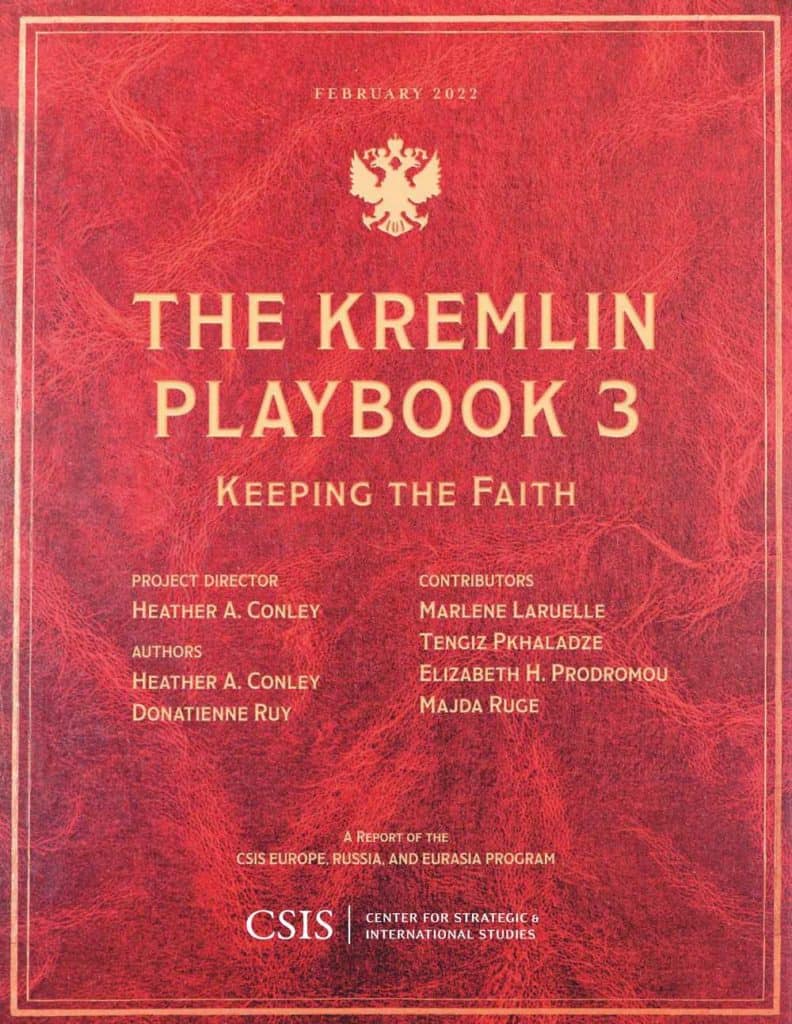
    For six years, the Kremlin Playbook series has studied Russia’s malign influence efforts in Europe, primarily through the economic lens. This research showed the Kremlin has developed a pattern of malign economic influence in Europe through the cultivation of “an opaque network of patronage across the region that it uses to influence and direct decision-making.” The aim is to weaken democratic systems from within, using existing and creating new societal divides.

    But what if Russia, for its own malign purposes, were to seek to influence religious or traditional views? The Kremlin Playbook 3: Keeping the Faith aims to protect these beliefs by exposing how Russian malign influence works in this particularly challenging and very personal dimension—a new strategic seam—to ensure citizens do not unwittingly become part of an influence operation. The instrumentalization of values, traditions, and religious beliefs is a relatively recent and particularly pernicious front of the Kremlin’s influence efforts in Europe and elsewhere. This study investigates these dynamics in four case study countries: Bosnia and Herzegovina, France, Georgia, and Greece.

    This report explores how the United States and its European allies can protect the religious beliefs and values of their citizens from malign influence at a time when transatlantic societies are grappling with the speed of societal change. Societal anxiety and fear related to these rapid economic, demographic, and generational shifts—and the subsequent politics and political figures that seek to capitalize on them—have fueled societal divisions around the so-called cultural wars in Western societies. Through two main channels, the Orthodox world and the traditional values ecosystem, the Kremlin has taken advantage of these fears to accentuate societal wedges in Europe and Eurasia.

    You can access the full report here.

    DOWNLOADS
    Download the Full Report
    Bosnia Case Study
    France Case Study
    Georgia Case Study

    See especially the Greece Case Study written by Elizabeth H. Prodromou, excerpted below :

    Greece

    INFLUENCE OPERATIONS IN GREECE’S RELIGIOUS ECOSYSTEM

    Elizabeth H. Prodromou

    INTRODUCTION

    Greece’s Unique Significance for Russia’s Geostrategy of Weaponizing Traditionalism
    Greece plays a unique role as a crucial geospace for Russian geostrategic ambitions in the twenty-first century. [362] Throughout the Cold War and in the 30 years following it, Russia has had an unwavering focus on maximizing relations with Greece. Greece is a key target because of its role in both NATO and within the global Orthodox ecosystem, making the Kremlin’s influence-building goals in Greece twofold and mutually reinforcing. In this regard, Moscow views the weaponization of traditionalism as a geometric influence builder with regional, transnational, and international impacts in Greece and, more broadly, across Eurasia.

    The Church of Greece and Mount Athos are the two primary operational spaces in which Russia deploys strategic conservatism through a combination of soft- and sharp-power tools that highlight the need for transatlantic policymakers to understand the linkages between religion and geopolitics. The Church of Greece is a norms entrepreneur in that church leaders understand the social impact and political relevance of Orthodoxy as dependent on the deployment of “moral arguments and strategic constructions to persuade relevant audiences” to define both their interests and their identities.[363]

    Furthermore, Orthodoxy’s crucial historical role in the establishment of the Greek state makes the Church of Greece a stakeholder in political conversations related to Greek sovereignty and the country’s place in the democratic international architecture, specifically NATO. But perhaps more powerfully, Mt. Athos, or “the Holy Mountain,” has been the undisputed center of Orthodox Christian spirituality since the tenth-century establishment of the monastic community under Byzantine imperial patronage. The self-governing, legal personality of the Monastic Republic of Mt. Athos is recognized in both the Greek Constitution and European Union law and is part of Greek sovereign territory…

    Read the complete study here (PDF)

    This research was made possible by the support of the Smith Richardson Foundation.

    Share. Facebook Twitter Pinterest LinkedIn Tumblr Email WhatsApp Copy Link
    Previous ArticleMissing the Mark: The Fail of Orthodoxy without Orthopraxy
    Next Article True Greatness – A Viewpoint by Fr. Theodore Stylianopoulos

    Related Posts

    December 1, 20251 Min Read

    #Giving Tuesday – Support Orthodox Christian Laity!

    November 28, 20255 Mins Read

    Archon Officers Participate in Historic Pilgrimage to Nicaea

    November 28, 20251 Min Read

    Ecumenical Patriarch Bartholomew and Pope Leo recite the Creed together during 1700th Anniversary of Nicaea

    Leave A Reply Cancel Reply

    This site uses Akismet to reduce spam. Learn how your comment data is processed.

    Sign the Declaration for Orthodox Unity – click here…

    Register for OCL's Annual Conference - October 11, 2025

    Sign the Declaration for Orthodox Christian Unity

    Enter the Slogan Contest

    Share this page
    DISCLAIMER

    All articles represent the views of the authors and  not necessarily the official views of Orthodox Christian Laity (OCL). They are posted to encourage thoughtful discussion on topics and concerns relevant to Orthodox Christians living in a pluralistic society. OCL encourages your comments.

    Stay Informed!

    Subscribe to our Newsletter

    WE WELCOME YOUR INPUT AND SUPPORT!

    Your donation impacts and helps advance the unity of the Orthodox Church of America.

    DONATE NOW

    THANK YOU FOR YOUR CONTINUED SUPPORT!

    Upcoming Events
    Notice
    There are no upcoming events.
    Recent Comments
    • George Warholak on Ecumenical Patriarch Bartholomew and Pope Leo recite the Creed together during 1700th Anniversary of Nicaea
    • Dn Nicholas on Ecumenical Patriarch Bartholomew and Pope Leo recite the Creed together during 1700th Anniversary of Nicaea
    • Dana C Purnell on Ethiopian Bible is the oldest and complete bible on earth
    • Peter on Abp. Elpidophoros installed as National Council of Churches board chair
    • james wiliams on Video: A Vision for Orthodox Christianity’s Future in North America
    • Veras Coltroupis on Abp. Elpidophoros installed as National Council of Churches board chair
    • Joe Forzani on Ancient Christianity (Free Course) – Hillsdale College Online
    • Joe Forzani on Ancient Christianity (Free Course) – Hillsdale College Online
    • sandy myers on Ethiopian Bible is the oldest and complete bible on earth
    • Peter on Unity in the Orthodox Church
    OCL Archives Online
    Project for Orthodox Renewal
    renewal-resize
    OCL Digital Newsletter

    Subscribe to our Newsletter

    MAKE A DONATION

    Sign the Declaration for Orthodox Christian Unity

    Facebook
    Twitter
    YouTube

    St. Symeon the New Theologian and St. Photini are the Patron Saints of OCL

    footer-fnl

    Orthodox Christian Laity
    PO Box 6954

    West Palm Beach, FL · 33405
    561-585-0245

    ocladmin@ocl.org (or) orthodoxchristianlaity@gmail.com

    Sponsored by Ann Souvall in memory of husband George

    DISCLAIMER: All articles represent the views of the authors and  not necessarily the official views of Orthodox Christian Laity (OCL). They are posted to encourage thoughtful discussion on topics and concerns relevant to Orthodox Christians living in a pluralistic society. OCL encourages your comments.

    ©2025 Orthodox Christian Laity (OCL) ·  Login

    Type above and press Enter to search. Press Esc to cancel.