
Close Menu
    Facebook X (Twitter) Instagram
    Trending
    • #Giving Tuesday – Support Orthodox Christian Laity!
    • Together We Thrive: OCL Annual Conference & Year-End Giving Campaign
    • Archon Officers Participate in Historic Pilgrimage to Nicaea
    • Ecumenical Patriarch Bartholomew and Pope Leo recite the Creed together during 1700th Anniversary of Nicaea
    • Mission Center Board Convenes
    • The “Orthodoxy as Masculinity” Narrative
    • Walk with Us: Orthodox Volunteer Corps (OVC)
    • St. John Chrysostom’s Legacy: From Antioch to America
    Orthodox Christian Laity
    Facebook X (Twitter) YouTube
    • Home
    • OCL
      • About OCL
      • Leadership
      • OCL News
      • OCL Publications
      • Focused Study and Research Topics
      • OCL Archives at DePaul University
    • Orthodox News & Links
      • Orthodox News Stories
      • Headlines & News Archives
      • Governance & Unity
        • Governance Top Stories
        • Governance & Unity Essays
        • Grassroots Unity in Action
      • OCL Forums
      • Orthodox Christian Laity News
      • Web Links
    • Audio & Video
      • Audio Index
      • Video Index
    • Contact
    • Make a Donation
    Orthodox Christian Laity
    You are at:Home»Orthodox News»Ancestors of the Orthodox Faith: The Reception of Peter

    Ancestors of the Orthodox Faith: The Reception of Peter

    0
    By Webmaster on July 8, 2015 Orthodox News, Orthodox News Top Stories
    Share
    Facebook Twitter LinkedIn Pinterest Email Telegram WhatsApp Copy Link
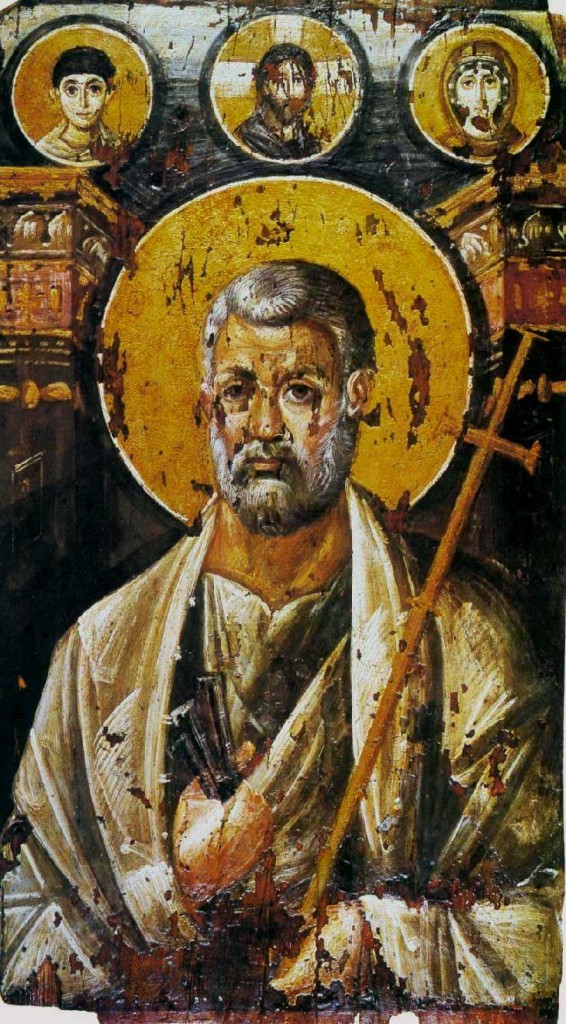
    Ancestors of the Orthodox Faith: The Reception of Peter An icon depicting Peter, holding a set of keys, St. Catherine’s Monastery, Sinai peninsula, Egypt. The painting dates to the sixth or seventh century A.D.
    An icon depicting Peter, holding a set of keys, St. Catherine’s Monastery, Sinai peninsula, Egypt. The painting dates to the sixth or seventh century A.D.

    Source: The Deily Planet

    Ancestors of the Orthodox Faith: The Reception of Peter

    What happened to St. Peter? The short answer is that we don’t know. The longer answer is more interesting.

    It is precisely the lack of authoritative information about Peter that enabled laterChristians to develop competing legends about the final years of his life. In some cases, these differences are quite surprising, especially for modern readers used to associating St. Peter with the Vatican. But not all of the stories about Peter place him in Rome.

    Why is there such an important discrepancy? And what do all these stories tell us about the diversity of Christian opinions about Peter?

    The last biographical mention of Peter in the New Testament occurs in the Acts of the Apostles (15). This chapter places Peter at a meeting of the disciples in Jerusalem. For biographers, there’s not much else to go on. Two ancient letters—attributed to Peter, included in the New Testament, but most likely written by someone else in Peter’s name—offer no information about him apart from a vague reference that sends greetings from “Babylon.”

    The earliest written accounts of Peter’s post-biblical activity, known as “apocrypha,” date to the late second century A.D. Many of these accounts offer elaborate tales in which Peter is the heroic protagonist. Not surprisingly, there has been a great deal of scholarly interest in these texts.

    Among the oldest surviving references to Peter in this material is a story that he traveled to Rome in order to combat the false teaching of a sorcerer named Simon. This story builds on material known from earlier writers. In Acts 8, for example, Peter had rebuked Simon for trying to purchase the gifts of the Holy Spirit. Interestingly, Simon will reappear in almost every apocryphal account of Peter’s activities as a kind of arch-nemesis.

    The Martyrdom of Peter and the Acts of Peter exemplify Peter’s dramatic encounter with Simon. In both accounts, Peter and Simon trade supernatural blows. In some versions, Simon dies and Peter’s demonstration of power leads to widespread conversion. Some writers place this quasi-duel in Rome. Then, they proceed to narrate Peter’s martyrdom there. In one account, Peter is killed by a group of angry Roman landowners because the saint has convinced their wives to adopt celibacy.

    What is equally remarkable, though, is that not all of the ancient writers place Peter in the city of Rome.

    An alternate view is provided by a collection of texts known as the Pseudo-Clementines. These texts were written in Palestine by a variety of authors in the fourth century A.D. The collection contains homilies, supposedly preached by Peter; a treatise; and two letters. In all but one of the letters, the disparate writers see Jerusalem—not Rome—as the center of the Christian world. The texts themselves deal exclusively with the churches of Palestine and Syria. For many of the same reasons that the Roman church would eventually emphasize the connections between Peter, Rome, and the Roman church, so too these other documents, the Pseudo-Clementines, emphasize Peter’s role in the foundation narratives of many Syrian and Palestinian communities.

    None of these apocryphal texts describe Peter as a bishop. Only a very few, moreover, describe him as having any relationship to the episcopal structure of Rome.

    To be sure, there are some ancient sources that do link Peter to the episcopal structure of the Roman church, but it is important to emphasize that there was no single “orthodox” tradition in early Christianity about what happened to Peter when he drops out of the historical narrative of the Book of Acts. Indeed, it was one of the most significant achievements of the Roman church in the fifth and sixth centuries that it was able to convince other Christian communities to adopt its tradition concerning the end of Peter’s life, which situated him squarely in Rome and as the foundation of the papacy.


    DemacopoulosGeorge E Demacopoulos (Ph.D., University of North Carolina Chapel Hill) is Professor of Theology and Director & Co-Founder of the Orthodox Christian Studies Center at Fordham University in New York. Follow George on Deily and Twitter @GDemacopoulos.

    [subscribe2]
    Share. Facebook Twitter Pinterest LinkedIn Tumblr Email WhatsApp Copy Link
    Previous ArticleClergy Families: The Helpless Forgottens’ Cry for Help Answered Through Reality Therapy
    Next Article The Greek Orthodox Archdiocese: Its Past, Present, and Future – An Interview with Archimandrite Nathanael Symeonides

    Related Posts

    December 1, 20251 Min Read

    Together We Thrive: OCL Annual Conference & Year-End Giving Campaign

    November 22, 20253 Mins Read

    Mission Center Board Convenes

    November 20, 20253 Mins Read

    Walk with Us: Orthodox Volunteer Corps (OVC)

    Leave A Reply Cancel Reply

    This site uses Akismet to reduce spam. Learn how your comment data is processed.

    Sign the Declaration for Orthodox Unity – click here…

    Register for OCL's Annual Conference - October 11, 2025

    Sign the Declaration for Orthodox Christian Unity

    Enter the Slogan Contest

    Share this page
    DISCLAIMER

    All articles represent the views of the authors and  not necessarily the official views of Orthodox Christian Laity (OCL). They are posted to encourage thoughtful discussion on topics and concerns relevant to Orthodox Christians living in a pluralistic society. OCL encourages your comments.

    Stay Informed!

    Subscribe to our Newsletter

    WE WELCOME YOUR INPUT AND SUPPORT!

    Your donation impacts and helps advance the unity of the Orthodox Church of America.

    DONATE NOW

    THANK YOU FOR YOUR CONTINUED SUPPORT!

    Upcoming Events
    Notice
    There are no upcoming events.
    Recent Comments
    • George Warholak on Ecumenical Patriarch Bartholomew and Pope Leo recite the Creed together during 1700th Anniversary of Nicaea
    • Dn Nicholas on Ecumenical Patriarch Bartholomew and Pope Leo recite the Creed together during 1700th Anniversary of Nicaea
    • Dana C Purnell on Ethiopian Bible is the oldest and complete bible on earth
    • Peter on Abp. Elpidophoros installed as National Council of Churches board chair
    • james wiliams on Video: A Vision for Orthodox Christianity’s Future in North America
    • Veras Coltroupis on Abp. Elpidophoros installed as National Council of Churches board chair
    • Joe Forzani on Ancient Christianity (Free Course) – Hillsdale College Online
    • Joe Forzani on Ancient Christianity (Free Course) – Hillsdale College Online
    • sandy myers on Ethiopian Bible is the oldest and complete bible on earth
    • Peter on Unity in the Orthodox Church
    OCL Archives Online
    Project for Orthodox Renewal
    renewal-resize
    OCL Digital Newsletter

    Subscribe to our Newsletter

    MAKE A DONATION

    Sign the Declaration for Orthodox Christian Unity

    Facebook
    Twitter
    YouTube

    St. Symeon the New Theologian and St. Photini are the Patron Saints of OCL

    footer-fnl

    Orthodox Christian Laity
    PO Box 6954

    West Palm Beach, FL · 33405
    561-585-0245

    ocladmin@ocl.org (or) orthodoxchristianlaity@gmail.com

    Sponsored by Ann Souvall in memory of husband George

    DISCLAIMER: All articles represent the views of the authors and  not necessarily the official views of Orthodox Christian Laity (OCL). They are posted to encourage thoughtful discussion on topics and concerns relevant to Orthodox Christians living in a pluralistic society. OCL encourages your comments.

    ©2025 Orthodox Christian Laity (OCL) ·  Login

    Type above and press Enter to search. Press Esc to cancel.