
Close Menu
    Facebook X (Twitter) Instagram
    Trending
    • #Giving Tuesday – Support Orthodox Christian Laity!
    • Together We Thrive: OCL Annual Conference & Year-End Giving Campaign
    • Archon Officers Participate in Historic Pilgrimage to Nicaea
    • Ecumenical Patriarch Bartholomew and Pope Leo recite the Creed together during 1700th Anniversary of Nicaea
    • Mission Center Board Convenes
    • The “Orthodoxy as Masculinity” Narrative
    • Walk with Us: Orthodox Volunteer Corps (OVC)
    • St. John Chrysostom’s Legacy: From Antioch to America
    Orthodox Christian Laity
    Facebook X (Twitter) YouTube
    • Home
    • OCL
      • About OCL
      • Leadership
      • OCL News
      • OCL Publications
      • Focused Study and Research Topics
      • OCL Archives at DePaul University
    • Orthodox News & Links
      • Orthodox News Stories
      • Headlines & News Archives
      • Governance & Unity
        • Governance Top Stories
        • Governance & Unity Essays
        • Grassroots Unity in Action
      • OCL Forums
      • Orthodox Christian Laity News
      • Web Links
    • Audio & Video
      • Audio Index
      • Video Index
    • Contact
    • Make a Donation
    Orthodox Christian Laity
    You are at:Home»Orthodox News»Revival in the Balkans

    Revival in the Balkans

    0
    By Webmaster on June 27, 2014 Orthodox News, Orthodox News Top Stories
    Share
    Facebook Twitter LinkedIn Pinterest Email Telegram WhatsApp Copy Link
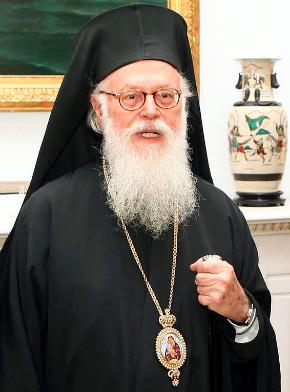
    Anastasios, the archbishop of Tirana and the primate of the Autocephalous Albanian Orthodox Church. Licensed under CC BY-SA 2.0 via Wikimedia Commons.
    Anastasios, the archbishop of Tirana and the primate of the Autocephalous Albanian Orthodox Church. Licensed under CC BY-SA 2.0 via Wikimedia Commons.

    Source: The Christian Century

    by Philip Jenkins

    During the 1990s, perhaps 150,000 people perished in the hellish violence that raged over the Balkan peninsula. Al­though the conflicts were largely defined by ethnic differences, religion played a critical role in the three-sided war be­tween Orthodox Christians, Roman Catholics, and Muslims. Armed gangs would burst into a house and demand that residents make the sign of the cross. Your life could depend on whether you made the horizontal bar from right to left (Orthodox) or vice versa (Catholic). Across Kosovo and Bosnia-Herzegovina, ancient places of worship were desecrated and their artistic treasures vandalized.

    After such horrors, it might seem unthinkable to find signs of hope in the region’s religious life, but some forceful individuals demand our attention. One is Mustafa Cerić, the Islamic grand mufti of Bosnia. In the worst of the violence, his faith not only survived but grew and broadened. As he said, “When you are faced with death and when you see that humans do not help you, and you are left alone for four years in besieged Sarajevo, therefore you cannot live alone, you have to seek some help.” He has worked diligently to promote understanding between Europe’s Muslim, Jewish, and Christian leaders.

    Mustafa Cerić speaks force­fully to European Muslims, who face the twin seductions of secularism and Islamist extremism. Muslims, he says, must reject any view that “the only hope is in the Muslim past as a way of life and a goal of history.” In words that apply across religions, he urges Muslim migrants to Western Europe to follow three fundamental laws: learn the language of your host country; obey its laws; and try and do something good for that country.

    Although the nation of Albania was not directly involved in the wars, ethnic Albanians suffered heavily from the fighting in neighboring Kosovo. Albania itself, moreover, recovered only slowly from the horrendous communist tyranny of Enver Hoxha, a self-proclaimed Stalinist who had a deep animus against religion of all kinds. In 1967 he declared Albania the world’s first wholly atheist state, and persecutions were wide-ranging and ferocious. Catholics and Muslims were targeted for harsh treatment. In its way, then, postcommunist Albania needed a thoroughgoing spiritual reconstruction no less than Bosnia.

    The most impressive leader of this process has been Anastasios, the archbishop of Tirana and the primate of the Autocephalous Albanian Orthodox Church. (He is by origin an ethnic Greek.) When he took office in 1992 he faced a nightmare situation. His see had been vacant since 1973, and virtually all its institutions formally closed. Albanian Orthodoxy survived in a diasporic existence, with its overseas capital in Boston. The country’s Orthodox Church, claiming the loyalty of perhaps 15 percent of the population, faced extinction.

    First and foremost, Anastasios is a polymath scholar, with interests in history, linguistics, and comparative religion, but it is difficult to imagine any religious leader accomplishing so much practical real-world good in such a short time. In 20 years he reorganized several hundred parishes, a process that often demanded whole new buildings. Monasteries flourish once more. The archbishop restored the theological academy and seminary and ordained hundreds of new priests. A whole range of Orthodox media now operate, including newspapers and radio stations.

    The church’s social outreach and charitable works have been spectacular. The results include new schools and medical clinics, which serve people without regard to religious affiliation. When the wars in former Yugoslavia drove thousands of refugees into Albania, the Orthodox Church took the lead in humanitarian efforts, with Muslims the main beneficiaries. Anastasios works for harmony with the country’s other faiths, including its majority Muslim population and its crucial Sufi orders.

    Ironically, Anastasios’s accomplishments seem to contradict Mustafa Cerić’s warning against a return to the Middle Ages. In his comprehensive religious, educational, and social activism, Anastasios sometimes seems like a theocratic throwback to the Byzantine Middle Ages.

    But he had few options. In past centuries, bishops simply had to take on so many areas of enterprise because the state was not adequate to the task, and that was the situation Albania found itself in following the depredations of communism. Civil society had been obliterated, and only the church could hope to recreate it.

    But Anastasios found other, strictly modern inspiration for his work. Before returning to Albania in 1992, he had spent a decade supervising the well-established Orthodox congregations in East Africa. As the acting archbishop in charge of Kenya, Uganda, and Tanzania, he built up a church from the grass roots, training and ordaining clergy, translating the scriptures, and developing new parish churches and schools.

    His time in Africa constituted perfect on-the-job training for his later work in Europe. What he learned in building a surging new Christianity in the Global South could now be applied to restoring an ancient European church, with its roots in the Roman Empire.

    [subscribe2]
    Share. Facebook Twitter Pinterest LinkedIn Tumblr Email WhatsApp Copy Link
    Previous ArticleOCA Holy Synod holds summer meeting
    Next Article What’s Going On at OCF?

    Related Posts

    December 1, 20251 Min Read

    Together We Thrive: OCL Annual Conference & Year-End Giving Campaign

    November 22, 20253 Mins Read

    Mission Center Board Convenes

    November 20, 20253 Mins Read

    Walk with Us: Orthodox Volunteer Corps (OVC)

    Leave A Reply Cancel Reply

    This site uses Akismet to reduce spam. Learn how your comment data is processed.

    Sign the Declaration for Orthodox Unity – click here…

    Register for OCL's Annual Conference - October 11, 2025

    Sign the Declaration for Orthodox Christian Unity

    Enter the Slogan Contest

    Share this page
    DISCLAIMER

    All articles represent the views of the authors and  not necessarily the official views of Orthodox Christian Laity (OCL). They are posted to encourage thoughtful discussion on topics and concerns relevant to Orthodox Christians living in a pluralistic society. OCL encourages your comments.

    Stay Informed!

    Subscribe to our Newsletter

    WE WELCOME YOUR INPUT AND SUPPORT!

    Your donation impacts and helps advance the unity of the Orthodox Church of America.

    DONATE NOW

    THANK YOU FOR YOUR CONTINUED SUPPORT!

    Upcoming Events
    Notice
    There are no upcoming events.
    Recent Comments
    • George Warholak on Ecumenical Patriarch Bartholomew and Pope Leo recite the Creed together during 1700th Anniversary of Nicaea
    • Dn Nicholas on Ecumenical Patriarch Bartholomew and Pope Leo recite the Creed together during 1700th Anniversary of Nicaea
    • Dana C Purnell on Ethiopian Bible is the oldest and complete bible on earth
    • Peter on Abp. Elpidophoros installed as National Council of Churches board chair
    • james wiliams on Video: A Vision for Orthodox Christianity’s Future in North America
    • Veras Coltroupis on Abp. Elpidophoros installed as National Council of Churches board chair
    • Joe Forzani on Ancient Christianity (Free Course) – Hillsdale College Online
    • Joe Forzani on Ancient Christianity (Free Course) – Hillsdale College Online
    • sandy myers on Ethiopian Bible is the oldest and complete bible on earth
    • Peter on Unity in the Orthodox Church
    OCL Archives Online
    Project for Orthodox Renewal
    renewal-resize
    OCL Digital Newsletter

    Subscribe to our Newsletter

    MAKE A DONATION

    Sign the Declaration for Orthodox Christian Unity

    Facebook
    Twitter
    YouTube

    St. Symeon the New Theologian and St. Photini are the Patron Saints of OCL

    footer-fnl

    Orthodox Christian Laity
    PO Box 6954

    West Palm Beach, FL · 33405
    561-585-0245

    ocladmin@ocl.org (or) orthodoxchristianlaity@gmail.com

    Sponsored by Ann Souvall in memory of husband George

    DISCLAIMER: All articles represent the views of the authors and  not necessarily the official views of Orthodox Christian Laity (OCL). They are posted to encourage thoughtful discussion on topics and concerns relevant to Orthodox Christians living in a pluralistic society. OCL encourages your comments.

    ©2025 Orthodox Christian Laity (OCL) ·  Login

    Type above and press Enter to search. Press Esc to cancel.