
Source: Orthodox Christian Laity
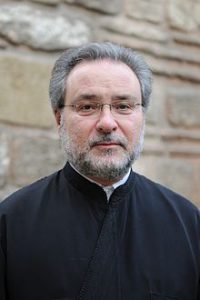
Interview of Rev. Dr. John Chryssavgis by Gayle E. Woloschak, Ph. D
- Congratulations to the Patriarchate for convening the meeting. In this age of communication we hope that this is the first of yearly meetings of the Patriarchs or their representatives. Why not propose that the Orthodox Patriarchs set up a Secretariat where all of them employ their representatives to work on matters on a daily basis. The world would know where they can call the Orthodox Church and the Church will not be seen as fragmented?
One of the anticipated goals of this Council is that the process of dialogue and communication started here will continue in years to come and even lead to more Councils or smaller meetings in the future. The root of the Greek word for council (syn-odos) means precisely “being on the same road together.” Exactly how that will be accomplished very much depends upon the final statements of the Council, on the definitive message of the council, as well as the reception of the council’s decisions and conclusions by the people of God.
Our churches have not assembled “in one place, together” for centuries. Yet, we call ourselves the church of the councils. Councils are what bishops are supposed to be doing and attending; they are where the problems and challenges of our church are resolved. If we do not meet in council, then our church is distorted, disfigured, diminished into an authoritarian institution. But that is not the way of the Church; it is not the way of the Gospel; and it is certainly not the way of Christ.
- How can the bishops solicit and receive the input of the clergy and laity in matters related to the issues and administration of the Church? How do they set up mechanisms to receive the input of clergy and laity?
For this Council, lay input was achieved in several ways. Beyond the primate (or first hierarch) of each autocephalous Orthodox Church, each delegation includes 24 hierarchs and an additional 6 advisors. Among these advisors, lay people have been included on some of the delegations to the Council. I know that our (ecumenical) patriarchate included two laywomen and a layman. In addition, several lay people (theologians and scholars) participated on the special Pan-Orthodox Drafting Committee for the final statement to be approved by the Synaxis and, subsequently, the Council. Of course this is not sufficient progress, and we look for ways to include laity even more. Perhaps within the paramount reception process of the Holy and Great Council’s decisions and documents, continued discussion will be vital for the Church as a whole and should certainly including both clergy and laity together.
- When will the Assemblies of Bishops in the lands outside the old Roman Empire USA, Europe etc. become synods and elect their own head? Parallel jurisdictions in one geographic area hinder the outreach mission of the Orthodox Church, and the fragmentation confuses everyone. This change is necessary.
The rules for this Council do not permit the introduction of new topics at this point. Nevertheless, the question of the Diaspora (whether we use the word or not is, to me, secondary, especially when our churches seem so far behind reality on this issue) will be reviewed and discussed in relation to the regional Assemblies of Bishops that were established over the past decade. However we cannot expect the conversation to develop into the creation of new jurisdictions, especially since the topic of autocephaly was removed from the agenda. These topics will no doubt become more essential as things progress beyond the Council. In many ways, it is up to the local Assemblies of Bishops to propose models of church administration based on the canonical tradition. That is what the Mother Churches have asked them. So if there is little progress – inactivity or indifference – I would place the responsibility squarely in the hands of the churches that constitute the local Assemblies.
- How can the works of lay theologians be better utilized to educate the clergy and laity? How do we bring these insights closer to the people of all faiths?
As observed previously, lay theologians have already been involved in writing both the documents for the Council itself as well as the final statement to be released for the Council. There are scholars also participating in the Council not only as delegates but also as part of the press team of the Ecumenical Patriarchate, whose phenomenal work you can consult on orthodoxcouncil.org. After the Council, I have no doubt that their insights will be important for the process of theological discussion and wider reception.
- How can Orthodox Christian Laity (OCL) assist the Patriarchates in continuing to move forward in unity and outreach?
OCL can assist by continuing to serve as a call for prayer and a conduit of information about the Council to the general Orthodox population in the US. This event is undoubtedly the greatest (even if criticized), largest (even if some churches changed their minds about attending), most comprehensive (even if controversial) gathering of churches and bishops in council for over 1,000 years. Yet, there is a lack of awareness among the Orthodox faithful about what the Council actually is doing, what its function should be in the Orthodox Church, and what issues the Council is discussing. OCL can certainly continue to “get the word out” that the Council is taking place and that the Orthodox bishops of the world really are concerned about issues related of Pan-Orthodox unity and pastoral concern. And after the Council, OCL could continue to promote discussion about the Council’s and impact and importance.
1 Comment
What a joke, Fr. Dr. John, to say that “new subjects cannot be added at this late date.”
The orchestrators excluded Canonical Orthodox bishops from around the globe, kowtowing not to Christ
but to Nationalist Foreign Ministries, robbing this & all such Councils of any shred of credibility.
The Romanian delegate shamelessly asserted his Patriarchate’s entitlement to treat Romanians established
“Permanently abroad” (Patriarch Daniel’s precise words) as theirs! STOP serving others than Christ. My grandfathers immigrated in 1906 & both fought in U. S. Army uniforms in WWI. Their sons did likewise in WWII. As an American,
I must go to church with my next-door neighbors, whose daughter dates my son, with whom I have a fence dispute,
with whom I go on ski/ golf weekends. Stop serving anyone other than Christ.