
Source: Orthodox Observer
We have published His All-Holiness Ecumenical Patriarch Bartholomew’s address to the Templeton Foundation in its entirety here.
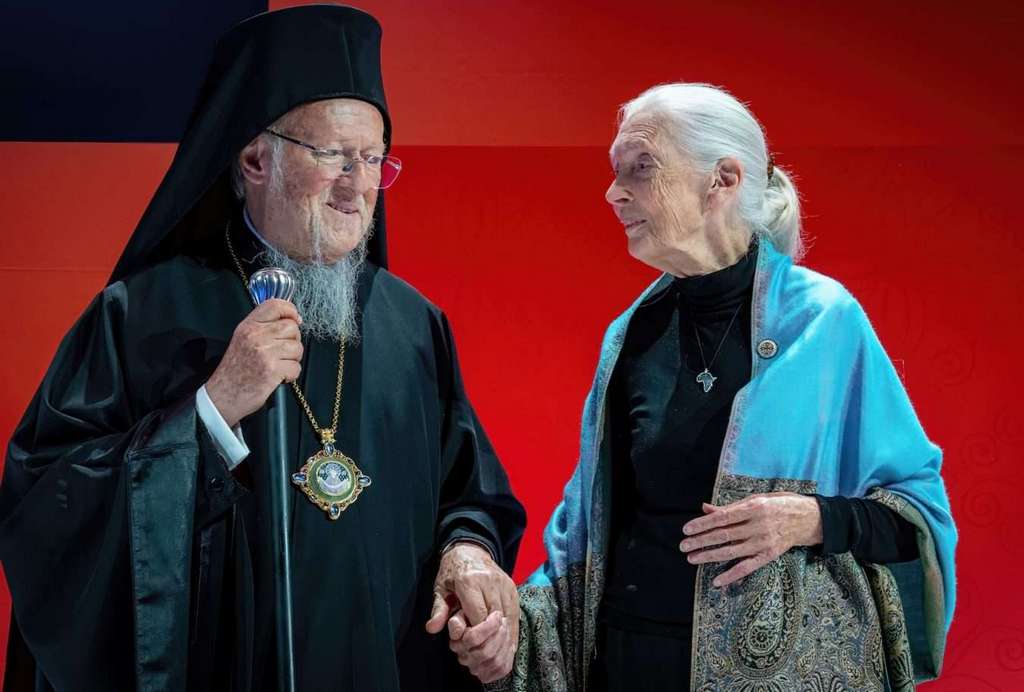
Last night, the Templeton Prize was conferred on His All-Holiness Ecumenical Patriarch Bartholomew for his enduring commitment to the environment that has transcended the political seasons of the secular world.
Instrumental in Ecumenical Patriarch Bartholomew’s nomination for the Templeton Prize, world-renowned primatologist and conservationist Dr. Jane Goodall offered congratulatory remarks at New York City’s Lincoln Center. She was followed by former Vice President Al Gore, and Greek Prime Minister Kyriakos Mitsotakis also praised the Ecumenical Patriarch for his devotion to God and the conservation of creation. Also in attendance was the President of Cyprus Nikos Christodoulides.

“I am struck by the weight of a recognition that surely belongs not to an individual, but to a vision that has animated the Ecumenical Patriarchate for over three decades,” the Ecumenical Patriarch said. “That the God who breathed stars and humans into being is the same God who grieves when a single sparrow falls, when a coral reef bleaches white as bone, and when a child gasps for clean air.”
The Ecumenical Patriarch accepted the honor on behalf of his predecessor, Ecumenical Patriarch Demetrios, “whose prophetic voice first called our Church to embrace its role as guardian of creation in 1989.”
Joining a Distinguished Line of Laureates
With this award, the Ecumenical Patriarch joins a revered group of laureates that includes Dr. Goodall herself, honored in 2021, the Dalai Lama in 2012, and Notre Dame University theologian Alvin Plantinga in 2017.

Established in 1972, the Templeton Prize recognizes individuals whose work affirms the spiritual dimension of life, whether through science, philosophy, theology, or public engagement. The Ecumenical Patriarch received the award for his forceful spiritual engagements with the environment, and his efforts to bridge the disciplines of scientific investigation with the Word of God.
“We have witnessed a tragic alienation—religion withdrawing to its sanctuaries, science retreating to its laboratories, each suspicious of the other’s claims upon truth,” stated the Ecumenical Patriarch, speaking to the distance felt between the sciences and people of faith. “The disassociation between faith and science must end. They are both on the same page.”
Early Voice for Creation
Barely a month after his unanimous election in 1991 as Archbishop of Constantinople, New Rome and Ecumenical Patriarch, His All-Holiness convened the first of many symposia on environmental issues. On the island of Crete, he forged relationships with environmental advocates that would have a ripple effect throughout his leadership—namely with Prince Philip, co-founder and then chairman of the World Wildlife Fund.
From those beginnings, the Ecumenical Patriarch became a perennial voice for the spiritual cause of environmental preservation among world leaders, earning him the sobriquet of Green Patriarch.
Declaring Environmental Sin
In 1997, during a landmark visit to Santa Barbara, Calif., Bartholomew declared that desecrating the environment was a sin—a stunning pronouncement that reverberated across Christian theology. The idea has since become foundational in Orthodox teaching and was woven into works such as the church’s Social Ethos, a document reflecting the Church’s ethical teachings from the thought of Eastern Orthodox scholars of the highest echelon.

“We get it wrong when we treat environmental destruction as someone else’s problem instead of recognizing it as the spiritual crisis of our age,” the Ecumenical Patriarch said. The Green Patriarch then moved to place Christ at the center of his victory. “We get it right when we appreciate that caring for the environment is not simply about hugging trees—though the mystics remind us that trees, too, deserve our embrace—but about worshipping the God who chose to become flesh, who sanctified matter by dwelling in it.”
Contraponto to Political Retreat
The Ecumenical Patriarch’s U.S. visit comes at a moment of political retrenchment. In March, the Environmental Protection Agency announced what it described as the largest deregulatory action in its history, rolling back protections on air quality, wastewater, and emissions.
“When rising seas swallow islands and we speak only of divine sovereignty while ignoring carbon emissions, we become complicit in suffering,” the Ecumenical Patriarch said. “When ancient forests fall to feed our consumption and we offer only ‘thoughts and prayers’ instead of systemic change, we practice a faith so detached from reality that it has ceased to be faith at all.”

Nations across the world continue to struggle balancing protections for the environment with sustained economic development. Leaders often face competing demands: the pressure to expand industries and create jobs and the insurmountable evidence of ecological damage caused by it. The tension has produced cycles of progress and retreat, with environmental pledges frequently softened in the face of political and economic realities.
His All-Holiness’s 1997 declaration of environmental sin in Santa Barbara has manifested itself as a core part of Christian ethics suited for a modern world experiencing the pains of overconsumption, pollution, and the inaction of world governments on climate, even as climate researchers predict a world barreling toward irreversible and catastrophic consequences.
“There is no doubt that the Ecumenical Patriarch’s approach to contemporary environmental issues has been refined and reinforced over the last few decades,” said Fr. John Chryssavgis, Archdeacon of the Ecumenical Throne and theological advisor to the Ecumenical Patriarch. “His stunning pronouncement in 1997 that desecrating the environment is a sin has generated a movement of theological conversation on scriptural and patristic, as well as liturgical and spiritual, aspects of creation care.”
Different Kinds of Environmental Crisis
The Ecumenical Patriarch also spoke to the anxieties of the youth regarding climate change. His All-Holiness cited studies that show the mental health epidemic among youth is directly linked to anxieties on the environment.
“We have forgotten the joy of watching seeds become saplings, saplings become trees that will comfort and protect generations we will never meet,” the Ecumenical Patriarch said. “When our children lose hope for tomorrow, we must recognize this as both moral failure and spiritual emergency. Their fear is not irrational—it is symbolic; it is prophetic. They see what we have chosen not to see. That the world we are leaving them may be unsustainable and even unlivable.”

Ecumenical Patriarch Bartholomew included a condemnation of social inequality alongside environmental degradation, stating that the issues are inseparable.
“We cannot achieve environmental sustainability while maintaining social inequality. We cannot save the earth without practicing justice,” the Ecumenical Patriarch said. “After all, some may be more responsible or accountable for the crisis that we face in the present, but it is only together that we can respond to and resolve it for the future.”
Legacy of Environmental Witness
This year marks the 20th anniversary of Hurricane Katrina, which destroyed much of New Orleans and killed more than 1,800 people. In the aftermath, the Ecumenical Patriarch made what would become his most well-known visit to the U.S., during which he was photographed traversing the rubble of the city’s flooded Ninth Ward.
Now, more than three decades after his election, His All-Holiness’s leadership of the Eastern Orthodox Church remains guided by an unrelenting commitment to preserving creation, and by a moral vision that casts environmental care as a spiritual imperative.

“Beyond any doctrinal or traditional rationale, praying for and protecting the natural environment is a fundamental, central, and vital component of our faith in God the Creator, the Incarnate Word who assumed flesh and sanctified the world, and the Comforter Spirit who is present everywhere and fills all things” said Fr. John. “This means that every time we recite the Nicene Creed, we are affirming our pledge to care for and transform all of creation.”
The Ecumenical Patriarch closed his address by bridging the necessities of science and religion.
“The future of our planet depends on our capacity to bring together the precision of scientific method with the perception of spiritual vision, the urgency of prophetic witness with the patience of contemplative practice,” said the Ecumenical Patriarch. “May we remember, even in dark moments, that every crisis is also an opportunity, every death the possibility of resurrection. The earth is groaning, but it is also hoping. The question is whether we will join its song of grief or its chorus of gratitude.”
Photos by Archons/Orthodox Observer/J. Mindala