
Close Menu
    Facebook X (Twitter) Instagram
    Trending
    • #Giving Tuesday – Support Orthodox Christian Laity!
    • Together We Thrive: OCL Annual Conference & Year-End Giving Campaign
    • Archon Officers Participate in Historic Pilgrimage to Nicaea
    • Ecumenical Patriarch Bartholomew and Pope Leo recite the Creed together during 1700th Anniversary of Nicaea
    • Mission Center Board Convenes
    • The “Orthodoxy as Masculinity” Narrative
    • Walk with Us: Orthodox Volunteer Corps (OVC)
    • St. John Chrysostom’s Legacy: From Antioch to America
    Orthodox Christian Laity
    Facebook X (Twitter) YouTube
    • Home
    • OCL
      • About OCL
      • Leadership
      • OCL News
      • OCL Publications
      • Focused Study and Research Topics
      • OCL Archives at DePaul University
    • Orthodox News & Links
      • Orthodox News Stories
      • Headlines & News Archives
      • Governance & Unity
        • Governance Top Stories
        • Governance & Unity Essays
        • Grassroots Unity in Action
      • OCL Forums
      • Orthodox Christian Laity News
      • Web Links
    • Audio & Video
      • Audio Index
      • Video Index
    • Contact
    • Make a Donation
    Orthodox Christian Laity
    You are at:Home»Governance & Unity News»Governance & Unity Essays»Metropolitan Georges Khodr on the Coming Great and Holy Council

    Metropolitan Georges Khodr on the Coming Great and Holy Council

    0
    By Webmaster on May 18, 2016 Governance & Unity Essays, Governance & Unity News
    Share
    Facebook Twitter LinkedIn Pinterest Email Telegram WhatsApp Copy Link
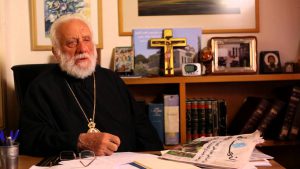
    His Eminence Metropolitan GEORGE (KHODR) of Mount Lebanon
    His Eminence Metropolitan GEORGE (KHODR) of Mount Lebanon

    Source: Notes on Arab Orthodoxy

    Arabic original here. Note that in Arabic, the word for “synod” and “council” is the same. For a succinct expression of a similar understanding of primacy by a medieval patriarch of Antioch, seehere. For more discussions of Antiochian ecclesiology, see here andhere.

    The Holy Synod

    It is the gathering  of the regional church, which they call the local church, and in most churches it is made up of their bishops. For example, the churches gathered around the patriarch of Antioch are called the Antiochian Church, those around the patriarch of Alexandria the Church of Alexandria, and so forth. The Orthodox have an Antiochian Church whose unity is represented by the patriarch and the bishops with their people. A group of people along with their spiritual leaders we call a church. Likewise, we call the Orthodox Church in the world a church. We do not have any administrative structure between the regional church, such as the See of Antioch, and the whole Orthodox world. In terms of dignity and essential existence, the churches are equal. Even if there is an organizational taxis, this absolutely does not mean that a given church submits to another church. In order to facilitate cooperation and communication, there has been an agreement explained by ecclesiastical canons since the fourth century whereby we announce the Ecumenical Patriarch first, but this does not mean that he has authority over the other patriarchs. In this sense, the Orthodox Church does not have an administrative center. There is only a taxis of dignity explained by the early councils whereby the Ecumenical Patriarch comes in honor only before his other colleagues if they gather together. This does not mean that he has any authority over them.

    The church that we call local is led by a first among equals who has no authority outside the borders of his church. Unity between the Orthodox churches is a unity of faith and an ecclesiastical ordering in a specific taxis canonically since the fourth century, in which there is no executive matter of one patriarch being over another patriarch. Rather, it is based on consultation between the heads of autocephalous churches. According to what we know in history, if the heads of the Orthodox churches gather in friendship, it is because they submit to one set of rules in dogma and order. The Orthodox churches are one in dogma without even the slightest difference, one in order, and realistically one in the fundamentals of theological thinking. Administrative diversity, with the existence of administratively independent churches, never means difference in faith, worship, or cooperation between the clergy and the people. Orthodox unity is very manifest, despite the different administrations between Russians, Greeks, and Arabs. All the Orthodox speak with one voice and have one worship in all their regions and languages.

    If the worldwide Holy Synod meets in the unity of the regional churches, then it will demonstrate true unity among us. We see unity in hearts, just as we see it in the process of coordination and cooperation between our churches. We do not look to unity in commands issued from above, but we see it in the Orthodox peoples’ receiving what their synods decide. For us, the synod is legitimate if all accept it.

    The Holy Synod is not above the Church. It proceeds from her because she proceeds from Christ in the Apostles and tradition. It is true that the bishops have authority, but this is because they come from the holy people. If the synod of bishops departs from truth or right, then there can be no obedience to it. A system only has truth or right if it is a right from the Church. The council has no existence if it does not establish through its acts that that it is faithful to the Church.There is no one in the Church unless he is truly of her, that is, in the content of what he says. You are not above others merely on account of your position, unless you are of them in the content of what you teach.

    From this perspective, the synod of bishops is not over the holy people. It is from them and its holiness is in them. If a bishop deviates from the tradition and practices of the Church, then he ceases within himself to be a bishop, even if he does not know it. In principle, the Holy Council is the place where the faithful know that if they come from it, they are coming from the Lord.


    Share. Facebook Twitter Pinterest LinkedIn Tumblr Email WhatsApp Copy Link
    Previous ArticleArchbishop Demetrios to speak at STOTS Commencement May 28
    Next Article Ecumenical Patriarchate Provides Resources for Holy and Great Council

    Related Posts

    December 1, 20251 Min Read

    #Giving Tuesday – Support Orthodox Christian Laity!

    November 28, 20255 Mins Read

    Archon Officers Participate in Historic Pilgrimage to Nicaea

    November 28, 20251 Min Read

    Ecumenical Patriarch Bartholomew and Pope Leo recite the Creed together during 1700th Anniversary of Nicaea

    Leave A Reply Cancel Reply

    This site uses Akismet to reduce spam. Learn how your comment data is processed.

    Sign the Declaration for Orthodox Unity – click here…

    Register for OCL's Annual Conference - October 11, 2025

    Sign the Declaration for Orthodox Christian Unity

    Enter the Slogan Contest

    Share this page
    DISCLAIMER

    All articles represent the views of the authors and  not necessarily the official views of Orthodox Christian Laity (OCL). They are posted to encourage thoughtful discussion on topics and concerns relevant to Orthodox Christians living in a pluralistic society. OCL encourages your comments.

    Stay Informed!

    Subscribe to our Newsletter

    WE WELCOME YOUR INPUT AND SUPPORT!

    Your donation impacts and helps advance the unity of the Orthodox Church of America.

    DONATE NOW

    THANK YOU FOR YOUR CONTINUED SUPPORT!

    Upcoming Events
    Notice
    There are no upcoming events.
    Recent Comments
    • George Warholak on Ecumenical Patriarch Bartholomew and Pope Leo recite the Creed together during 1700th Anniversary of Nicaea
    • Dn Nicholas on Ecumenical Patriarch Bartholomew and Pope Leo recite the Creed together during 1700th Anniversary of Nicaea
    • Dana C Purnell on Ethiopian Bible is the oldest and complete bible on earth
    • Peter on Abp. Elpidophoros installed as National Council of Churches board chair
    • james wiliams on Video: A Vision for Orthodox Christianity’s Future in North America
    • Veras Coltroupis on Abp. Elpidophoros installed as National Council of Churches board chair
    • Joe Forzani on Ancient Christianity (Free Course) – Hillsdale College Online
    • Joe Forzani on Ancient Christianity (Free Course) – Hillsdale College Online
    • sandy myers on Ethiopian Bible is the oldest and complete bible on earth
    • Peter on Unity in the Orthodox Church
    OCL Archives Online
    Project for Orthodox Renewal
    renewal-resize
    OCL Digital Newsletter

    Subscribe to our Newsletter

    MAKE A DONATION

    Sign the Declaration for Orthodox Christian Unity

    Facebook
    Twitter
    YouTube

    St. Symeon the New Theologian and St. Photini are the Patron Saints of OCL

    footer-fnl

    Orthodox Christian Laity
    PO Box 6954

    West Palm Beach, FL · 33405
    561-585-0245

    ocladmin@ocl.org (or) orthodoxchristianlaity@gmail.com

    Sponsored by Ann Souvall in memory of husband George

    DISCLAIMER: All articles represent the views of the authors and  not necessarily the official views of Orthodox Christian Laity (OCL). They are posted to encourage thoughtful discussion on topics and concerns relevant to Orthodox Christians living in a pluralistic society. OCL encourages your comments.

    ©2025 Orthodox Christian Laity (OCL) ·  Login

    Type above and press Enter to search. Press Esc to cancel.