
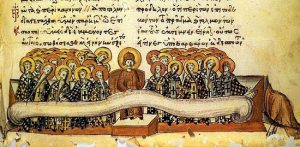
 Source: Orthodox Christian Laity
Pentecost 2017
One year ago, the worldwide Christian Community was looking East to Chania, Crete to see what would result from the gathering of Orthodox Bishops called together by Ecumenical Patriarch Bartholomew to meet as a Holy and Great Council. The preparations for the meeting were 60 years in the making. In 2008, the 14 Patriarchs and self-governing heads of the Churches of the old Roman Empire, the traditional Orthodox lands, agreed to meet and began discussions to settle on an agenda. Within this 8-year time frame, 6 agenda items were agreed upon. The meeting was on track until four months before the June 2016 date when four Church leaders broke the 8-year agreement to meet. Antioch, Russia, Bulgaria and Georgia, for various reasons, declined to attend.
To the great credit of Patriarch Bartholomew and the other bishops, the Holy and Great Council took place, and there were some positive results. Without the four obstructionist Churches attending, Orthodoxy showed that it could be a conciliar Church after all. The fact that the Holy and Great Council took place, and that the bishops attending signed the protocols and agreed that they need to meet more regularly, are hopeful signs. It is now up to the body of the Church to reinforce, discuss and accept the work of the Council, so that it can truly be a Holy and Great Council. It becomes a Holy and Great Council when the body of the Church affirms the work of the bishops. It really does not matter who attended and who did not.
But to affirm the work, we need to know what was decided. The Patriarchate issued detailed and official documents outlining what was discussed and agreed upon, and the names of the bishops are affixed to the document. Reading and digesting these documents is the first step in growing in understanding of the results of the meeting. They are a primary source. The Encyclical, Message and the other Official Documents of the Holy and Great Council are available at: https://www.holycouncil.org/.
Another excellent source is the Diary of the Council by Bishop Maxim of the Western American Diocese – Serbian Orthodox Church. This is another primary source. Every evening after the meetings, he kept a diary, which is also a personal reflection of daily proceedings and events. Bishop Maxim writes: “What the significance is and what the consequences are of this Council – the post conciliar period will show, since the process of the reception of the Council and its decisions may take time, depending on the vitality of the ecclesiastical body, and the work of the local bishops, among the people….This reception (giving and receiving) of the Council depends primarily on the work of the local bishops among their flocks.”
What about the Council has your local bishop discussed with you? Is your Diocese or Metropolis or Archdiocese moving “beyond words to actions…. Moving beyond what is mine and yours, to what is ours.” It is up to you to ask, act and decide to participate across jurisdictional lines locally. You need to get the bishops involved. Locally, parish by parish, we need to interconnect and find those in our communities who have skill sets and invite them to participate across jurisdictional lines to address the needs of your local Orthodox Christian Community. In the parish community, inter-jurisdictional programs for seniors, youth, religious education, counseling, outreach, mission, etc. will better meet the needs of the faithful. The best-qualified person in one parish can service all those with similar needs across jurisdictional lines. Parish by parish, we need to work together to be Orthodox Christians. Our young adults in college do this by reaching out to each other across jurisdictional lines to remain Orthodox on our college campuses.
Orthodox Christian Laity will continue to keep the vison of Unity alive. We have been doing this for 30 years. We invite you to watch the three video programs that we presented and recorded this year to help you know and understand what the Holy and Great Council was about. The videos are posted on OCL’s YouTube page. Two of them are presentations by two individuals who participated in the work of the Holy and Great Council. They were there. They are lay persons. The comments and impressions they present are primary sources. They are our eyes and ears into the work of the Council. Dr. Gayle Woloschak was part of the team that organized and implemented and facilitated the work secretariat for the bishops, press and observers attending the meeting. Dr. Elizabeth Prodromou was one of three women who attended the meeting in an official capacity appointed by Patriarch Bartholomew. Dr. Helen Theodoropoulos presents a picture of what we can do locally to be a unified church across jurisdictional barriers. Make plans to attend the OCL annual Meeting in Chicago on October 28, 2017.
Unity will come about because of the actions, desires and work of the laity. We must insist on a conciliar Church. This is the Orthodox administrative ethos. After seven years, the Assembly of Bishops has yet to agree on how to discuss unity. There is no way to include minority reports in their discussions. They proceed only when there is one hundred percent unanimity. Some Committees do not meet. Proceedings are not published. Bishops are now bogged down in ethnicity and old world politics. In some places, they refuse to serve together. Where is the accountability and transparency in their meetings? Where is the hierarchical leadership? The leadership void must be filled by the laity who know and understand and support the work of the Holy and Great Council. The laity must educate themselves and not let the work that was begun last year dissipate because of the lack of local hierarchical leadership and vison.
George Matsoukas
Related Video
THE DAY AFTER THE HOLY AND GREAT COUNCIL: PROCESS, OUTCOMES, AND TRANSFORMATION – Dr Elizabeth Prodromou
11 Comments
Concerning the article, The Post Conciliar Orthodox Christian Church One Year after the Holy and Great Council, I take offense to you calling the four church leaders from Antioch, Russia, Bulgaria and Georgia as “obstructionist”. Those hierarchs had their reasons for not attending and your judgement of them is unfair.
Secondly, to say, “It becomes a Holy and Great Council when the body of the Church affirms the work of the bishops. It really does not matter who attended and who did not” is not entirely true. By definition, a Holy and Great Council has to include ALL Orthodox hierarchs otherwise it is not complete and decisions for The Church can not be made without ALL. You do a disservice by telling readers that “It is now up to the body of the Church to reinforce, discuss and accept the work of the Council, so that it can truly be a Holy and Great Council.” It is not the decision of the laity to decide if this was truly a Holy and Great Council. No amount of wishing it to be so will make it so until ALL the hierarchs come together.
Christine Chavez wrote: “By definition, a Holy and Great Council has to include ALL Orthodox hierarchs otherwise it is not complete and decisions for The Church can not be made without ALL.”
By whose definition? Looking at Christian history, one would be hard-pressed to find any of the seven ancient Ecumenical Councils that include ALL bishops or even all local churches. In fact, some local churches had no representation at all at some of them. Take, for example, the second Ecumenical Council (Constantinople I), at which then Orthodox Rome was absent and had no representation whatsoever, yet accepted the council as ecumenical afterwards.
Excellent response! This council didn’t discuss things of greater importance such as confirming the Council of Constantinople 1351 and the calendar problem. This could have been truly a “Holy and Great Council.”
Way to be divisive, once again, OCL. First though, great job at pointing out that, except for the patriarchates that didn’t participate, all patriarchates participated.
But, on a more serious note, calling these patriarchates, including the 3rd ranked patriarchate (not to mention the 5th and largest ranked patriarchate) “obstructionist” is EXTREMELY improper. First, the reason Antioch withdrew was because its petitions were falling on deaf ears and it refused to cater to a patriarchate that is trying it’s best to be New Rome in the worst way possible. Antioch had actual concerns that it appealed to Constantinople for and was ignored. Additionally, it had concerns with the documents. Again, it was ignored. Antioch wasn’t Greek enough for Constantinople to care about. I get it. Nothing is really affecting the Antiochian Church at all.
Bulgaria and Georgia, meanwhile, withdrew because they had concerns with the texts and were pretty much told to “shut up and color.” Russia saw what was happening and decided to be the strong brother and when they saw that Constantinople didn’t care, used their strength to bring attention. Not that Constantinople cared.
Furthermore, the actions of Constantinople after the “council” have been lamentable. Threatening bishops that don’t fall under their See is ridiculous. Interference with autocephalous Church synods is uncalled for.
” It becomes a Holy and Great Council when the body of the Church affirms the work of the bishops. It really does not matter who attended and who did not.” Is OCL trying to imply that the Antioch, Bulgaria, Georgia, and Russia don’t matter? Again. We’re not Catholics. the EP is not the end-all, be-all. By definition, if those Churches don’t affirm anything, then the council isn’t affirmed. Period.
Constantinople can keep trying to pull off this Eastern papacy thing all they want. But, the other Churches are starting to show backbone that they won’t just go along with it because the Constantinople wants it. And, if the See continues this, they could end up finding themselves alone. And groups like OCL that want to push this agenda will also find themselves alone.
The EP not acknowledging the concerns of the Churches that did not attend does not amount to them “obstructing,” him acting as the “Eastern Pope” did’t help as well. This article lacking lacking in depth and could have been written better to actually show the concerns about the meeting. My guess is that this event will not be accept by the vast majority of Orthodox, so who cares anyways
Most of the Orthodox world was looking west, not east. If they were looking at all. The Patriarchate of Constantinople is dead. The Muslims did a great job of strangling them. There is no reason to listen to them and their innovations.
“First though, great job at pointing out that, except for the patriarchates that didn’t participate, all patriarchates participated.”
That line is Orthodox comedy gold! hahahahahahahaha
Why does this article sound threatening?
Who or what is behind such writings?
If the council is evident as being truly Orthodox, won’t it be accepted?
As it is, the council will never be accepted. In the words of Wesley from, The Princess Bride: “Get used to disappointment.”
OCL – you better stop punting off this baloney or you may become a collaborator and perhaps one of many spring boards into schism.
When the monks of Mt. Athos as well as Bp. Athanasios of Limassol are vehemently opposed to what went on at the Council (which Bp. A. attended), you’re mischaracterizing the level of opposition among the faithful.
Your characterization of the Assembly of Bishops is spot on, however.
Remember when the Orthodox Church used to hold councils that were actually orthodox?
Pepperidge Farm remembers . . .
Yes, and remember when they had an Emperor (or Empress) to make them hold it?
Something something something ecumenical
Something something something complete